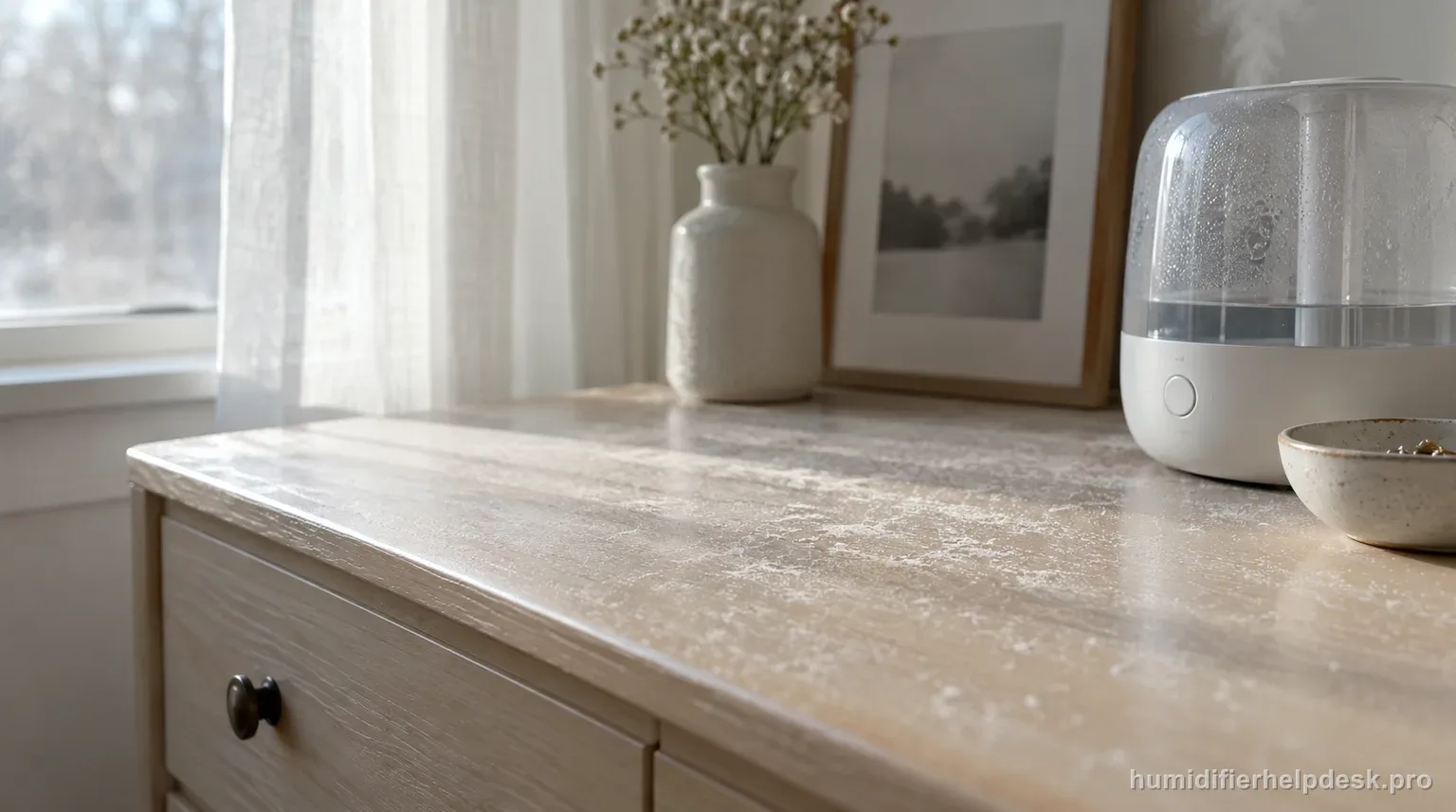
White dust comes from minerals in hard water, not a defect. Use distilled water and replace the demineralization cartridge when buildup increases.
Does this match what you are seeing?
Owners describe this HoMedics UHE-WMTF185 problem in a few different ways. If one of these sounds like yours, this guide covers it:
- White dust
- Leaving white powder
- Mineral dust on furniture
- White residue after misting
Check these in order
- Use distilled water, especially with hard water or a water softener.
- Use the UHE-HDC4 demineralization cartridge if desired.
- Replace the cartridge about every 30–40 fillings, or sooner in very hard water, per the manual.
Diagnostic decision path
HoMedics explicitly describes white dust as mineral residue from hard water, not a humidifier defect. For the UHE-WMTF185, the manual recommends distilled water and provides a demineralization-cartridge path, with a typical cartridge interval of about 30–40 tank fillings and earlier replacement when very hard water causes buildup sooner.
- Clean existing white residue from a nearby test surface so new dust is easy to judge.
- Use a clean tank and reservoir before changing water source.
- If a demineralization cartridge is installed, note how many fills it has seen and whether white dust has recently increased.
If: White dust appears while hard tap water is used
What it means: The symptom matches the manual’s mineral-residue explanation.
Do next: Switch to distilled water and monitor whether new residue falls.
If: A cartridge has been used for roughly 30–40 fillings
What it means: It has reached the manual’s typical replacement range.
Do next: Replace the cartridge, especially if white dust has begun increasing.
If: Very hard water produces dust well before 30–40 fills
What it means: HoMedics notes that harder water can shorten cartridge life.
Do next: Replace the cartridge sooner or rely on distilled water for a cleaner comparison.
If: A new cartridge still allows white dust
What it means: The mineral load may still be too high for the cartridge to control adequately.
Do next: Use distilled water rather than adding water-softening chemicals to the humidifier.
How to interpret the retest
This branch fits the HoMedics UHE-WMTF185 only when the unit actually shows “White dust appears while hard tap water is used”. The HoMedics UHE-WMTF185 source path describes that state as “The symptom matches the manual’s mineral-residue explanation”. Check “Use distilled water, especially with hard water or a water softener”, then reproduce the same complaint under otherwise similar conditions. If the result matches, the next step is “Switch to distilled water and monitor whether new residue falls”. If it does not match, this explanation does not fit the current HoMedics UHE-WMTF185 white dust test.
On the HoMedics UHE-WMTF185, use “A cartridge has been used for roughly 30–40 fillings” as the observation to check first. On the HoMedics UHE-WMTF185, the source-backed interpretation is “It has reached the manual’s typical replacement range”. Make “Use the UHE-HDC4 demineralization cartridge if desired” the only deliberate change, then repeat the same symptom test. If the observation matches, continue with “Replace the cartridge, especially if white dust has begun increasing”; if it does not, note that this HoMedics UHE-WMTF185 white dust path did not match and move on.
Start from a concrete state. After “Replace the cartridge about every 30–40 fillings, or sooner in very hard water, per the manual”, does the HoMedics UHE-WMTF185 show “Very hard water produces dust well before 30–40 fills”? A yes points to the documented interpretation “HoMedics notes that harder water can shorten cartridge life”, so the next move is “Replace the cartridge sooner or rely on distilled water for a cleaner comparison”. If the state is absent, do not use the action from that HoMedics UHE-WMTF185 possibility; record that it did not match the white dust complaint and test the next documented condition.
After the preceding check, retest under the same conditions and look for “A new cartridge still allows white dust” rather than changing several settings at once. If the HoMedics UHE-WMTF185 matches that observation, use the interpretation “The mineral load may still be too high for the cartridge to control adequately” and follow with “Use distilled water rather than adding water-softening chemicals to the humidifier”. First, check “Use distilled water, especially with hard water or a water softener”. If the state does not appear again, keep that result and continue with the next documented possibility for white dust on the HoMedics UHE-WMTF185.
Model-specific context that changes the diagnosis
Two HoMedics UHE-WMTF185 clues that point to different fixes
The first two states look similar to an owner but lead to different branches. When “White dust appears while hard tap water is used” is true, the HoMedics UHE-WMTF185 path points to “The symptom matches the manual’s mineral-residue explanation”; use “Switch to distilled water and monitor whether new residue falls”. When “A cartridge has been used for roughly 30–40 fillings” is the better match, the path changes to “It has reached the manual’s typical replacement range”, so use “Replace the cartridge, especially if white dust has begun increasing”. Retest one explanation before trying the action tied to the other.
Retest white dust after each correction
Keep this retest simple: change one condition at a time. Test “Use distilled water, especially with hard water or a water softener” first, then inspect the HoMedics UHE-WMTF185 again. If the behavior persists, use “Use the UHE-HDC4 demineralization cartridge if desired”; save “Replace the cartridge about every 30–40 fillings, or sooner in very hard water, per the manual” for the next step. That order gives the HoMedics UHE-WMTF185 white dust path a meaningful comparison instead of several changes with no clear cause.
Common mistakes that make this harder to diagnose
- Treating white dust as proof of a defective ultrasonic membrane.
- Assuming 30–40 fillings is a guaranteed interval regardless of water hardness.
- Adding water-softening additives to the tank.
- Replacing cartridges repeatedly without testing distilled water.
The white-dust problem is resolved when distilled water and/or a serviceable demineralization cartridge prevents significant new mineral residue. Cartridge replacement should follow actual buildup and water hardness, using 30–40 fillings only as the manual’s typical guide.
Questions people ask about this exact symptom
Why is my HoMedics UHE-WMTF185 leaving white dust?
For the HoMedics UHE-WMTF185, white dust comes from minerals in hard water, not a defect; use distilled water and replace the demineralization cartridge when buildup increases. For this white dust check on the HoMedics UHE-WMTF185, start with “Use distilled water, especially with hard water or a water softener” and check the result before making another change. If the behavior is unchanged, continue with “Use the UHE-HDC4 demineralization cartridge if desired”.
What should I check first if my HoMedics UHE-WMTF185 leaves white dust?
Make one supported correction at a time so the result stays interpretable. On the HoMedics UHE-WMTF185, begin with “Use distilled water, especially with hard water or a water softener” and observe the result. Continue to “Use the UHE-HDC4 demineralization cartridge if desired”, then “Replace the cartridge about every 30–40 fillings, or sooner in very hard water, per the manual”, only if the earlier step does not change the result.
When should I contact HoMedics about this HoMedics UHE-WMTF185 problem?
If the HoMedics UHE-WMTF185 still has the same problem after the manual-supported checks for white dust, contact HoMedics rather than disassembling the unit. Tell support what changed after the last white dust check on the HoMedics UHE-WMTF185, and do not bypass any protection or interlock. Do not open powered sections on the HoMedics UHE-WMTF185 or assume an internal failed part unless HoMedics documents that procedure for this white dust case.
Why this path is model-specific
The UHE-WMTF185 manual explains white dust as suspended water minerals and gives distilled-water and demineralization-cartridge guidance.
For the HoMedics UHE-WMTF185, the machine type matters: it is hybrid. Visible mist is part of normal output when mist production is active, so a true no-mist complaint deserves model-specific troubleshooting.
This symptom appears on other humidifiers too, but the meaning and reset path can change by technology, sensor logic, and control layout. Use the exact model source above before borrowing a fix from a neighboring model.
Compare this symptom across verified models
If you are still deciding whether this behavior is normal or model-specific, use the symptom hub to compare only manufacturer-linked guides. Keep the HoMedics UHE-WMTF185 instructions above as the controlling path for this machine.
If the problem is still there
If the checks above do not change the symptom, use the manufacturer support path for this exact model. We intentionally stop before undocumented resets, sensor bypasses, internal mains work, or parts replacement that the consumer manual does not authorize.
What we do not recommend
Do not defeat a float, water-level sensor, overheat protection, interlock, or other safety feature. Do not open mains-powered sections for live testing. If the unit smells burned, becomes abnormally hot, smokes, sparks, has water near electrical parts, or repeatedly trips a circuit, stop using it and keep clear. Unplug it only if the plug, outlet, and surrounding area are dry and safe to reach; otherwise do not touch wet equipment and contact manufacturer support for next steps.
Primary source for this diagnosis
Source checked during the September 4, 2026 editorial review. Manufacturer documents can change; a material re-review updates this guide’s reviewed date rather than stamping unrelated pages.