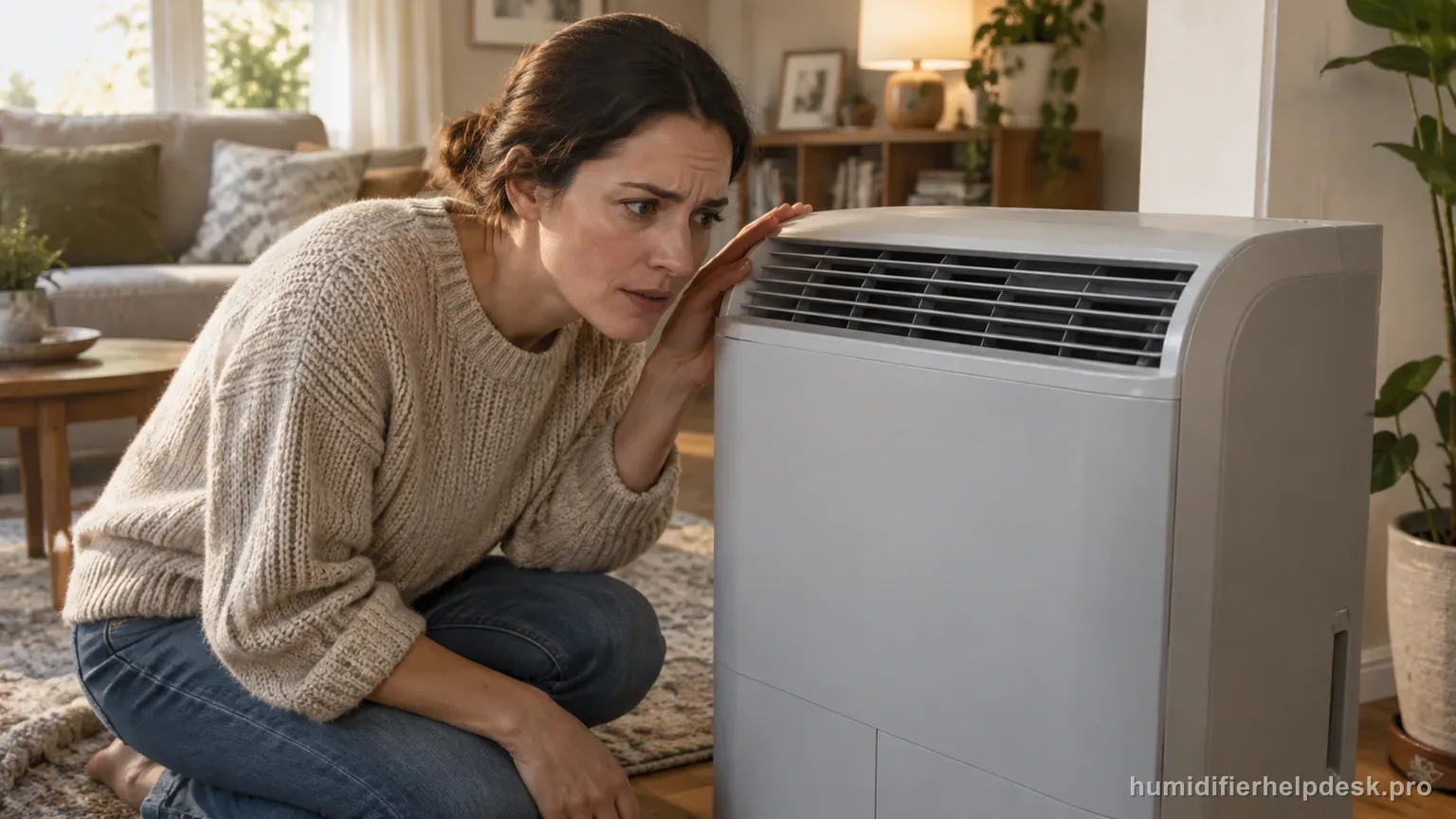
Some fan noise is expected on the higher MA0800 speeds because the unit is moving much more air.
Does this match what you are seeing?
Owners describe this AIRCARE MA0800 problem in a few different ways. If one of these sounds like yours, this guide covers it:
- Making unusual noise
- Loud humidifier noise
- Strange water sound
- Making noise while running
Check these in order
- Compare the sound at F1 versus F3.
- Make sure the unit is on a stable, level surface.
- If the sound is grinding, scraping, or suddenly different from normal airflow noise, stop and inspect only user-serviceable parts.
Diagnostic decision path
The MA0800 can sound dramatically louder at its higher fan settings without being defective. AIRCARE describes the Mini-Console as a high-airflow evaporative unit, so the useful diagnosis is to compare the character of the sound across speeds and separate ordinary rushing-air noise from scraping, rattling, or a sudden mechanical change.
- Confirm the complaint is about the MA0800 and not another AIRCARE console with different speed labels.
- Set the unit on a firm, level floor with clear airflow around the cabinet before comparing sounds.
- Do not open the motor housing; the fan and electrical section are not part of normal owner service.
If: The sound is much louder on F3 than F1 but remains a smooth fan/airflow sound
What it means: That pattern matches normal higher-output operation rather than a fault.
Do next: Use a lower fan speed when noise matters more than maximum moisture output, or use Auto so the unit can reduce speed as humidity rises.
If: The cabinet rattles only on one surface
What it means: The surface may be amplifying normal fan vibration.
Do next: Move the MA0800 to a stable, level location and make sure nothing is touching or leaning against the cabinet.
If: The sound is scraping, grinding, clicking, or suddenly different from its previous airflow sound
What it means: That is not the normal box-fan-like noise AIRCARE describes for higher speeds.
Do next: Turn the unit off, unplug it, check only obvious user-serviceable obstructions, then use AIRCARE support if the abnormal sound persists.
If: High-speed noise is the only complaint and humidity output is otherwise normal
What it means: The humidifier is likely trading acoustic comfort for higher airflow as designed.
Do next: Choose a quieter speed rather than treating loud but smooth airflow as a reason to replace the motor.
How to interpret the retest
For this branch, begin by asking what happens after “Compare the sound at F1 versus F3”, does the AIRCARE MA0800 show “The sound is much louder on F3 than F1 but remains a smooth fan/airflow sound”? If you can reproduce it, the source-backed reading is “That pattern matches normal higher-output operation rather than a fault”, so the next move is “Use a lower fan speed when noise matters more than maximum moisture output, or use Auto so the unit can reduce speed as humidity rises”. A non-match means you should not apply the action from that AIRCARE MA0800 possibility; record that it did not match the loud fan complaint and test the next documented condition.
The next useful observation is “The cabinet rattles only on one surface” rather than changing several settings at once. If the AIRCARE MA0800 matches that observation, use the interpretation “The surface may be amplifying normal fan vibration” and follow with “Move the MA0800 to a stable, level location and make sure nothing is touching or leaning against the cabinet”. First, check “Make sure the unit is on a stable, level surface”. If the state does not appear again, keep that result and continue with the next documented possibility for loud fan on the AIRCARE MA0800.
Use this explanation for the AIRCARE MA0800 only when the unit actually shows “The sound is scraping, grinding, clicking, or suddenly different from its previous airflow sound”. The AIRCARE MA0800 source path describes that state as “That is not the normal box-fan-like noise AIRCARE describes for higher speeds”. Check “If the sound is grinding, scraping, or suddenly different from normal airflow noise, stop and inspect only user-serviceable parts”, then reproduce the same complaint under otherwise similar conditions. A match points to “Turn the unit off, unplug it, check only obvious user-serviceable obstructions, then use AIRCARE support if the abnormal sound persists”. If it does not match, this explanation does not fit the current AIRCARE MA0800 loud fan test.
Model-specific context that changes the diagnosis
Let the AIRCARE MA0800 observation choose the next step
Treat the next two observations as alternative branches, not a combined checklist. If you can reproduce “The sound is much louder on F3 than F1 but remains a smooth fan/airflow sound” on the AIRCARE MA0800, continue with “Use a lower fan speed when noise matters more than maximum moisture output, or use Auto so the unit can reduce speed as humidity rises” because the documented meaning is “That pattern matches normal higher-output operation rather than a fault”. If you reproduce “The cabinet rattles only on one surface” instead, use “Move the MA0800 to a stable, level location and make sure nothing is touching or leaning against the cabinet” because that state is interpreted as “The surface may be amplifying normal fan vibration”. Test those two possibilities separately.
Retest the AIRCARE MA0800 without changing multiple variables
Make one change and retest before touching the next variable. For the AIRCARE MA0800, begin with “Compare the sound at F1 versus F3”. If that does not change the outcome, continue to “Make sure the unit is on a stable, level surface”, followed by “If the sound is grinding, scraping, or suddenly different from normal airflow noise, stop and inspect only user-serviceable parts” if needed. During this AIRCARE MA0800 loud fan retest, avoid changing water level, placement, mode, and cleaning state together unless the step itself requires it.
Common mistakes that make this harder to diagnose
- Calling every loud F3 operating sound a bad fan.
- Testing on a resonant or uneven surface and blaming the cabinet.
- Putting objects against the air path to quiet the unit and accidentally restricting airflow.
- Opening the motor/fan housing to chase normal high-speed noise.
The concern is resolved when F1 is clearly quieter, F3 remains a smooth airflow sound, and there is no scraping, grinding, or unstable vibration. A new mechanical sound that remains after placement checks should be treated as a support case, not normal high-speed noise.
Questions people ask about this exact symptom
Why is my AIRCARE MA0800 making an unusual sound?
For the AIRCARE MA0800, some fan noise is expected on the higher MA0800 speeds because the unit is moving much more air. For this loud fan check on the AIRCARE MA0800, start with “Compare the sound at F1 versus F3” and check the result before making another change. If the behavior is unchanged, continue with “Make sure the unit is on a stable, level surface”.
What should I check first if my AIRCARE MA0800 makes an unusual or loud sound?
Start with “Compare the sound at F1 versus F3”. If the AIRCARE MA0800 behaves the same, move to “Make sure the unit is on a stable, level surface”; use “If the sound is grinding, scraping, or suddenly different from normal airflow noise, stop and inspect only user-serviceable parts” only after judging that result. For this loud fan complaint, one change at a time gives you a cleaner before-and-after comparison than a batch of simultaneous fixes.
When should I contact AIRCARE about this AIRCARE MA0800 problem?
Escalate the AIRCARE MA0800 to AIRCARE if the documented checks do not resolve loud fan. When you contact support about loud fan on the AIRCARE MA0800, report the last condition you tested, what changed, and what stayed the same; do not guess at an internal part. Do not open powered sections on the AIRCARE MA0800 or assume an internal failed part unless AIRCARE documents that procedure for this loud fan case.
Why this path is model-specific
AIRCARE notes that higher MA0800 speeds are louder and compares the sound to a box fan; it says this is normal high-output operation.
For the AIRCARE MA0800, the machine type matters: it is evaporative. Its moisture output is not supposed to look like ultrasonic fog, so “I cannot see mist” by itself is not evidence of a failure.
Compare this symptom across verified models
If you are still deciding whether this behavior is normal or model-specific, use the symptom hub to compare only manufacturer-linked guides. Keep the AIRCARE MA0800 instructions above as the controlling path for this machine.
If the problem is still there
If the checks above do not change the symptom, use the manufacturer support path for this exact model. We intentionally stop before undocumented resets, sensor bypasses, internal mains work, or parts replacement that the consumer manual does not authorize.
What we do not recommend
Do not defeat a float, water-level sensor, overheat protection, interlock, or other safety feature. Do not open mains-powered sections for live testing. If the unit smells burned, becomes abnormally hot, smokes, sparks, has water near electrical parts, or repeatedly trips a circuit, stop using it and keep clear. Unplug it only if the plug, outlet, and surrounding area are dry and safe to reach; otherwise do not touch wet equipment and contact manufacturer support for next steps.
Primary source for this diagnosis
Source checked during the September 3, 2026 editorial review. Manufacturer documents can change; a material re-review updates this guide’s reviewed date rather than stamping unrelated pages.