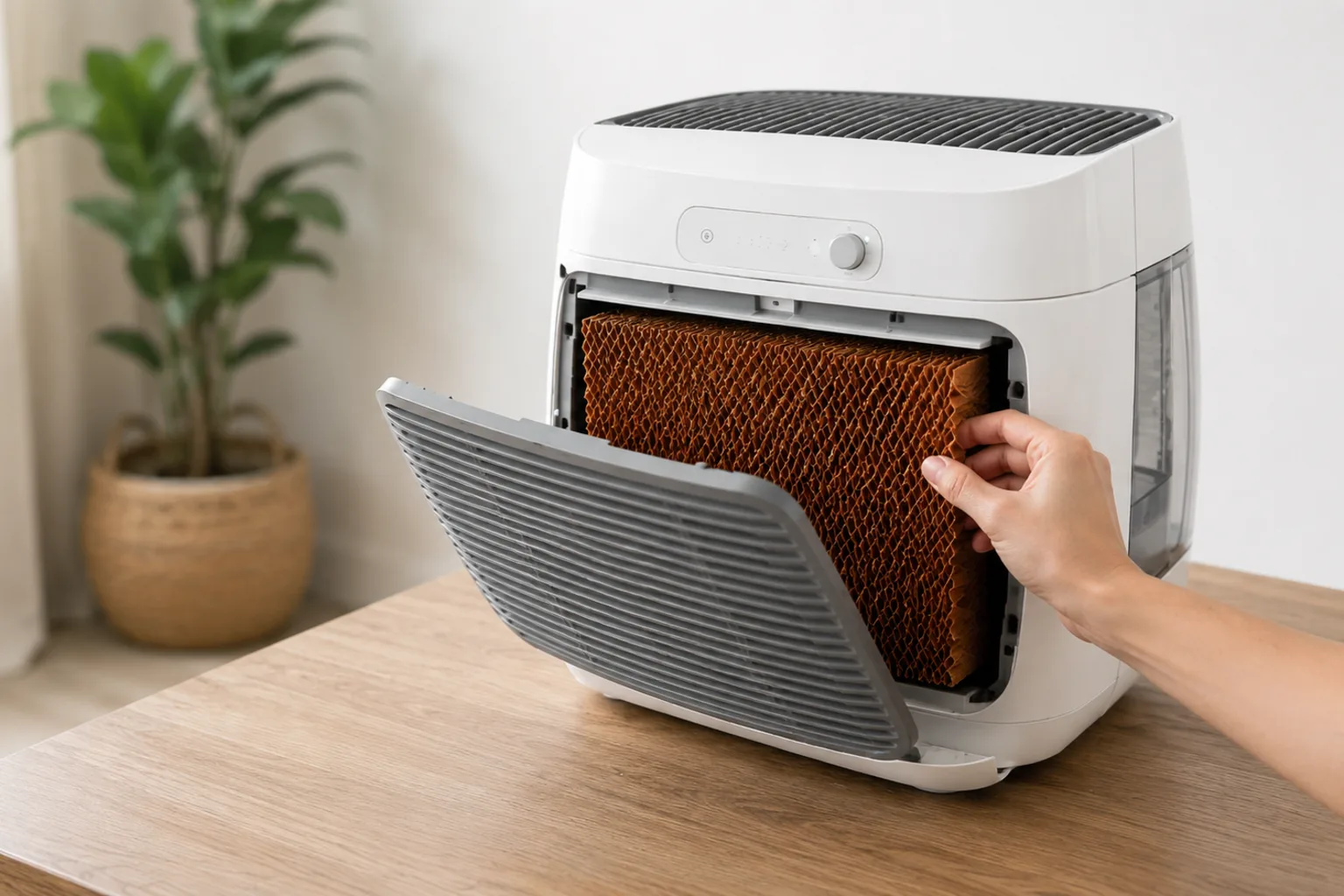
Discoloration alone does not automatically mean the wick has failed; mineral deposits can change its color. Honeywell says a cool-water soak may loosen deposits, but the brown color can remain without hurting performance.
Does this match what you are seeing?
Owners describe this Honeywell HCM350 problem in a few different ways. If one of these sounds like yours, this guide covers it:
- Wick filter problem
- Filter hard or crusty
- Wick not getting wet
- Filter smells or looks dirty
Check these in order
- Inspect the wick for hardness, crusting, odor, or reduced output—not color alone.
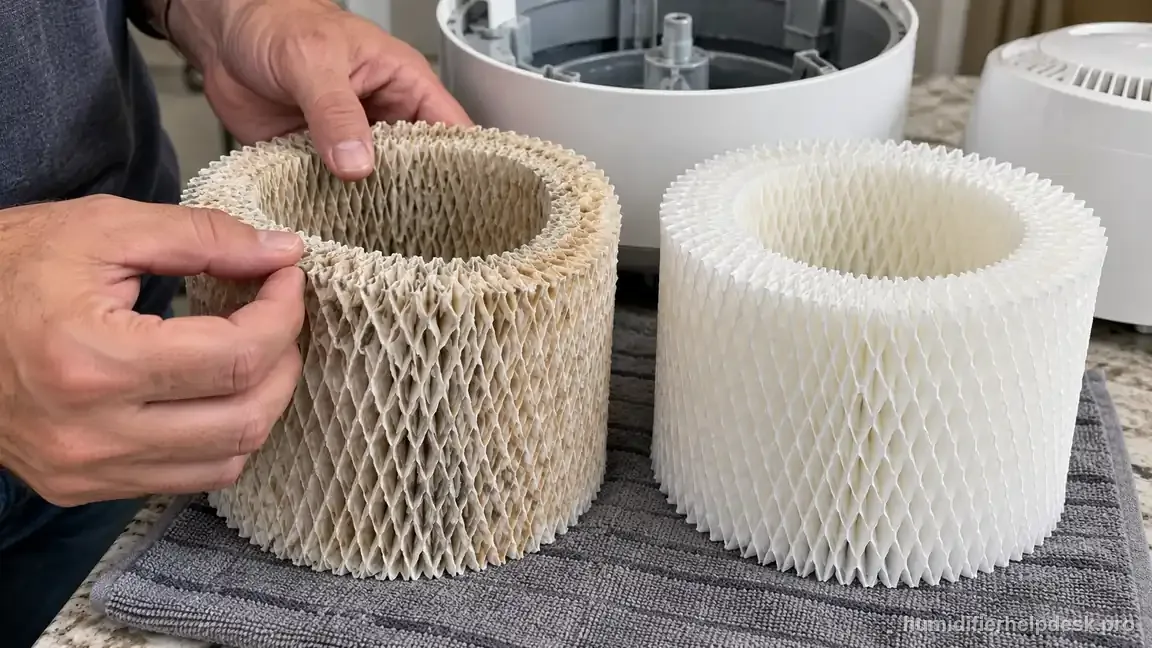
Illustrative: Judge the wick by hardness, crust, odor, or reduced output; light color change alone may be mineral staining. - Soak/rinse only as directed by Honeywell; do not use vinegar or bleach on the wick.
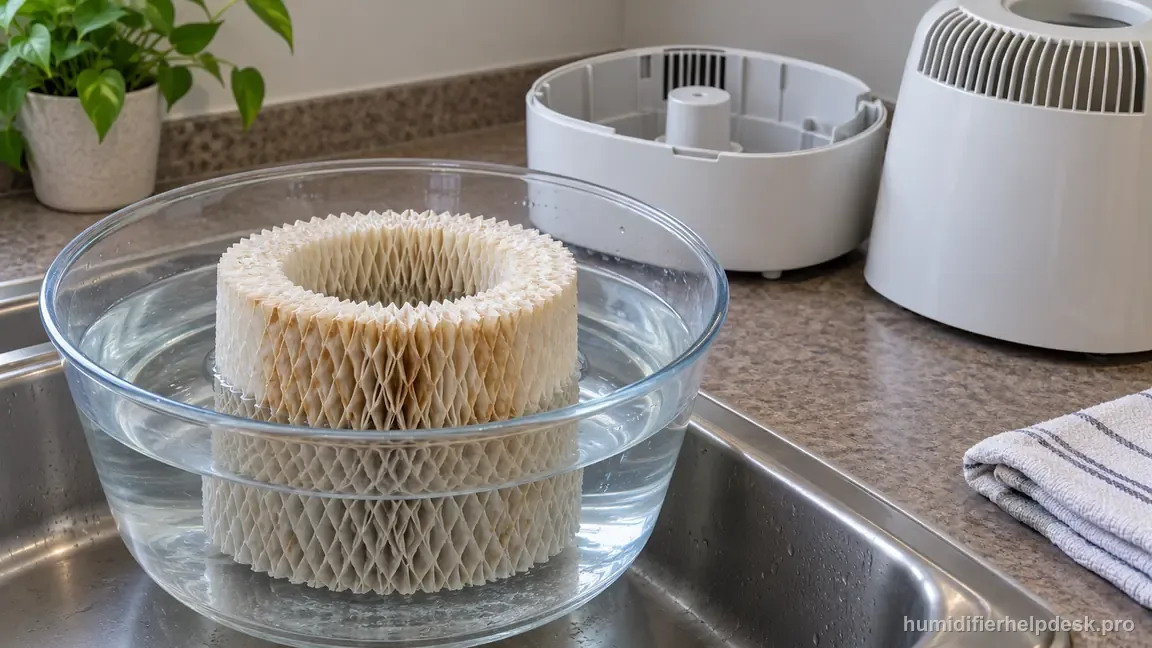
Illustrative: Soak a hardened wick in cool water only as directed; never clean the wick with vinegar or bleach. - Replace the wick when it becomes hard/crusty, develops odor, or output drops significantly.
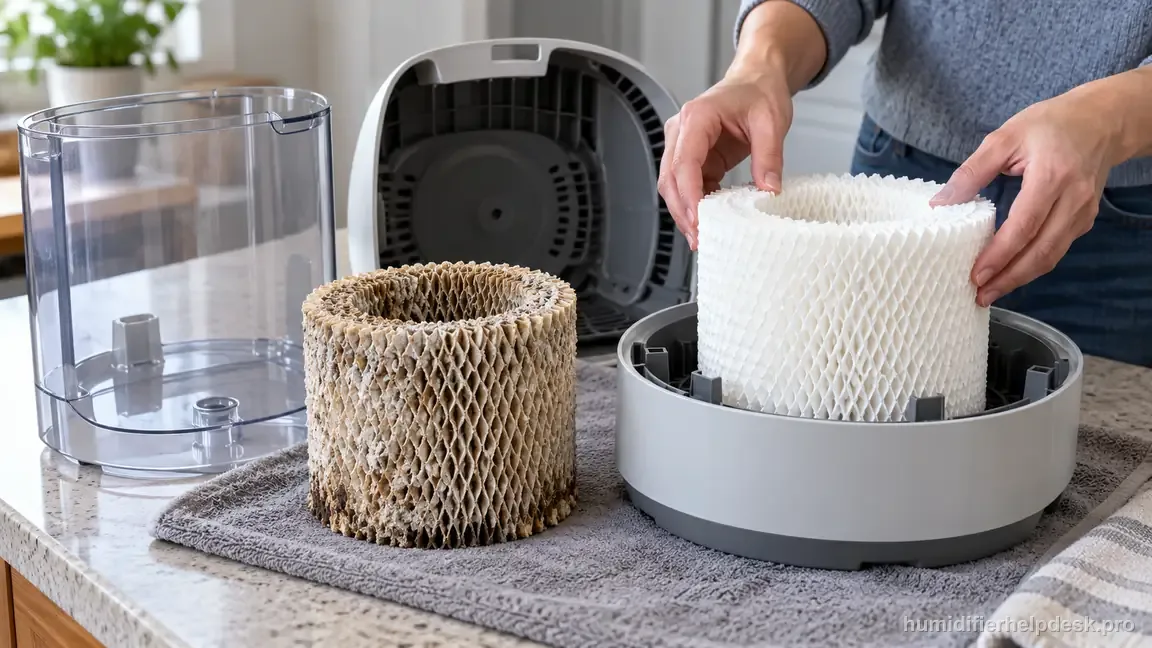
Illustrative: Replace a wick that is hard or crusty, smells, or has noticeably reduced moisture output.
Diagnostic decision path
Brown or rust-colored staining on the HCM350 wick is not, by itself, a replacement diagnosis. Honeywell says a cool-water soak can loosen mineral deposits, but the stain may remain without affecting performance. Judge the wick by its condition and output, not by whether soaking makes it white again.
- Look at the whole wick, not one stained area.
- Check whether it still wets through, remains flexible, and has no objectionable odor.
- Compare humidifier output and water use with the wick condition before deciding to replace it.
If: The wick is brown but still soft, wets normally, and output is normal
What it means: The color is consistent with mineral staining and does not automatically indicate failure.
Do next: Continue normal use and routine rinsing/maintenance rather than replacing solely for appearance. A cool-water soak may loosen deposits, but do not expect it to remove all staining.
If: The wick is hard or crusty
What it means: Mineral buildup is now affecting the physical structure that supports evaporation.
Do next: Replace the wick when the documented condition signs are present instead of trying to restore it with harsh chemicals.
If: The wick has developed odor or humidification has dropped significantly
What it means: The issue has moved from cosmetic discoloration to a performance/condition problem.
Do next: Replace the wick and clean the user-serviceable humidifier parts according to Honeywell guidance.
If: A new wick discolors quickly but performance stays normal
What it means: Local water minerals may be causing fast staining.
Do next: Focus on water quality and normal maintenance; do not assume repeated product defects from color alone.
How to interpret the retest
After the preceding check, retest under the same conditions and look for “The wick is brown but still soft, wets normally, and output is normal” rather than changing several settings at once. If the Honeywell HCM350 matches that observation, use the interpretation “The color is consistent with mineral staining and does not automatically indicate failure” and follow with “Continue normal use and routine rinsing/maintenance rather than replacing solely for appearance”. First, check “Inspect the wick for hardness, crusting, odor, or reduced output—not color alone”. If the state does not appear again, keep that result and continue with the next documented possibility for brown or rust-colored wick on the Honeywell HCM350.
Use a single checkpoint here. After “Soak/rinse only as directed by Honeywell; do not use vinegar or bleach on the wick”, does the Honeywell HCM350 show “The wick is hard or crusty”? If that state is present, the documented reading is “Mineral buildup is now affecting the physical structure that supports evaporation”, so the next move is “Replace the wick when the documented condition signs are present instead of trying to restore it with harsh chemicals”. If the state is absent, do not use the action from that Honeywell HCM350 possibility; record that it did not match the brown or rust-colored wick complaint and test the next documented condition.
On the Honeywell HCM350, use “The wick has developed odor or humidification has dropped significantly” as the observation to check first. On the Honeywell HCM350, the source-backed interpretation is “The issue has moved from cosmetic discoloration to a performance/condition problem”. Make “Replace the wick when it becomes hard/crusty, develops odor, or output drops significantly” the only deliberate change, then repeat the same symptom test. If the observation matches, continue with “Replace the wick and clean the user-serviceable humidifier parts according to Honeywell guidance”; if it does not, note that this Honeywell HCM350 brown or rust-colored wick path did not match and move on.
Model-specific context that changes the diagnosis
Let the Honeywell HCM350 observation choose the next step
First decide which observation you can genuinely have. If the Honeywell HCM350 shows “The wick is brown but still soft, wets normally, and output is normal”, the source-backed interpretation is “The color is consistent with mineral staining and does not automatically indicate failure” and the next step is “Continue normal use and routine rinsing/maintenance rather than replacing solely for appearance”. If it instead shows “The wick is hard or crusty”, use the separate interpretation “Mineral buildup is now affecting the physical structure that supports evaporation” and follow with “Replace the wick when the documented condition signs are present instead of trying to restore it with harsh chemicals”. On the Honeywell HCM350, do not combine both responses; retest the explanation that matches the current brown or rust-colored wick complaint first.
Run the Honeywell HCM350 checks in order
For the cleanest comparison, use “Inspect the wick for hardness, crusting, odor, or reduced output—not color alone” as the first Honeywell HCM350 check. Retest before going to “Soak/rinse only as directed by Honeywell; do not use vinegar or bleach on the wick”, and reach “Replace the wick when it becomes hard/crusty, develops odor, or output drops significantly” only if the earlier result is unchanged. For the Honeywell HCM350, the goal is to learn which single documented condition affects the brown or rust-colored wick complaint while unrelated settings stay steady long enough to judge the result.
Common mistakes that make this harder to diagnose
- Replacing every brown wick immediately.
- Soaking the wick in vinegar or bleach to make it look white again.
- Scrubbing the wick aggressively and damaging its structure.
- Ignoring hardness, crusting, odor, and output because the color seems like the only visible clue.
No “repair” is needed for color alone. Replace the wick when its physical condition or performance meets the manufacturer’s replacement signs. A discolored wick that remains soft, wets correctly, and supports normal output can remain serviceable.
Questions people ask about this exact symptom
Why is the wick or filter in my Honeywell HCM350 hard, crusty, or discolored?
For the Honeywell HCM350, discoloration alone does not automatically mean the wick has failed; mineral deposits can change its color. For this brown or rust-colored wick check on the Honeywell HCM350, start with “Inspect the wick for hardness, crusting, odor, or reduced output—not color alone” and check the result before making another change. If the behavior is unchanged, continue with “Soak/rinse only as directed by Honeywell; do not use vinegar or bleach on the wick”.
What should I check first if my Honeywell HCM350 has a hard, crusty, or discolored wick or filter?
Change one documented condition, then judge the result before continuing. On the Honeywell HCM350, begin with “Inspect the wick for hardness, crusting, odor, or reduced output—not color alone” and observe the result. Continue to “Soak/rinse only as directed by Honeywell; do not use vinegar or bleach on the wick”, then “Replace the wick when it becomes hard/crusty, develops odor, or output drops significantly”, only if the earlier step does not change the result.
When should I contact Honeywell about this Honeywell HCM350 problem?
Contact Honeywell if the Honeywell HCM350 still has the same problem after the documented checks for brown or rust-colored wick. Give support the Honeywell HCM350's current mode and the before-and-after result from the documented brown or rust-colored wick checks. Do not open powered sections on the Honeywell HCM350 or assume an internal failed part unless Honeywell documents that procedure for this brown or rust-colored wick case.
Why this path is model-specific
Honeywell says light brown/rust coloration can be mineral deposit and may not affect performance; its HCM350 owner manual recommends soaking the wick in cool water to loosen deposits and lists hardness, odor, and reduced output as replacement signs.
For the Honeywell HCM350, the machine type matters: it is evaporative. Its moisture output is not supposed to look like ultrasonic fog, so “I cannot see mist” by itself is not evidence of a failure.
Compare this symptom across verified models
If you are still deciding whether this behavior is normal or model-specific, use the symptom hub to compare only manufacturer-linked guides. Keep the Honeywell HCM350 instructions above as the controlling path for this machine.
If the problem is still there
If the checks above do not change the symptom, use the manufacturer support path for this exact model. We intentionally stop before undocumented resets, sensor bypasses, internal mains work, or parts replacement that the consumer manual does not authorize.
What we do not recommend
Do not defeat a float, water-level sensor, overheat protection, interlock, or other safety feature. Do not open mains-powered sections for live testing. If the unit smells burned, becomes abnormally hot, smokes, sparks, has water near electrical parts, or repeatedly trips a circuit, stop using it and keep clear. Unplug it only if the plug, outlet, and surrounding area are dry and safe to reach; otherwise do not touch wet equipment and contact manufacturer support for next steps.
Primary source for this diagnosis
Source checked during the September 4, 2026 editorial review. Manufacturer documents can change; a material re-review updates this guide’s reviewed date rather than stamping unrelated pages.