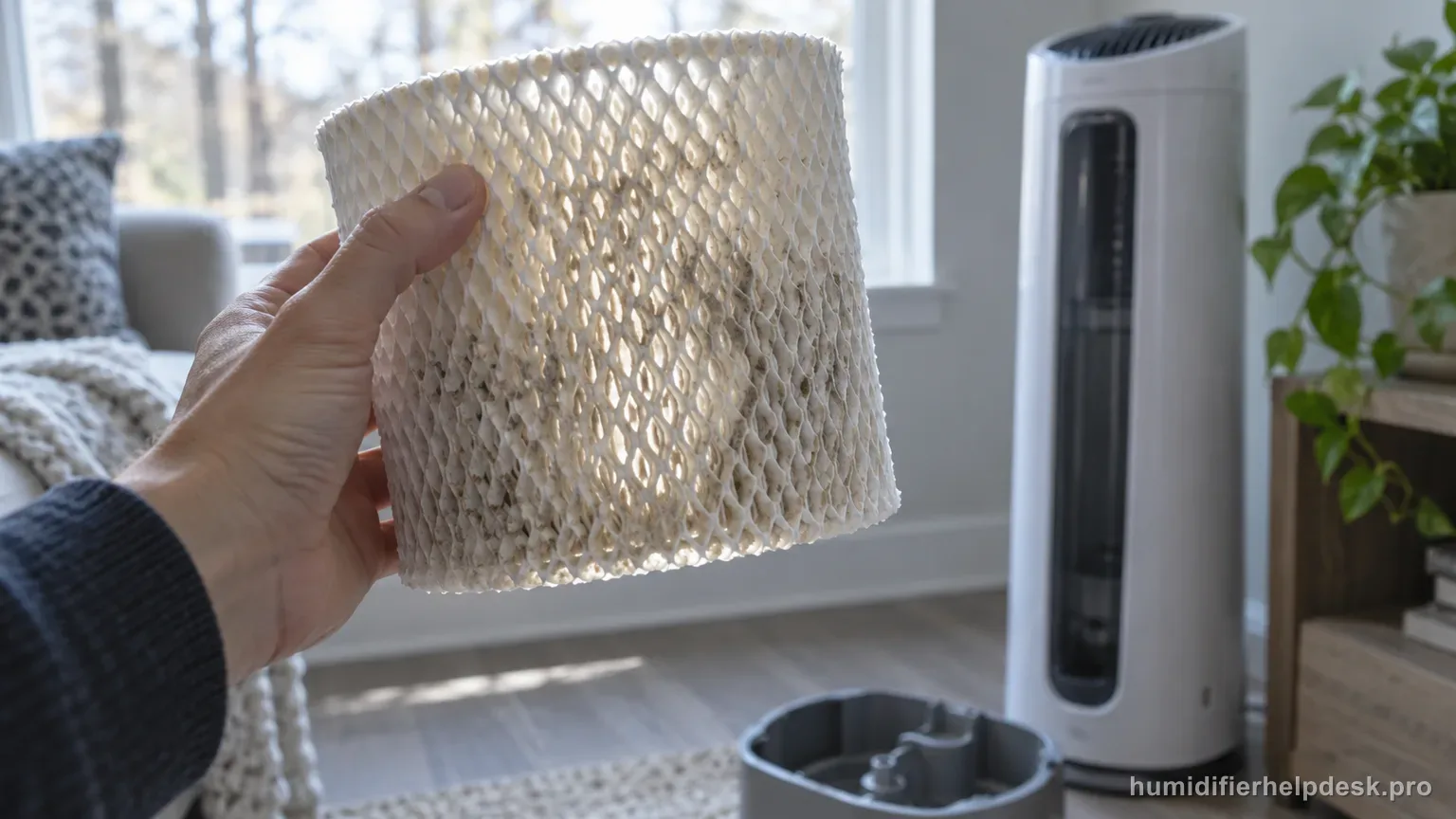
Low output often starts with the HFT600 wick: wet it, inspect for mineral hardening/odor, and replace it when performance drops.
Does this match what you are seeing?
Owners describe this Honeywell HEV620 problem in a few different ways. If one of these sounds like yours, this guide covers it:
- Humidity not increasing
- Room humidity not going up
- Not reaching target humidity
- Running but room still dry
Check these in order
- Wet the wick before use.
- Inspect for a hard/crusty wick, odor, or visibly reduced moisture output.
- Flip the wick top-to-bottom when refilling to help it age evenly.
- Replace the wick based on condition; Honeywell gives a typical 30–60 day range depending on water quality and use.
Diagnostic decision path
When the HEV620 is running but room humidity rises slowly, the HFT600 wick is the first serviceable restriction to inspect. Honeywell recommends wetting the wick, flipping it during refills, and replacing it when hardness, crusting, odor, or reduced output shows that mineral loading has overtaken its useful evaporative surface. Its typical replacement guidance is about 30–60 days, with water quality and use determining whether that interval is shorter or longer.
- Unplug the tower before handling the wick.
- Confirm the wick is HFT600 and correctly seated.
- For a useful output test, make sure the humidistat is actually calling for moisture.
If: The wick is dry after installation/refill
What it means: A dry evaporation surface can make output look weak even when the fan is healthy.
Do next: Wet the HFT600 with cool water and reinstall it before retesting.
If: The wick dries unevenly or the top hardens first
What it means: Uneven aging is reducing active wet surface.
Do next: Flip the wick top-to-bottom at refills as Honeywell recommends.
If: The wick remains hard/crusty, smells, or output stays low
What it means: It meets Honeywell’s condition-based replacement signals.
Do next: Replace the HFT600; do not try vinegar, bleach, or another cleaning solution on the wick.
If: A healthy wet wick and active fan still do not raise humidity in a dry room
What it means: The problem has moved beyond ordinary filter condition.
Do next: Check placement/room load and use Honeywell support if the HEV620 still cannot deliver expected evaporative output.
How to interpret the retest
Use the HFT600 wick as the first filter-specific checkpoint because Honeywell identifies it as the required evaporative media for the HEV620. If a recently installed wick is still dry, pre-wet it with cool water and reinstall it before judging output; a dry surface cannot evaporate much moisture yet.
Flip the wick top-to-bottom during refills as Honeywell recommends. That routine helps prevent one edge from drying and aging much faster than the rest. If the top repeatedly hardens while the lower section stays wet, uneven use can reduce effective evaporative area even though the filter still looks intact.
Use condition-based replacement signals rather than color alone. Honeywell lists a wick that becomes hard/crusty, develops odor, or produces noticeably less moisture as reasons to replace it. The commonly cited 30–60 day interval varies with water quality and usage and should not be treated as an exact expiration date.
Do not wash the HFT600 with vinegar, bleach, soap, or another chemical solution. Honeywell warns that chemical cleaning can damage the wick. A cool-water soak may temporarily loosen mineral buildup on a hard filter, but a repeatedly rigid or poorly wetting wick still needs replacement rather than stronger cleaning.
Separate wick restriction from humidistat control. The HEV620 can reduce or stop fan operation when the selected humidity is reached, so low water use while the room is already at target does not prove a bad filter. Evaluate wick condition during a period when the unit is actually being asked to humidify.
If a wet, flexible, correctly installed HFT600 and active fan still cannot raise humidity in a genuinely dry room, move beyond the filter-only diagnosis. Verify placement and room load, then use Honeywell support if performance remains poor. Do not open the motor housing to chase an output problem.
Model-specific context that changes the diagnosis
The HFT600 wick is the first output checkpoint
The HEV620 is an evaporative humidifier, so output depends heavily on the wick’s ability to stay wet and expose a large moist surface to fan airflow. Honeywell specifically connects a hard, crusty, odorous, or performance-limiting HFT600 with replacement need. No visible fog is expected; judge output by wick condition, water use, fan operation, and room humidity instead.
Flip and pre-wet the wick for a fair performance test
Honeywell recommends wetting the wick and turning it top-to-bottom when the tank is refilled so it ages more evenly. If one edge repeatedly dries while the other stays saturated, effective evaporative area can fall. Correct the simple wick-handling steps before deciding the motor or humidistat is weak, then watch whether water use and room humidity improve.
Cool-water soaking is temporary help, not full restoration
If the wick becomes hard from mineral loading, Honeywell says a cool-water soak may loosen buildup and temporarily improve performance while a replacement is obtained. The company specifically warns against cleaning the wick with vinegar, soap, bleach, or other chemical solutions. Those products can damage the paper media rather than renew it.
Replacement timing depends on water and use
Honeywell gives a typical 30–60 day range, but condition matters more than an exact calendar date. Hard water can shorten wick life substantially. If the HFT600 is hard/crusty, develops odor, or output has fallen despite normal water and fan behavior, replace it. If a fresh, properly wetted wick still produces weak room-humidity gain, then evaluate room load and support options.
Common mistakes that make this harder to diagnose
- Ignoring the digital humidistat and testing while the target is already satisfied.
- Cleaning the HFT600 with vinegar or bleach.
- Assuming every discolored wick is spent.
- Never flipping the wick during refills.
Low output is resolved when a wet, flexible HFT600 and an active fan produce normal water consumption and room-humidity gain. Replace a persistently hard/crusty or odorous wick; escalate if a healthy wick still cannot support output.
Questions people ask about this exact symptom
Why is my Honeywell HEV620 fan running but humidity output is low?
Start with the HFT600 wick. Honeywell says low output can accompany a wick that has become hard or crusty, developed odor, or lost moisture-transfer performance. Wet and seat the wick correctly, flip it as directed, and replace it when those condition-based signs remain; the typical 30–60 day interval varies with water quality and use.
Can I clean the HFT600 with vinegar?
No. Honeywell specifically warns not to clean the wicking filter with vinegar, soap, bleach, or other chemical solutions. A cool-water soak may temporarily loosen mineral buildup, but a worn wick ultimately needs replacement. For the next Honeywell HEV620 check, use “Inspect for a hard/crusty wick, odor, or visibly reduced moisture output” and note whether the symptom changes.
Why is there low output even though I cannot see a mist problem?
The HEV620 is evaporative, so visible fog is not the performance test. Check that the wick is wet and serviceable, water is being consumed, the fan is operating, and room humidity is actually rising over time. Before escalating the Honeywell HEV620, confirm “Flip the wick top-to-bottom when refilling to help it age evenly” and note the result.
Why this path is model-specific
Honeywell’s HEV615/620 support and HFT600 guidance tie wick condition to output and recommend regular flipping and replacement as needed.
For the Honeywell HEV620, the machine type matters: it is evaporative. Its moisture output is not supposed to look like ultrasonic fog, so “I cannot see mist” by itself is not evidence of a failure.
This symptom appears on other humidifiers too, but the meaning and reset path can change by technology, sensor logic, and control layout. Use the exact model source above before borrowing a fix from a neighboring model.
Compare this symptom across verified models
If you are still deciding whether this behavior is normal or model-specific, use the symptom hub to compare only manufacturer-linked guides. Keep the Honeywell HEV620 instructions above as the controlling path for this machine.
If the problem is still there
If the checks above do not change the symptom, use the manufacturer support path for this exact model. We intentionally stop before undocumented resets, sensor bypasses, internal mains work, or parts replacement that the consumer manual does not authorize.
What we do not recommend
Do not defeat a float, water-level sensor, overheat protection, interlock, or other safety feature. Do not open mains-powered sections for live testing. If the unit smells burned, becomes abnormally hot, smokes, sparks, has water near electrical parts, or repeatedly trips a circuit, stop using it and keep clear. Unplug it only if the plug, outlet, and surrounding area are dry and safe to reach; otherwise do not touch wet equipment and contact manufacturer support for next steps.
Primary source for this diagnosis
Source checked during the September 4, 2026 editorial review. Manufacturer documents can change; a material re-review updates this guide’s reviewed date rather than stamping unrelated pages.