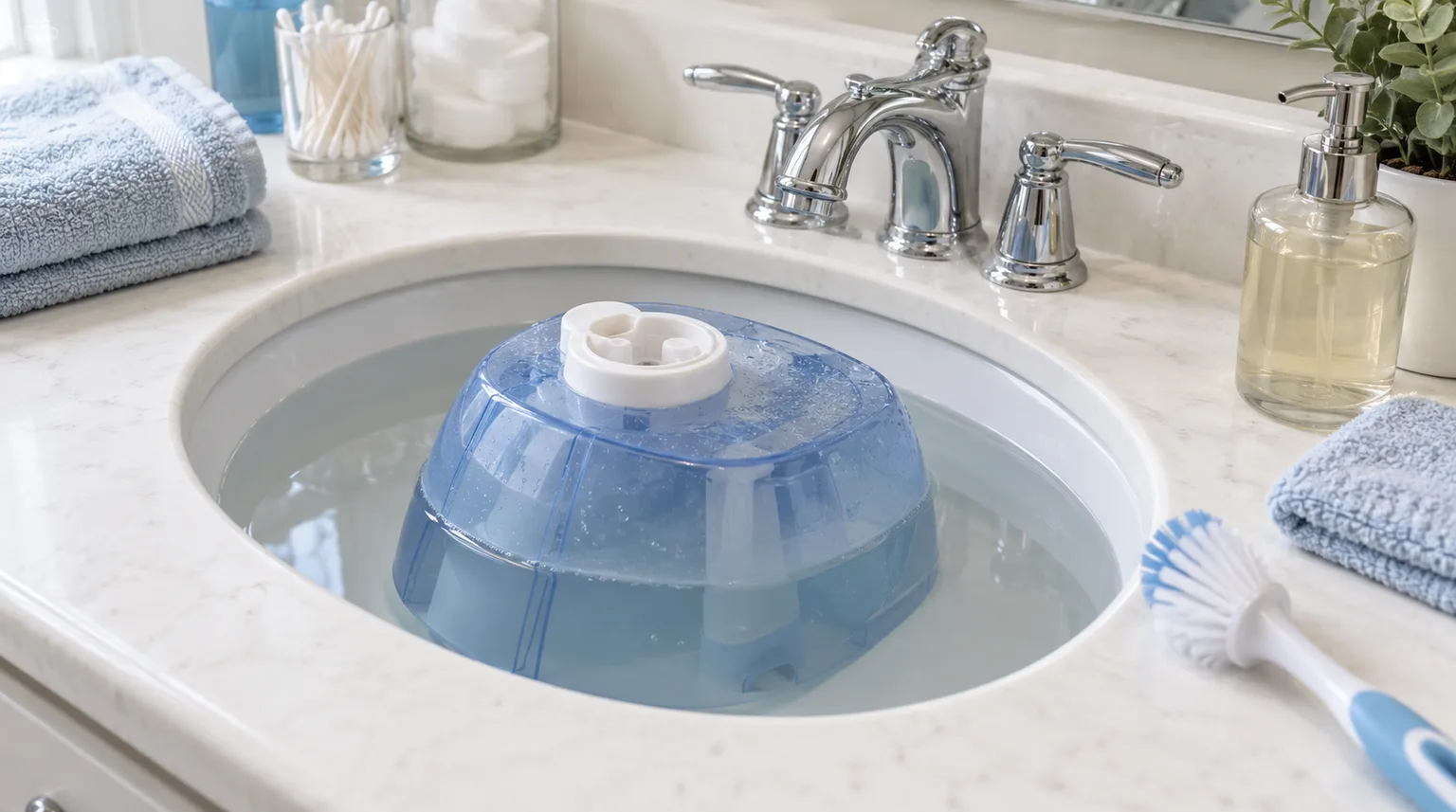
Use the separate scale-removal process in Vicks support and never mix vinegar and bleach.
Does this match what you are seeing?
Owners describe this Vicks VUL520 problem in a few different ways. If one of these sounds like yours, this guide covers it:
- Mineral buildup
- Scale on humidifier
- Weak output from scale
- Cleaning mineral deposits
Check these in order
- Turn off and unplug the unit.
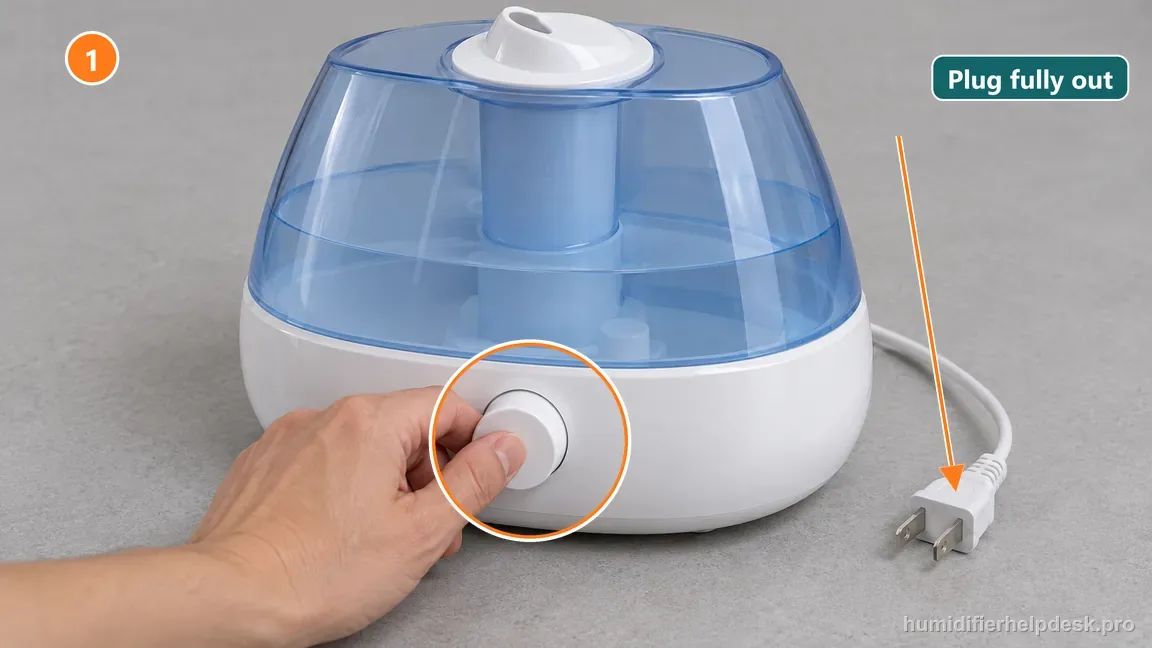
Illustrative: Switch off the humidifier and unplug it before handling the tank or base. - Use distilled white vinegar for scale removal as directed by Vicks.
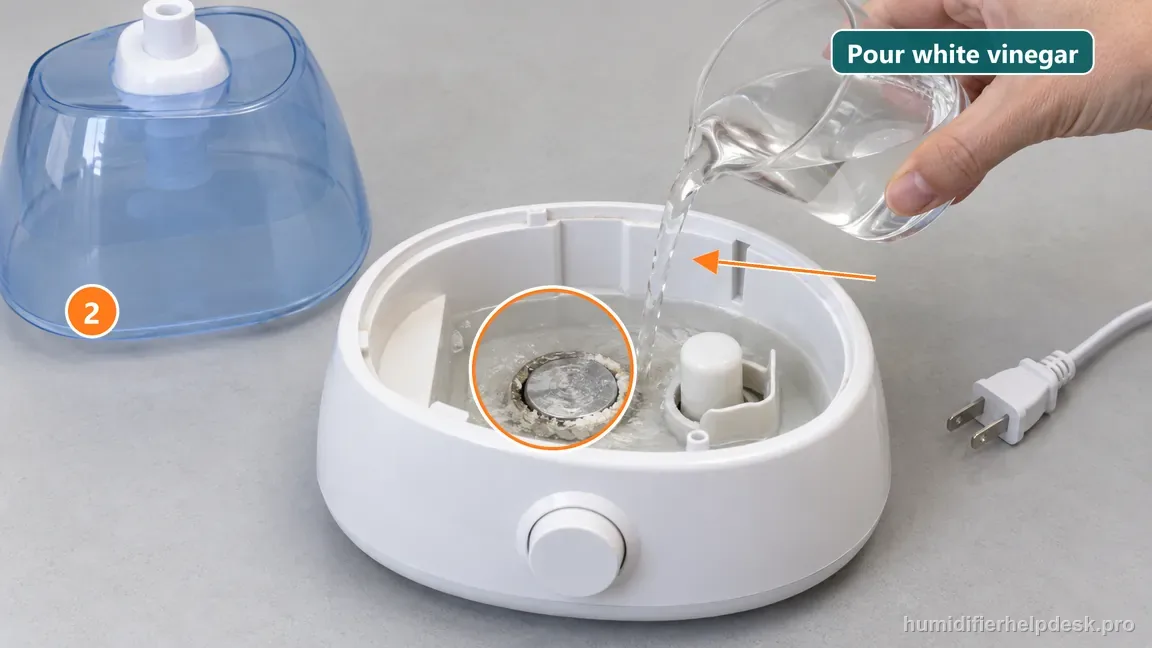
Illustrative: Use distilled white vinegar for the Vicks scale-removal process, following the specified amount. - Allow the reservoir/nebulizer area to soak for the specified time, then wipe loosened scale with a soft cloth.
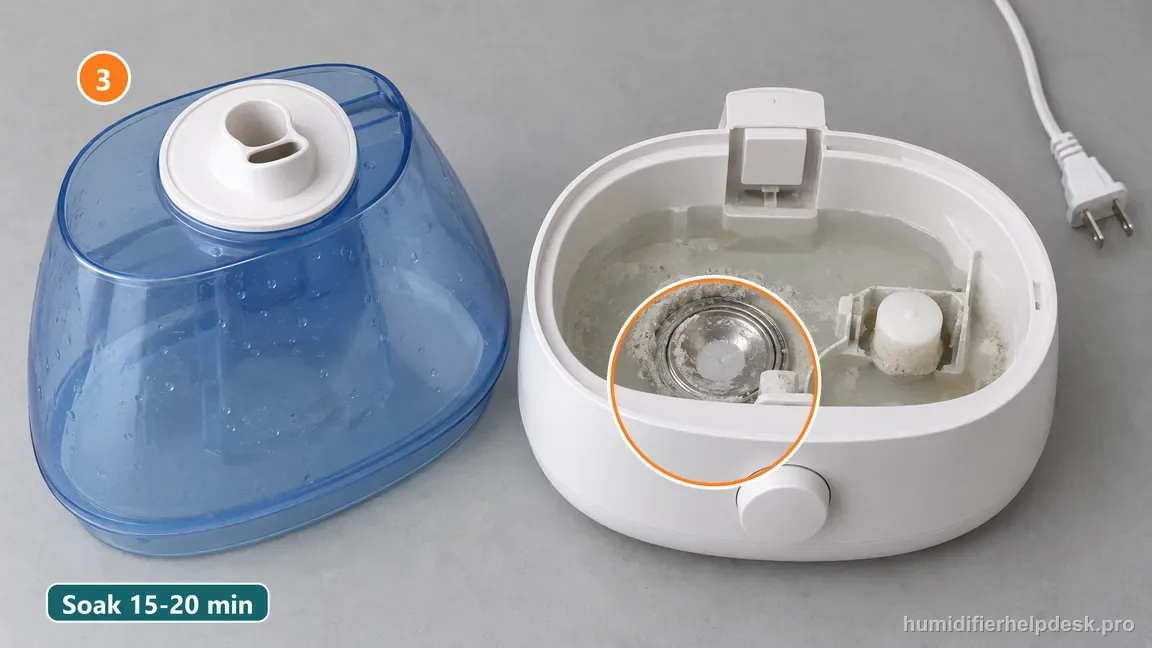
Illustrative: Let the water-path parts soak for the specified time so mineral scale softens. 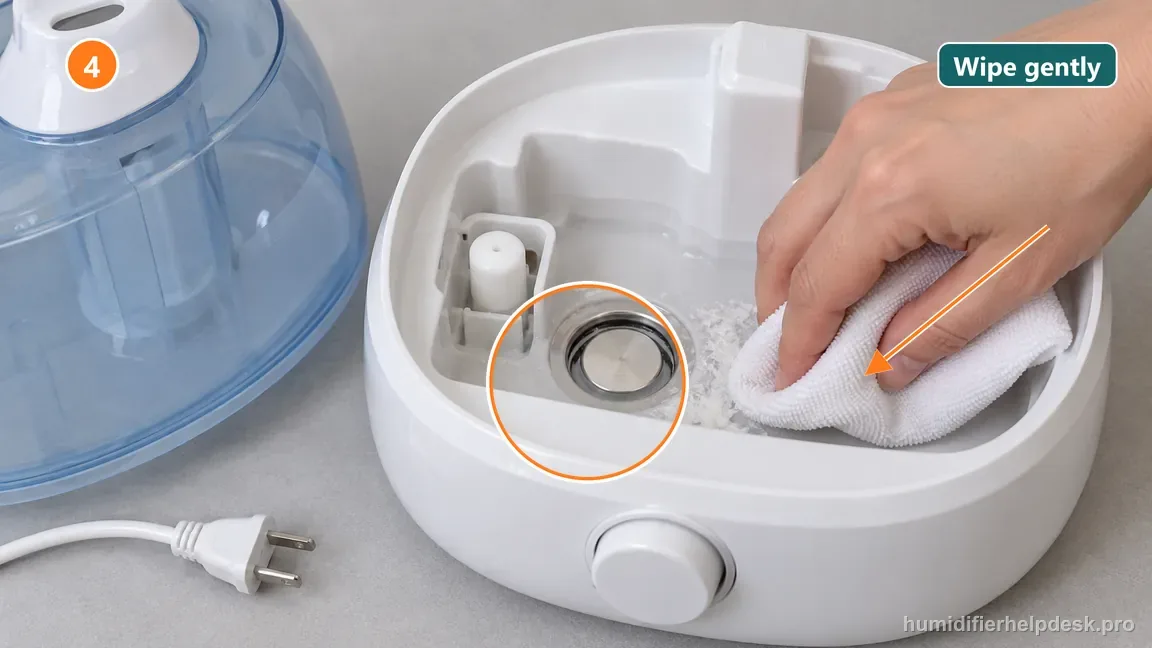
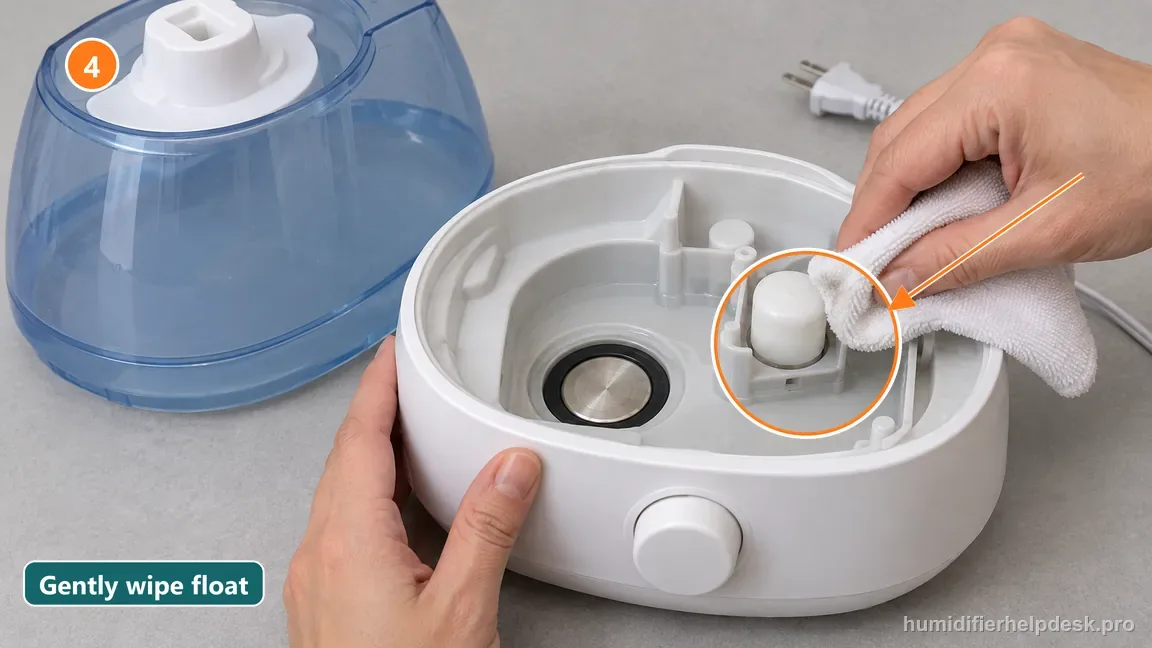
Illustrative: Wipe softened deposits from the ultrasonic disc and float gently with a soft cloth. - Rinse until the vinegar smell is gone before normal use.
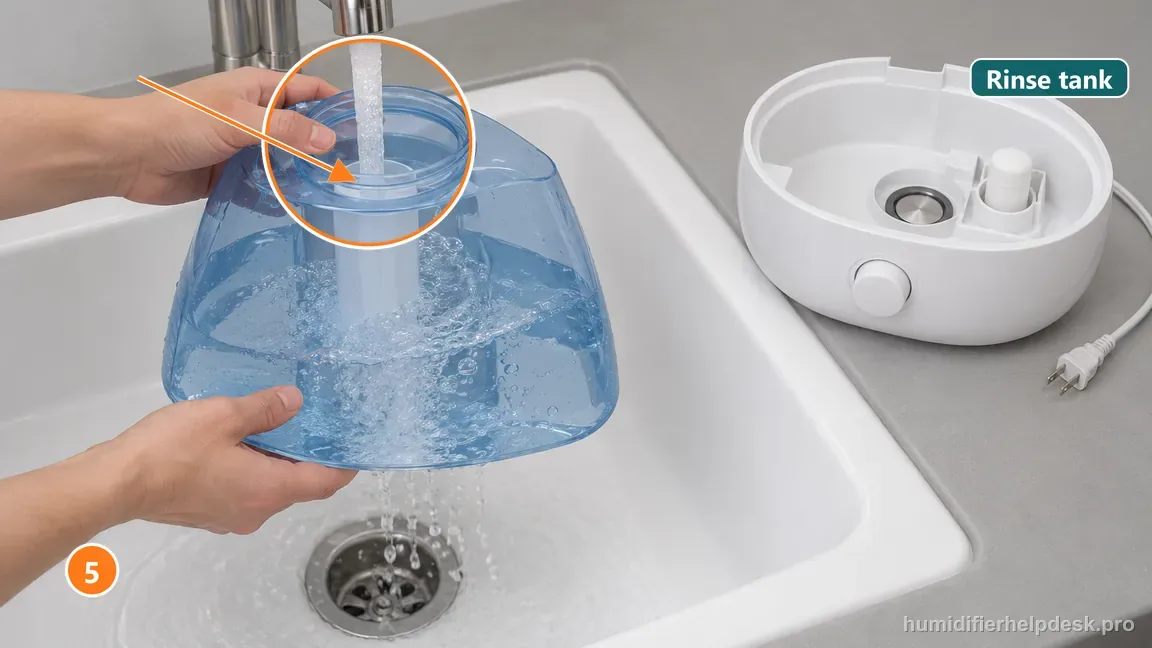
Illustrative: Rinse the tank thoroughly after vinegar cleaning before normal use. 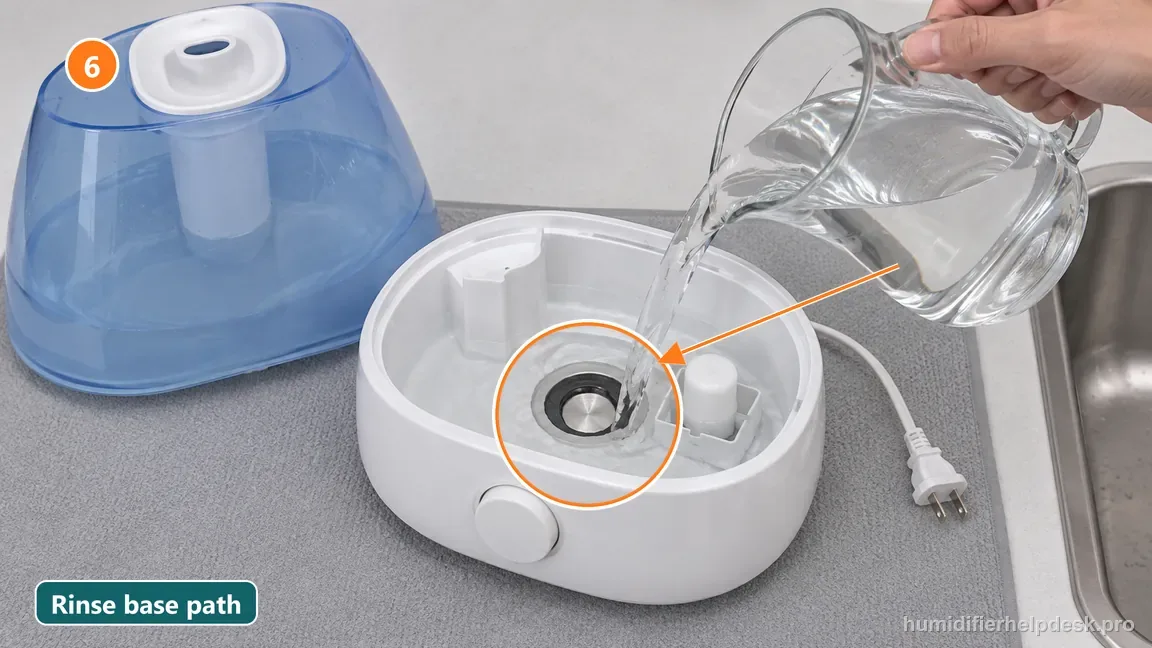
Illustrative: Flush the reservoir with clean water until no vinegar odor remains. - Never combine vinegar and bleach; Vicks requires scale removal and disinfecting to be separate processes.
Diagnostic decision path
Vicks treats scale removal and disinfection as two separate maintenance procedures on the VUL520. For mineral buildup or weak mist, the scale-removal path uses undiluted distilled white vinegar to loosen deposits on the tank, nebulizer, float, and reservoir. The key safety rule is to finish and rinse that process completely before any bleach-based disinfecting step.
- Turn the knob off and unplug the humidifier before handling the tank or base.
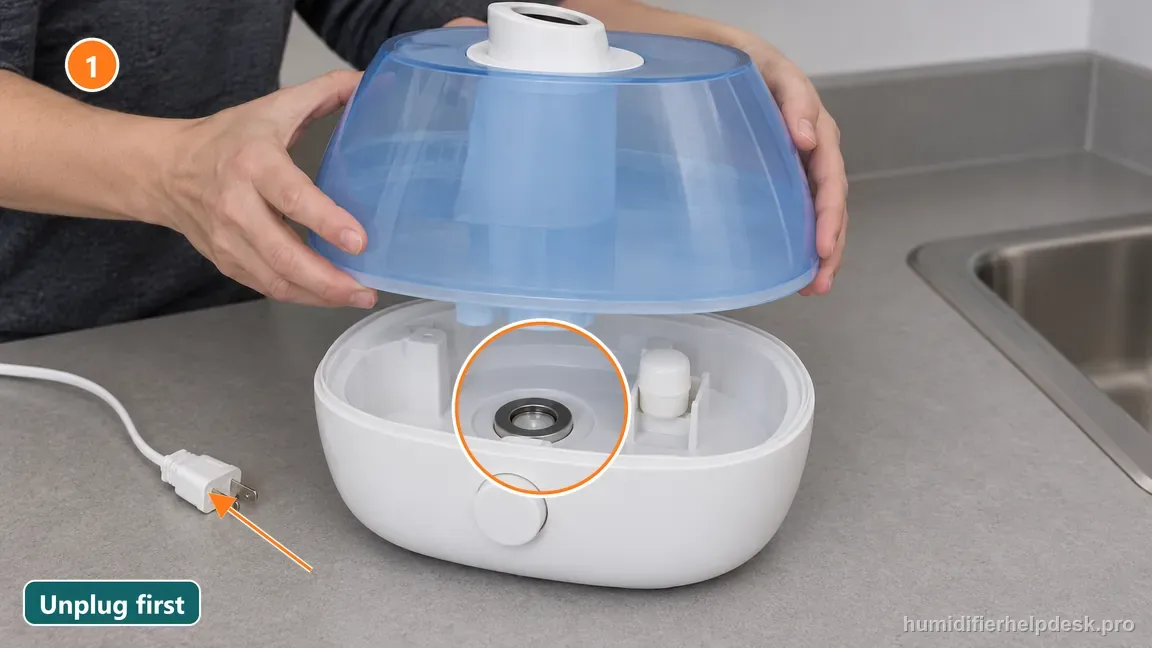
Illustrative: Turn the control off and unplug the humidifier before lifting its tank or handling the base. - Work near a sink on a water-resistant surface and keep liquid out of the rear fan opening and power control.
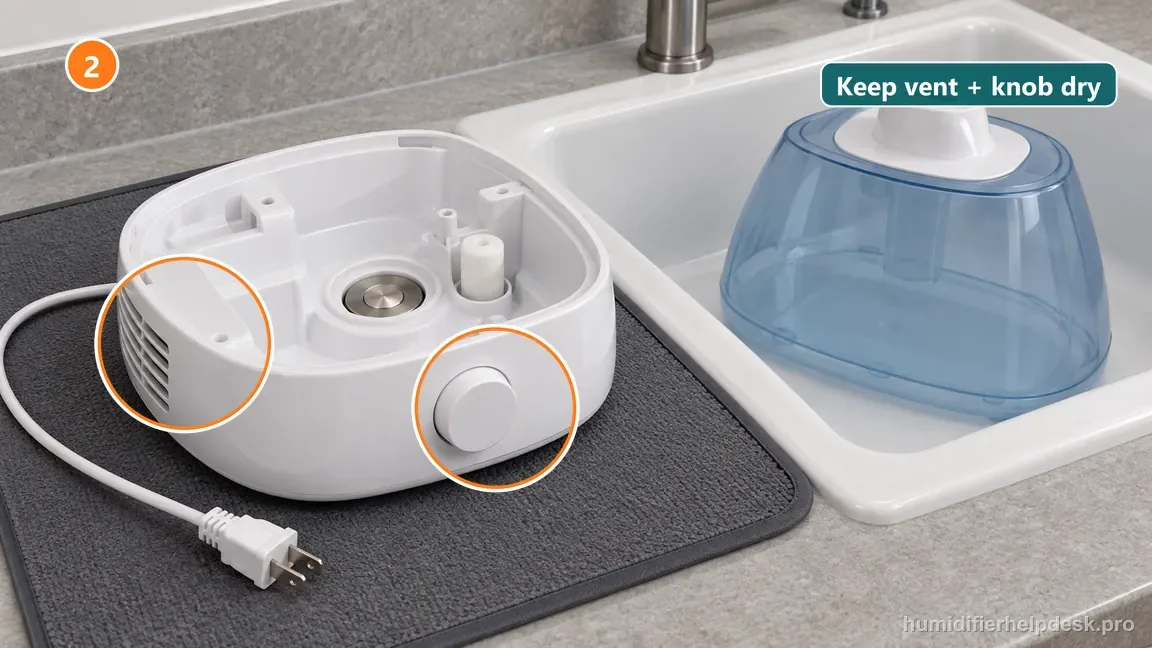
Illustrative: Set up beside a sink on a water-resistant surface and keep cleaning liquid away from the fan vent and control. - Remove accessories before cleaning because Vicks warns they can be damaged by the cleaning process.
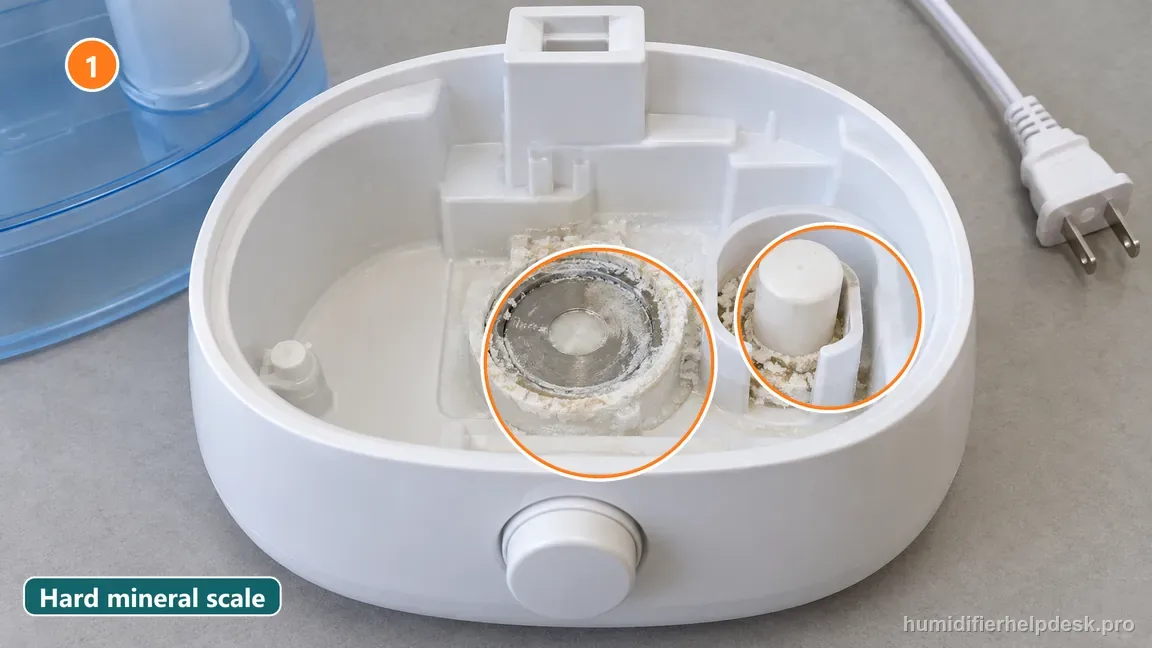
If: White or crusty mineral deposits are visible around the nebulizer/float
What it means: Hard-water scale is present in the user-cleanable water path.
Do next: Add 2 cups of undiluted distilled white vinegar as Vicks directs and let the tank/base path soak for about 15–20 minutes.
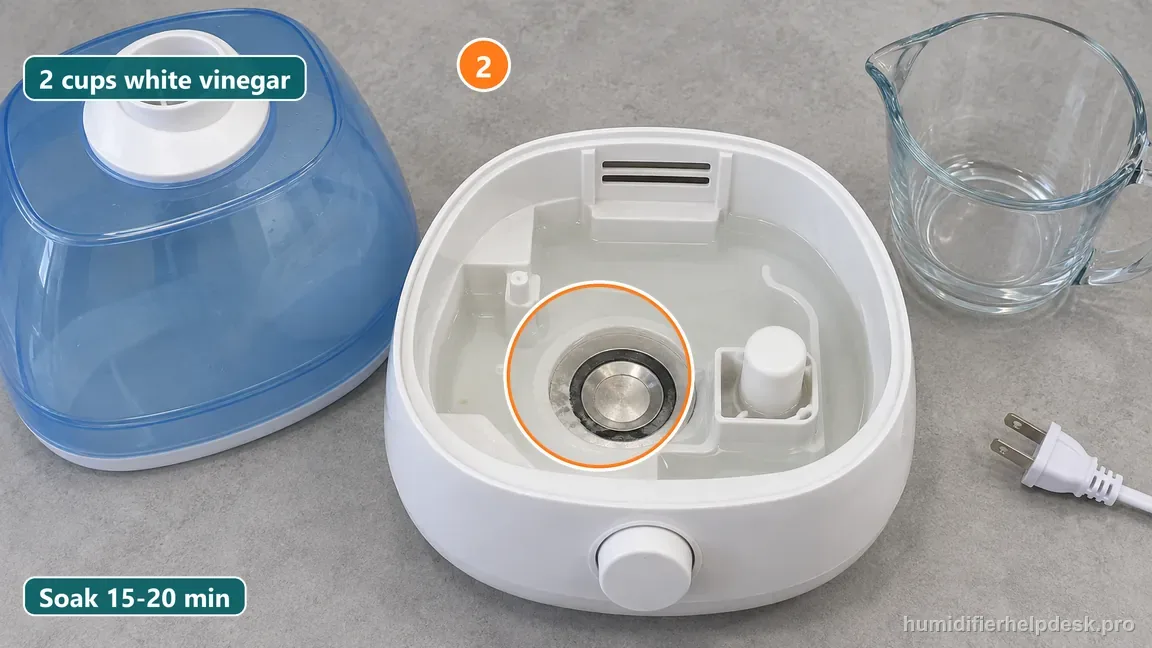
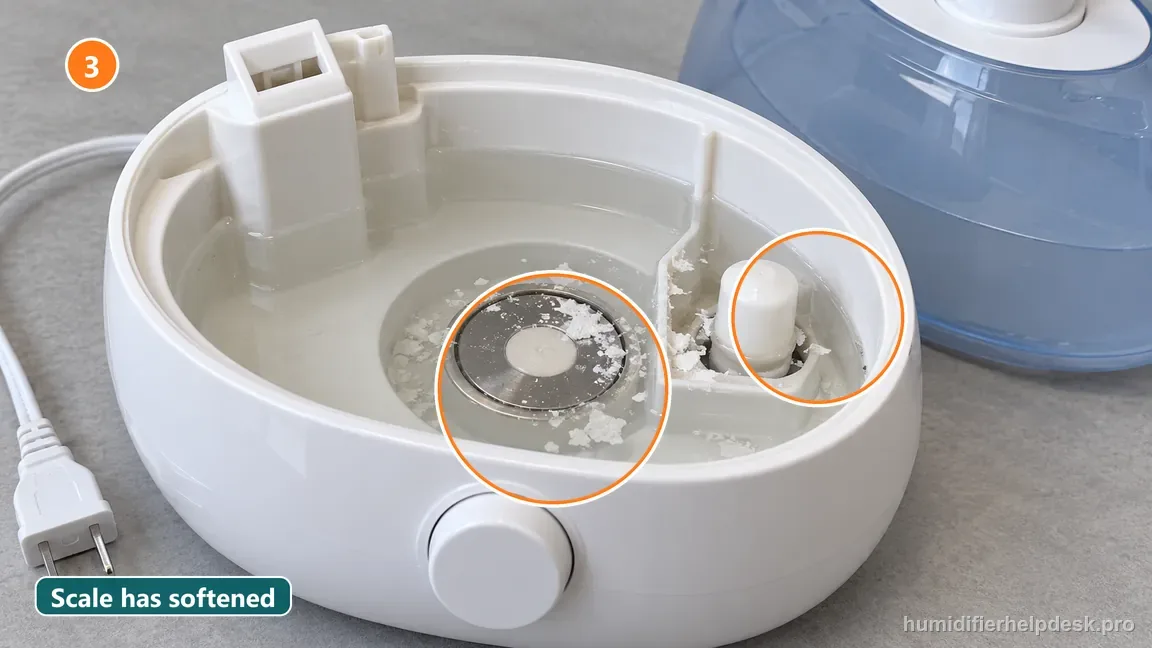
If: Scale softens after the soak
What it means: The vinegar has loosened mineral deposits without requiring scraping of the ultrasonic parts.
Do next: Wipe the nebulizer and float gently with a soft cloth, empty the vinegar, and rinse tank/reservoir thoroughly.
If: The vinegar smell remains
What it means: Cleaning solution is still present and the unit is not ready for normal misting.
Do next: Continue rinsing until the vinegar odor is gone before refilling for use.
If: You also want to disinfect the humidifier
What it means: Disinfection is a different chemical process from scale removal.
Do next: Complete and rinse the vinegar process first, then follow the separate Vicks disinfecting procedure; never combine vinegar and bleach.
How to interpret the retest
For the follow-up check, focus on “White or crusty mineral deposits are visible around the nebulizer/float” rather than changing several settings at once. If the Vicks VUL520 matches that observation, use the interpretation “Hard-water scale is present in the user-cleanable water path” and follow with “Add 2 cups of undiluted distilled white vinegar as Vicks directs and let the tank/base path soak for about 15–20 minutes”. First, check “Turn off and unplug the unit”. If the state does not appear again, keep that result and continue with the next documented possibility for mineral buildup or weak mist on the Vicks VUL520.
Use a single checkpoint here. After “Use distilled white vinegar for scale removal as directed by Vicks”, does the Vicks VUL520 show “Scale softens after the soak”? If that state is present, the documented reading is “The vinegar has loosened mineral deposits without requiring scraping of the ultrasonic parts”, so the next move is “Wipe the nebulizer and float gently with a soft cloth, empty the vinegar, and rinse tank/reservoir thoroughly”. If the state is absent, do not use the action from that Vicks VUL520 possibility; record that it did not match the mineral buildup or weak mist complaint and test the next documented condition.
On the Vicks VUL520, use “The vinegar smell remains” as the observation to check first. On the Vicks VUL520, the source-backed interpretation is “Cleaning solution is still present and the unit is not ready for normal misting”. Make “Allow the reservoir/nebulizer area to soak for the specified time, then wipe loosened scale with a soft cloth” the only deliberate change, then repeat the same symptom test. If the observation matches, continue with “Continue rinsing until the vinegar odor is gone before refilling for use”; if it does not, note that this Vicks VUL520 mineral buildup or weak mist path did not match and move on.
Model-specific context that changes the diagnosis
Two Vicks VUL520 clues that point to different fixes
Separate the observations before guessing at an internal fault. On the Vicks VUL520, “White or crusty mineral deposits are visible around the nebulizer/float” supports the interpretation “Hard-water scale is present in the user-cleanable water path” and leads to “Add 2 cups of undiluted distilled white vinegar as Vicks directs and let the tank/base path soak for about 15–20 minutes”. “Scale softens after the soak” supports “The vinegar has loosened mineral deposits without requiring scraping of the ultrasonic parts” and leads to “Wipe the nebulizer and float gently with a soft cloth, empty the vinegar, and rinse tank/reservoir thoroughly”. For the current Vicks VUL520 mineral buildup or weak mist complaint, choose the state you can actually reproduce and work from that result.
Run the Vicks VUL520 checks in order
A controlled comparison is more useful here than several simultaneous changes. Try “Turn off and unplug the unit” on the Vicks VUL520 and observe the same complaint. Only then move to “Use distilled white vinegar for scale removal as directed by Vicks” and, if necessary, “Allow the reservoir/nebulizer area to soak for the specified time, then wipe loosened scale with a soft cloth”. With mineral buildup or weak mist on the Vicks VUL520, keeping the other obvious variables steady makes it easier to tell whether a documented condition was actually responsible.
Common mistakes that make this harder to diagnose
- Mixing bleach with vinegar.
- Pouring cleaning liquid into the fan opening or power knob area.
- Scraping the nebulizer with a metal or abrasive tool.
- Skipping the rinse and running the humidifier while vinegar odor remains.
Descaling is complete when visible deposits have loosened/been wiped away, the water path has been thoroughly rinsed, and no vinegar odor remains. If weak mist persists after clean water, correct fill, and a properly descaled nebulizer/float, move to model-specific troubleshooting rather than stronger chemicals.
Questions people ask about this exact symptom
Why is mineral scale building up in my Vicks VUL520?
For the Vicks VUL520, use the separate scale-removal process in Vicks support and never mix vinegar and bleach. For this mineral buildup or weak mist check on the Vicks VUL520, start with “Turn off and unplug the unit” and check the result before making another change. If the behavior is unchanged, continue with “Use distilled white vinegar for scale removal as directed by Vicks”.
What should I check first if my Vicks VUL520 has mineral buildup or scale?
Start with “Turn off and unplug the unit”. If the Vicks VUL520 behaves the same, move to “Use distilled white vinegar for scale removal as directed by Vicks”; use “Allow the reservoir/nebulizer area to soak for the specified time, then wipe loosened scale with a soft cloth” only after judging that result.
When should I contact Vicks about this Vicks VUL520 problem?
Contact Vicks if the Vicks VUL520 still has the same problem after the documented checks for mineral buildup or weak mist. Give support the Vicks VUL520's current mode and the before-and-after result from the documented mineral buildup or weak mist checks. This safety boundary applies immediately at any point: “Do not let cleaning liquid enter the fan opening or power control area”.
Why this path is model-specific
Vicks provides a model-specific vinegar descaling process for the VUL520 and explicitly warns not to mix vinegar and bleach.
For the Vicks VUL520, the machine type matters: it is ultrasonic. Visible mist is part of normal output when mist production is active, so a true no-mist complaint deserves model-specific troubleshooting.
This symptom appears on other humidifiers too, but the meaning and reset path can change by technology, sensor logic, and control layout. Use the exact model source above before borrowing a fix from a neighboring model.
Compare this symptom across verified models
If you are still deciding whether this behavior is normal or model-specific, use the symptom hub to compare only manufacturer-linked guides. Keep the Vicks VUL520 instructions above as the controlling path for this machine.
If the problem is still there
If the checks above do not change the symptom, use the manufacturer support path for this exact model. We intentionally stop before undocumented resets, sensor bypasses, internal mains work, or parts replacement that the consumer manual does not authorize.
What we do not recommend
Do not defeat a float, water-level sensor, overheat protection, interlock, or other safety feature. Do not open mains-powered sections for live testing. If the unit smells burned, becomes abnormally hot, smokes, sparks, has water near electrical parts, or repeatedly trips a circuit, stop using it and keep clear. Unplug it only if the plug, outlet, and surrounding area are dry and safe to reach; otherwise do not touch wet equipment and contact manufacturer support for next steps.
Primary source for this diagnosis
Source checked during the September 3, 2026 editorial review. Manufacturer documents can change; a material re-review updates this guide’s reviewed date rather than stamping unrelated pages.