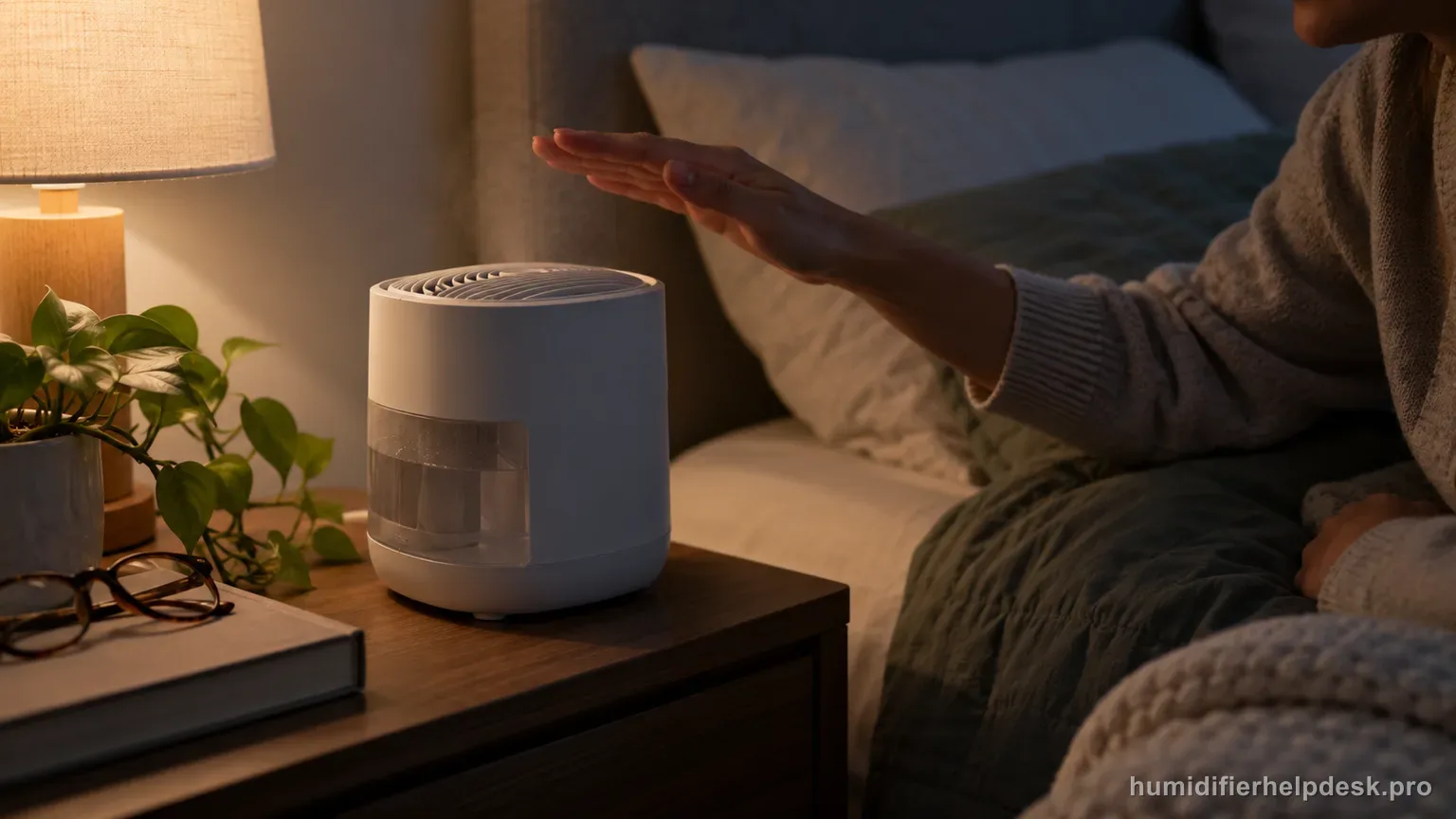
That is expected. The EV100 uses natural evaporation and does not create the visible fog associated with ultrasonic units.
Does this match what you are seeing?
Owners describe this Vornado EV100 problem in a few different ways. If one of these sounds like yours, this guide covers it:
- No visible mist
- Running but no mist
- Humidifier working but no fog
- Fan runs but I cannot see vapor
Check these in order
- Check that the fan/airflow is operating when humidity is below the set point.
- Watch the tank level over time rather than looking for fog.
- Inspect the wick if output seems low.
Diagnostic decision path
The EV100 is an evaporative whole-room humidifier, so visible mist is intentionally absent. Vornado’s design uses airflow through wet wicks and specifically avoids the fog/white-dust behavior associated with ultrasonic units. The right operating test is fan activity below the humidity set point, water consumption, and the condition of the wick/air path.
- Confirm the humidity setting is above current room humidity or use Continuous for a brief controlled test.
- Make sure airflow is not blocked.
- Judge the unit by water use and humidity change rather than by looking for fog.
If: The fan runs and the tank level falls over time
What it means: The EV100 is evaporating water normally even though the moisture cannot be seen.
Do next: Continue normal use and monitor room humidity.
If: The fan is off because the selected humidity set point has been reached
What it means: The unit is intentionally pausing output.
Do next: Wait for room humidity to fall or raise the set point/choose Continuous briefly to verify fan operation.
If: The fan runs but desired humidity remains low
What it means: The issue is output rather than “missing mist.”
Do next: Check water level, airflow obstruction, settings, and wick condition using the EV100 low-output path.
If: No water is being used in a dry room despite fan operation
What it means: Normal evaporative transfer is not occurring.
Do next: Inspect the wick/water path and escalate to Vornado support if user-serviceable checks do not restore output.
How to interpret the retest
Make this the first check: “Check that the fan/airflow is operating when humidity is below the set point”. With that step complete, compare the Vornado EV100 with “The fan runs and the tank level falls over time”. If the two states match, the source-backed interpretation is “The EV100 is evaporating water normally even though the moisture cannot be seen” and then “Continue normal use and monitor room humidity”. If they do not match, leave this Vornado EV100 path and continue; that non-match helps rule out this explanation for the no visible mist complaint.
Do not assign this cause until you have observed “The fan is off because the selected humidity set point has been reached”. For the Vornado EV100, use “Watch the tank level over time rather than looking for fog” as the controlled test. If the same observation appears, the source meaning is “The unit is intentionally pausing output” and the next action is “Wait for room humidity to fall or raise the set point/choose Continuous briefly to verify fan operation”. If it does not appear, record the non-match and continue through the remaining Vornado EV100 checks for no visible mist.
Keep the other conditions steady and compare the result around this check. Check “Inspect the wick if output seems low” on the Vornado EV100, then look specifically for “The fan runs but desired humidity remains low”. A match supports the manual's interpretation “The issue is output rather than “missing mist.”” and sends you to “Check water level, airflow obstruction, settings, and wick condition using the EV100 low-output path”. If the observation is missing, that result narrows the Vornado EV100 no visible mist diagnosis without jumping to an unrelated reset.
Use “No water is being used in a dry room despite fan operation” to decide which documented branch to test next, not to declare the cause on its own. On the Vornado EV100, it corresponds to “Normal evaporative transfer is not occurring”. Use “Check that the fan/airflow is operating when humidity is below the set point” and retest. When the observation is present, continue with “Inspect the wick/water path and escalate to Vornado support if user-serviceable checks do not restore output”. When it is absent, rule out that explanation for now and keep the result with the current Vornado EV100 no visible mist notes.
Model-specific context that changes the diagnosis
Separate the first two Vornado EV100 causes
The useful starting point is the observation you can reliably have. If the Vornado EV100 shows “The fan runs and the tank level falls over time”, the source-backed interpretation is “The EV100 is evaporating water normally even though the moisture cannot be seen” and the next step is “Continue normal use and monitor room humidity”. If it instead shows “The fan is off because the selected humidity set point has been reached”, use the separate interpretation “The unit is intentionally pausing output” and follow with “Wait for room humidity to fall or raise the set point/choose Continuous briefly to verify fan operation”. On the Vornado EV100, do not combine both responses; retest the explanation that matches the current no visible mist complaint first.
Retest no visible mist after each correction
Make the retest a clean before-and-after comparison. Try “Check that the fan/airflow is operating when humidity is below the set point” on the Vornado EV100 and observe the same complaint. Only then move to “Watch the tank level over time rather than looking for fog” and, if necessary, “Inspect the wick if output seems low”. With no visible mist on the Vornado EV100, keeping the other obvious variables steady makes it easier to tell whether a documented condition was actually responsible.
Common mistakes that make this harder to diagnose
- Expecting a visible cloud.
- Calling normal set-point fan shutoff a no-mist failure.
- Blocking airflow to try to concentrate moisture.
- Replacing the unit before checking water use and wick condition.
The no-mist concern is resolved when the EV100 cycles as expected around its humidity target and uses water while the fan runs. If room humidity remains low despite adequate water, clear airflow, and serviceable wicks, use the low-output/support path.
Questions people ask about this exact symptom
Is it normal that I cannot see mist from my Vornado EV100?
For the Vornado EV100, that is expected; the EV100 uses natural evaporation and does not create the visible fog associated with ultrasonic units. For this no visible mist check on the Vornado EV100, start with “Check that the fan/airflow is operating when humidity is below the set point” and check the result before making another change. If the behavior is unchanged, continue with “Watch the tank level over time rather than looking for fog”.
What should I check first if my Vornado EV100 has no visible mist?
Work through the checks in order: “Check that the fan/airflow is operating when humidity is below the set point”, then “Watch the tank level over time rather than looking for fog”, then “Inspect the wick if output seems low”. After each step, check whether the no visible mist complaint on the Vornado EV100 changed instead of making all three changes together.
When should I contact Vornado about this Vornado EV100 problem?
Escalate the Vornado EV100 to Vornado if the documented checks do not resolve no visible mist. When you contact support about no visible mist on the Vornado EV100, report the last condition you tested, what changed, and what stayed the same; do not guess at an internal part. Do not open powered sections on the Vornado EV100 or assume an internal failed part unless Vornado documents that procedure for this no visible mist case.
Why this path is model-specific
Vornado describes the EV100 as evaporative and explicitly says it eliminates mist and white dust.
For the Vornado EV100, the machine type matters: it is evaporative. Its moisture output is not supposed to look like ultrasonic fog, so “I cannot see mist” by itself is not evidence of a failure.
This symptom appears on other humidifiers too, but the meaning and reset path can change by technology, sensor logic, and control layout. Use the exact model source above before borrowing a fix from a neighboring model.
Compare this symptom across verified models
If you are still deciding whether this behavior is normal or model-specific, use the symptom hub to compare only manufacturer-linked guides. Keep the Vornado EV100 instructions above as the controlling path for this machine.
If the problem is still there
If the checks above do not change the symptom, use the manufacturer support path for this exact model. We intentionally stop before undocumented resets, sensor bypasses, internal mains work, or parts replacement that the consumer manual does not authorize.
What we do not recommend
Do not defeat a float, water-level sensor, overheat protection, interlock, or other safety feature. Do not open mains-powered sections for live testing. If the unit smells burned, becomes abnormally hot, smokes, sparks, has water near electrical parts, or repeatedly trips a circuit, stop using it and keep clear. Unplug it only if the plug, outlet, and surrounding area are dry and safe to reach; otherwise do not touch wet equipment and contact manufacturer support for next steps.
Primary source for this diagnosis
Source checked during the September 4, 2026 editorial review. Manufacturer documents can change; a material re-review updates this guide’s reviewed date rather than stamping unrelated pages.