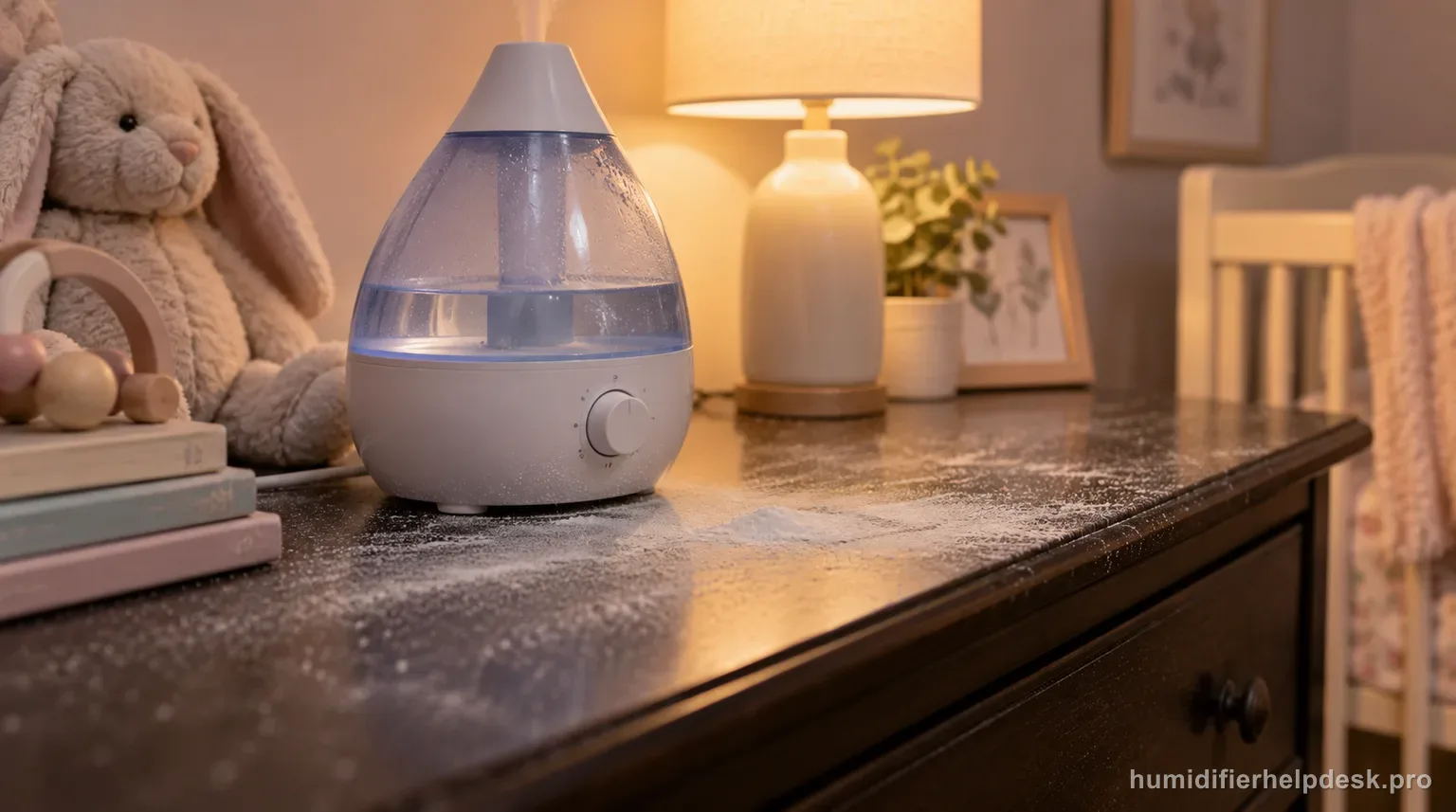
White dust from the HUL430 is a hard-water mineral issue, not evidence that the humidifier is defective. Honeywell recommends lowering the mineral load in the fill water and keeping the nebulizer descaled.
Does this match what you are seeing?
Owners describe this Honeywell HUL430 Designer Series problem in a few different ways. If one of these sounds like yours, this guide covers it:
- White dust
- Leaving white powder
- Mineral dust on furniture
- White residue after misting
Check these in order
- Compare residue when using a lower-mineral water mix; Honeywell specifically suggests distilled water mixed with tap water.
- Inspect the reservoir and nebulizer for mineral scale.
- Use the HUL430 vinegar scale-removal procedure when deposits are present.
- Do not put essential oils, inhalants, or other additives in the water tank.
Diagnostic decision path
Honeywell is explicit that HUL430 white dust is caused by minerals in the water, not by a defect in the humidifier. Because this is an ultrasonic model, those dissolved minerals can leave the water with the mist and settle on nearby surfaces. The highest-value test is therefore a water-mineral change, paired with descaling if the nebulizer already has deposits.
- Confirm the residue is a light mineral film near the humidifier rather than smoke, soot, or another room contaminant.
- Inspect the reservoir and nebulizer for visible mineral scale.
- Keep oils and other additives out of the water tank; the HUL430 has a separate essential-oil tray.
If: White dust is worst when using hard tap water
What it means: This matches the documented Honeywell mineral explanation.
Do next: Reduce the mineral load; Honeywell specifically suggests using distilled water mixed with tap water.
If: White dust is present and the nebulizer or reservoir also has scale
What it means: The same mineral load is affecting both room residue and the mist-producing surfaces.
Do next: Unplug and use the official HUL430 2-cup vinegar and 20-minute scale-removal process, then rinse completely.
If: Dust drops sharply after changing the fill-water mineral level
What it means: That controlled comparison confirms water hardness as the dominant variable.
Do next: Keep using the lower-mineral water approach and maintain a cleaning interval that prevents visible scale.
If: Someone has been adding essential oil or another product directly to the tank
What it means: That is outside the manual and can create residue or damage that white-dust guidance does not cover.
Do next: Stop adding products to tank water, rinse the water path, and use only the separate oil tray for compatible oils.
If: A similar residue persists even with lower-mineral water and a clean HUL430
What it means: The main documented humidifier variable has been removed.
Do next: Recheck whether the residue has another room source before assuming an internal HUL430 fault.
How to interpret the retest
Anchor this branch to one observation. After “Compare residue when using a lower-mineral water mix; Honeywell specifically suggests distilled water mixed with tap water”, does the Honeywell HUL430 Designer Series show “White dust is worst when using hard tap water”? If it does, the manual-supported interpretation is “This matches the documented Honeywell mineral explanation”, so the next move is “Reduce the mineral load; Honeywell specifically suggests using distilled water mixed with tap water”. If not, skip the action tied to that Honeywell HUL430 Designer Series possibility; record that it did not match the white dust or mineral residue complaint and test the next documented condition.
The next useful observation is “White dust is present and the nebulizer or reservoir also has scale” rather than changing several settings at once. If the Honeywell HUL430 Designer Series matches that observation, use the interpretation “The same mineral load is affecting both room residue and the mist-producing surfaces” and follow with “Unplug and use the official HUL430 2-cup vinegar and 20-minute scale-removal process, then rinse completely”. First, check “Inspect the reservoir and nebulizer for mineral scale”. If the state does not appear again, keep that result and continue with the next documented possibility for white dust or mineral residue on the Honeywell HUL430 Designer Series.
Model-specific context that changes the diagnosis
Two Honeywell HUL430 Designer Series clues that point to different fixes
Keep these first two states separate because they call for different actions. When “White dust is worst when using hard tap water” is true, the Honeywell HUL430 Designer Series path points to “This matches the documented Honeywell mineral explanation”; use “Reduce the mineral load; Honeywell specifically suggests using distilled water mixed with tap water”. When “White dust is present and the nebulizer or reservoir also has scale” is the better match, the path changes to “The same mineral load is affecting both room residue and the mist-producing surfaces”, so use “Unplug and use the official HUL430 2-cup vinegar and 20-minute scale-removal process, then rinse completely”. Retest one explanation before trying the action tied to the other.
Retest white dust or mineral residue after each correction
For the cleanest comparison, use “Compare residue when using a lower-mineral water mix; Honeywell specifically suggests distilled water mixed with tap water” as the first Honeywell HUL430 Designer Series check. Retest before going to “Inspect the reservoir and nebulizer for mineral scale”, and reach “Use the HUL430 vinegar scale-removal procedure when deposits are present” only if the earlier result is unchanged. For the Honeywell HUL430 Designer Series, the goal is to learn which single documented condition affects the white dust or mineral residue complaint while unrelated settings stay steady long enough to judge the result.
Common mistakes that make this harder to diagnose
- Treating white dust as proof the ultrasonic transducer is failing.
- Using stronger chemicals in operating water to try to bind minerals.
- Cleaning room surfaces but leaving heavy scale on the nebulizer.
- Putting essential oils into tank water instead of the dedicated tray.
The white-dust complaint is resolved when room residue falls after lowering fill-water minerals and removing internal scale. If the residue persists with a clean unit and lower-mineral water, investigate another environmental source rather than opening the humidifier.
Questions people ask about this exact symptom
Why is my Honeywell HUL430 Designer Series leaving white dust?
White dust on the HUL430 points to minerals in the fill water, not automatically to a failed humidifier. Honeywell recommends reducing mineral content in the water and keeping the nebulizer descaled. Try a lower-mineral water mix, including distilled water mixed with tap water as Honeywell suggests, then inspect and clean mineral scale if residue continues.
What should I check first if my Honeywell HUL430 Designer Series leaves white dust?
Start with “Compare residue when using a lower-mineral water mix; Honeywell specifically suggests distilled water mixed with tap water”. If the Honeywell HUL430 Designer Series behaves the same, move to “Inspect the reservoir and nebulizer for mineral scale”; use “Use the HUL430 vinegar scale-removal procedure when deposits are present” only after judging that result.
When should I contact Honeywell about this Honeywell HUL430 Designer Series problem?
Escalate the Honeywell HUL430 Designer Series to Honeywell if the documented checks do not resolve white dust or mineral residue. When you contact support about white dust or mineral residue on the Honeywell HUL430 Designer Series, report the last condition you tested, what changed, and what stayed the same; do not guess at an internal part.
Why this path is model-specific
Honeywell explains that ultrasonic HUL430 white dust comes from minerals suspended in hard water and says it is not a product defect; its HUL430 cleaning procedure removes mineral buildup from the nebulizer and reservoir.
For the Honeywell HUL430 Designer Series, the machine type matters: it is ultrasonic. Visible mist is part of normal output when mist production is active, so a true no-mist complaint deserves model-specific troubleshooting.
This symptom appears on other humidifiers too, but the meaning and reset path can change by technology, sensor logic, and control layout. Use the exact model source above before borrowing a fix from a neighboring model.
Compare this symptom across verified models
If you are still deciding whether this behavior is normal or model-specific, use the symptom hub to compare only manufacturer-linked guides. Keep the Honeywell HUL430 Designer Series instructions above as the controlling path for this machine.
If the problem is still there
If the checks above do not change the symptom, use the manufacturer support path for this exact model. We intentionally stop before undocumented resets, sensor bypasses, internal mains work, or parts replacement that the consumer manual does not authorize.
What we do not recommend
Do not defeat a float, water-level sensor, overheat protection, interlock, or other safety feature. Do not open mains-powered sections for live testing. If the unit smells burned, becomes abnormally hot, smokes, sparks, has water near electrical parts, or repeatedly trips a circuit, stop using it and keep clear. Unplug it only if the plug, outlet, and surrounding area are dry and safe to reach; otherwise do not touch wet equipment and contact manufacturer support for next steps.
Primary source for this diagnosis
Source checked during the September 3, 2026 editorial review. Manufacturer documents can change; a material re-review updates this guide’s reviewed date rather than stamping unrelated pages.