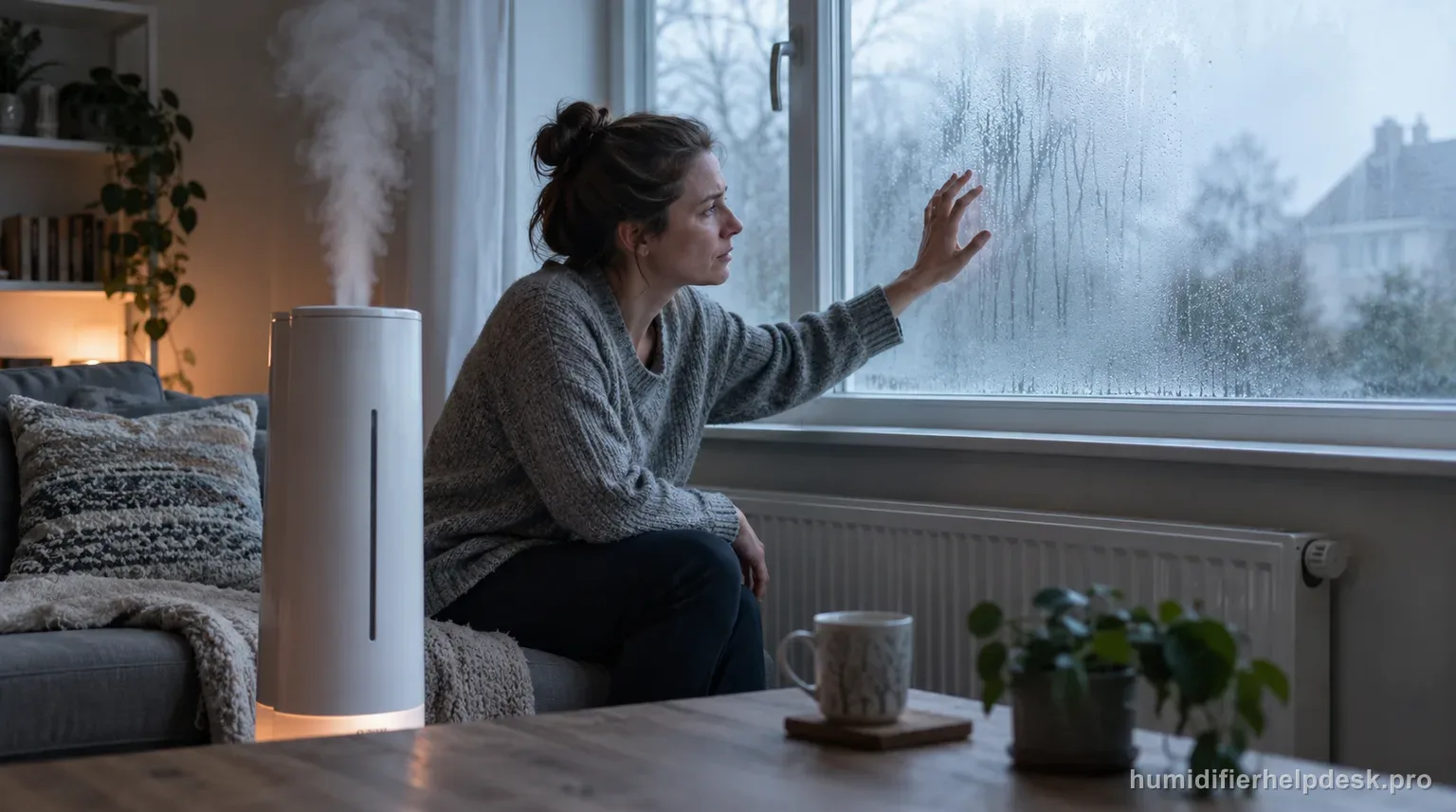
Condensation around an HWM845 usually means the warm-mist output is too high for the room size or the humidity already present. Honeywell says to lower or turn off output and open the room door if the space is becoming saturated.
Does this match what you are seeing?
Owners describe this Honeywell HWM845 Soothing Comfort problem in a few different ways. If one of these sounds like yours, this guide covers it:
- Condensation around humidifier
- Making floor or furniture wet
- Mist collecting on surfaces
- Room too damp when running
Check these in order
- If walls or windows are wet, turn the HWM845 off or reduce output to Low.
- Open the room door if moisture is building in a closed space.
- Keep the unit on a firm, level, water-resistant surface at least 12 inches from walls and direct steam away from walls, bedding, and furniture.
- Use a humidity monitor if useful; Honeywell describes about 40–60% RH as a comfortable indoor range.
- If a localized puddle keeps forming at the tank/base after room humidity is reduced, switch to the reservoir-overflow path.
Diagnostic decision path
Condensation is a humidity-control problem before it is a leak diagnosis on the HWM845. Honeywell directly says window/unit condensation can occur when mist intensity is too high for the room size or the humidity already present. The operating and safety sections add placement and room-saturation rules that make the retest much more useful than simply wiping up water.
- Dry nearby surfaces so old condensation does not look like a fresh tank leak.
- Keep the HWM845 on a firm, level, water-resistant surface at least 12 inches from walls with steam aimed away from walls, bedding, and furniture.
- Do not leave the warm-mist unit unattended in a closed room that is becoming saturated.
If: Windows or walls condense while the HWM845 is on High
What it means: The room is receiving more moisture than it can absorb at the current setting.
Do next: Turn the humidifier off or reduce output to Low and let room humidity fall.
If: Moisture builds primarily in a closed bedroom or small space
What it means: Limited air exchange can raise humidity even when the humidifier itself is operating normally.
Do next: Open the room door as Honeywell recommends and monitor room humidity before resuming a higher output.
If: Steam is directed toward a wall, window, bedding, or furniture
What it means: Local wetting can happen before moisture disperses through the room.
Do next: Reposition the unit while maintaining the 12-inch wall clearance and hot-steam child/pet safety zone.
If: A humidity monitor is around the documented 40–60% comfort range and surfaces stay dry on Low
What it means: The original symptom was over-humidification rather than reservoir leakage.
Do next: Keep the lower output/run time and adjust to room conditions rather than maximizing steam.
If: A localized puddle keeps reforming at the tank/base after humidity is reduced
What it means: That pattern no longer matches ordinary room condensation well.
Do next: Turn off, unplug, cool the unit, and use the HWM845 reservoir-overflow path for tank/cap/Water Tray checks.
How to interpret the retest
Start from a concrete state. After “If walls or windows are wet, turn the HWM845 off or reduce output to Low”, does the Honeywell HWM845 Soothing Comfort show “Windows or walls condense while the HWM845 is on High”? A yes points to the documented interpretation “The room is receiving more moisture than it can absorb at the current setting”, so the next move is “Turn the humidifier off or reduce output to Low and let room humidity fall”. A non-match means you should not apply the action from that Honeywell HWM845 Soothing Comfort possibility; record that it did not match the condensation or damp room complaint and test the next documented condition.
For the follow-up check, focus on “Moisture builds primarily in a closed bedroom or small space” rather than changing several settings at once. If the Honeywell HWM845 Soothing Comfort matches that observation, use the interpretation “Limited air exchange can raise humidity even when the humidifier itself is operating normally” and follow with “Open the room door as Honeywell recommends and monitor room humidity before resuming a higher output”. First, check “Open the room door if moisture is building in a closed space”. If the state does not appear again, keep that result and continue with the next documented possibility for condensation or damp room on the Honeywell HWM845 Soothing Comfort.
Model-specific context that changes the diagnosis
Separate the first two Honeywell HWM845 Soothing Comfort causes
Start with what the unit actually does, not with an internal-part theory. On the Honeywell HWM845 Soothing Comfort, “Windows or walls condense while the HWM845 is on High” supports the interpretation “The room is receiving more moisture than it can absorb at the current setting” and leads to “Turn the humidifier off or reduce output to Low and let room humidity fall”. “Moisture builds primarily in a closed bedroom or small space” supports “Limited air exchange can raise humidity even when the humidifier itself is operating normally” and leads to “Open the room door as Honeywell recommends and monitor room humidity before resuming a higher output”. For the current Honeywell HWM845 Soothing Comfort condensation or damp room complaint, choose the state you can actually reproduce and work from that result.
Run the Honeywell HWM845 Soothing Comfort checks in order
Make one documented correction, retest, and only then continue. Start with “If walls or windows are wet, turn the HWM845 off or reduce output to Low” and retest the Honeywell HWM845 Soothing Comfort. If the condensation or damp room complaint is unchanged, move to “Open the room door if moisture is building in a closed space”. Use “Keep the unit on a firm, level, water-resistant surface at least 12 inches from walls and direct steam away from walls, bedding, and furniture” only after judging the earlier result. Change only one thing at a time during this Honeywell HWM845 Soothing Comfort condensation or damp room retest so the result stays clear.
Common mistakes that make this harder to diagnose
- Increasing output because the room feels dry while windows are already visibly wet.
- Placing the unit close to a wall despite Honeywell’s 12-inch clearance and hot-steam guidance.
- Calling every puddle a tank leak without comparing room humidity and the first wet location.
- Treating 40–60% as a medical target rather than Honeywell’s comfort-range context for this product.
The condensation complaint is resolved when walls/windows stay dry at an appropriate Low/Off duty cycle, steam disperses into open room air, and humidity is kept around the intended comfort range. Persistent localized tank/base water after humidity is controlled belongs to the overflow/leak path.
Questions people ask about this exact symptom
Why is my Honeywell HWM845 Soothing Comfort causing condensation or dampness?
For the Honeywell HWM845 Soothing Comfort, condensation around an HWM845 usually means the warm-mist output is too high for the room size or the humidity already present; Honeywell says to lower or turn off output and open the room door if the space is becoming saturated.
What should I check first if my Honeywell HWM845 Soothing Comfort causes condensation or dampness?
Work through the checks in order: “If walls or windows are wet, turn the HWM845 off or reduce output to Low”, then “Open the room door if moisture is building in a closed space”, then “Keep the unit on a firm, level, water-resistant surface at least 12 inches from walls and direct steam away from walls, bedding, and furniture”.
When should I contact Honeywell about this Honeywell HWM845 Soothing Comfort problem?
Escalate the Honeywell HWM845 Soothing Comfort to Honeywell if the documented checks do not resolve condensation or damp room. When you contact support about condensation or damp room on the Honeywell HWM845 Soothing Comfort, report the last condition you tested, what changed, and what stayed the same; do not guess at an internal part.
Why this path is model-specific
The HWM845 troubleshooting table ties condensation to output that is too high for the room size or pre-existing humidity. Its operating/safety sections recommend lowering/off, opening a saturated room, 12-inch wall clearance, and a 40–60% comfort-humidity reference.
For the Honeywell HWM845 Soothing Comfort, the machine type matters: it is warm-mist. Visible steam is part of normal Honeywell HWM845 Soothing Comfort output after warm-up, so a true no-steam complaint needs the model-specific heater, water, scale, and reset path.
This symptom appears on other humidifiers too, but the meaning and reset path can change by technology, sensor logic, and control layout. Use the exact model source above before borrowing a fix from a neighboring model.
Compare this symptom across verified models
If you are still deciding whether this behavior is normal or model-specific, use the symptom hub to compare only manufacturer-linked guides. Keep the Honeywell HWM845 Soothing Comfort instructions above as the controlling path for this machine.
If the problem is still there
If the checks above do not change the symptom, use the manufacturer support path for this exact model. We intentionally stop before undocumented resets, sensor bypasses, internal mains work, or parts replacement that the consumer manual does not authorize.
What we do not recommend
Do not defeat a float, water-level sensor, overheat protection, interlock, or other safety feature. Do not open mains-powered sections for live testing. If the unit smells burned, becomes abnormally hot, smokes, sparks, has water near electrical parts, or repeatedly trips a circuit, stop using it and keep clear. Unplug it only if the plug, outlet, and surrounding area are dry and safe to reach; otherwise do not touch wet equipment and contact manufacturer support for next steps.
Primary source for this diagnosis
Source checked during the September 3, 2026 editorial review. Manufacturer documents can change; a material re-review updates this guide’s reviewed date rather than stamping unrelated pages.