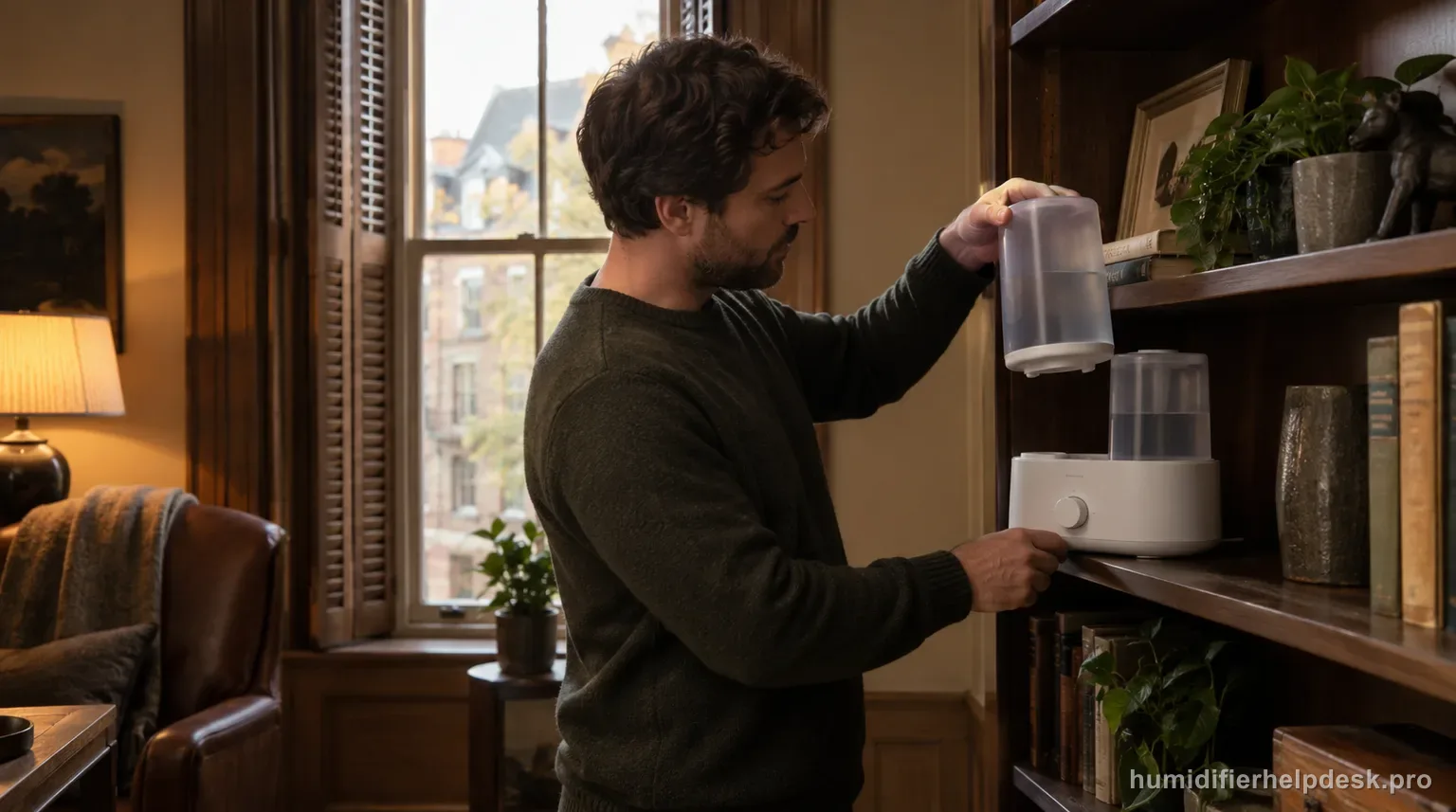
On the Dual 150, turn the mist knob higher and then check the water path before assuming the ultrasonic element failed. The manual separates an empty tank from excess water in the base chamber, and also calls out a blocked bottom air inlet, nozzle obstruction, an unlevel surface, very cold water, detergent residue, and a dirty water filter assembly.
Does this match what you are seeing?
Owners describe this Levoit Dual 150 problem in a few different ways. If one of these sounds like yours, this guide covers it:
- Not misting
- Not producing mist
- Stopped making mist
- Has power but no mist
Check these in order
- Turn the mist control to a clearly higher setting and observe whether output changes.
- Fill the tank if needed, seat it squarely, and do not pour water directly into the base chamber.
- If the base contains excess water, empty the base and let a correctly seated tank refill it normally.
- Keep the bottom air inlet clear and test on a hard, level surface rather than carpet or soft fabric.
- Check the nozzle and water filter assembly for obvious buildup; clean or replace only the user-serviceable filter as documented.
- If the problem began after cleaning, rinse away detergent residue; if the fill water is very cold, allow a short run on high before judging output.
Diagnostic decision path
A Dual 150 no-mist complaint is easiest to diagnose when the rotary control, water supply, airflow, and cleaning history are tested in that order. This is a simple non-smart humidifier, so there is no Auto Mode or app target to explain a missing plume. If turning the knob higher does not change output, the manual keeps the investigation outside the powered base: tank and base water levels, the lower air inlet, nozzle, level placement, water temperature, detergent residue, and the user-serviceable water filter assembly.
- Unplug before moving the tank or base, then put the humidifier on a hard, flat, level, water-resistant surface with the lower air inlet unobstructed.
- Use clean room-temperature water for the controlled test and fill only through the tank. Never pour water into the base chamber or mist tube.
- Note whether the refill indicator is on. A persistent refill light with water present has its own seating/filter path and should not be mixed into a generic no-mist diagnosis.
If: Mist increases when the control knob is turned higher
What it means: The transducer can create output and the original complaint was at least partly a low setting rather than complete mist failure.
Do next: Keep the unit stationary and adjust only enough output for the room. Do not continue into disassembly or unnecessary descaling if normal mist has returned.
If: The tank has water but the base chamber contains too much water
What it means: The tank can look full while the transducer area is in the wrong water condition. The manual treats excess base water as a separate no-mist cause.
Do next: Unplug, empty the base chamber, reseat the filled tank, and let the tank meter water back into the base normally before retesting.
If: Output remains weak with the bottom air inlet partly covered
What it means: The fan cannot move mist normally when the lower intake is restricted. Carpet and soft fabric are especially poor test surfaces.
Do next: Move the unit to a hard level surface, clear the inlet and nozzle, and repeat the same knob setting before changing the water or cleaning anything else.
If: Mist is weak immediately after a very cold refill but improves with time
What it means: Low water temperature fits the manual troubleshooting row and does not by itself prove a failed mist maker.
Do next: Do not add hot water. Let the humidifier run at a higher setting for a short period and reassess once the water path has stabilized.
If: The problem appeared after washing or the water filter assembly is visibly loaded with buildup
What it means: Cleaning residue or a restricted user-serviceable filter can reduce output even when tank level and airflow look normal.
Do next: Rinse the tank and base water path until detergent residue is gone, then clean or replace the documented water filter assembly and retest.
How to interpret the retest
Do not use sound alone as a transducer test. A faint operating sound does not prove that water level, airflow, and nozzle conditions are correct, and a quiet unit is not permission to open the powered base.
The manual separates excess water in the base from an empty tank. Adding more water directly to the base can therefore make the diagnostic state worse instead of helping a full tank feed correctly.
A nozzle obstruction and an air-inlet obstruction affect different parts of the airflow path. Check both externally rather than assuming that seeing an open top nozzle means the intake underneath is clear.
If mineral scale is visible, clean according to the manual, but do not make descaling the first answer for every no-mist event. A knob setting, empty tank, excess base water, blocked inlet, or detergent residue can create the same search symptom.
A stable one-variable retest is more informative than a reset-style routine. Keep the surface, tank seating, and mist setting constant after correcting one suspected cause so the change in output has a clear explanation.
Model-specific context that changes the diagnosis
Why this page is narrower than a generic ultrasonic checklist
The Dual 150 manual gives a concrete little-or-no-mist row, so the checks here stay within that row instead of importing app resets, humidity-sensor calibration, warm-mist heater checks, or other features this model does not have. Keeping the diagnosis tied to the exact symptom also makes it easier to know when the documented owner-level path has actually been exhausted.
Water filter service is a documented owner step
The Dual 150 ships with a water filter sponge/assembly and the troubleshooting table includes cleaning or replacing that filter for weak or missing mist. That does not authorize opening the base or removing the water-level sensor. Keep service limited to the tank, base chamber surfaces, nozzle, and documented filter assembly that the owner can access.
What to record before support
If mist still does not return, write down whether the knob was on a high setting, whether the refill light was on, whether excess water was found in the base, whether the inlet/nozzle were clear, and whether the filter or recent cleaning changed the result. Those observations are more useful than saying only that the machine “does not work.”
Common mistakes that make this harder to diagnose
- Pouring water directly into the base chamber because the tank looks full but mist is absent.
- Testing on carpet or a towel that blocks the lower air inlet and creates an artificial low-output condition.
- Cleaning several parts, changing the water, and changing the mist setting at once, then being unable to identify which correction mattered.
- Opening the powered base or trying to service the transducer after the manual’s external checks are exhausted.
The no-mist complaint is resolved when the Dual 150 produces stable visible mist at the selected knob position after one of the documented external corrections and continues to do so with the tank seated normally on a hard level surface. If high output remains absent after water level, excess base water, inlet/nozzle, placement, temperature, rinse, and filter checks, stop the owner-level diagnosis and use Levoit support rather than opening the base.
Questions people ask about this exact symptom
Why is my Levoit Dual 150 full of water but not making mist?
A full tank does not prove the base water path is correct. The Dual 150 manual also lists too much water in the base chamber, a blocked bottom air inlet or nozzle, an unlevel surface, cold water, detergent residue, and the water filter assembly. Test a higher mist setting first, then work through those external checks one at a time.
Can I pour water into the Dual 150 base to make it start misting?
No. Refill the water tank through the intended top-fill path and let a correctly seated tank supply the base. The manual specifically treats excess water in the base chamber as a little-or-no-mist cause. Adding water directly to the base can create the wrong water level and make the diagnosis less clear rather than restoring normal output.
When should I stop troubleshooting a Dual 150 with no mist?
Stop after a high mist setting still gives little or no output following the documented tank/base water, airflow, nozzle, level, water-temperature, rinse, and filter checks. Stop sooner for overheating, burning odor, sparking, or water near electrical parts. Do not open the powered base, remove the water-level sensor, or attempt transducer repair as a consumer step.
Why this path is model-specific
The Dual 150 manual lists mist setting, tank water, excess base water, air-inlet or nozzle obstruction, level placement, low water temperature, detergent residue, and the water filter assembly under little-or-no-mist troubleshooting. It does not direct owners to open the powered base or service the transducer internally.
For the Levoit Dual 150, the machine type matters: it is ultrasonic. Visible mist is part of normal output when mist production is active, so a true no-mist complaint deserves model-specific troubleshooting.
This symptom appears on other humidifiers too, but the meaning and reset path can change by technology, sensor logic, and control layout. Use the exact model source above before borrowing a fix from a neighboring model.
Compare this symptom across verified models
If you are still deciding whether this behavior is normal or model-specific, use the symptom hub to compare only manufacturer-linked guides. Keep the Levoit Dual 150 instructions above as the controlling path for this machine.
If the problem is still there
If the checks above do not change the symptom, use the manufacturer support path for this exact model. We intentionally stop before undocumented resets, sensor bypasses, internal mains work, or parts replacement that the consumer manual does not authorize.
What we do not recommend
Do not defeat a float, water-level sensor, overheat protection, interlock, or other safety feature. Do not open mains-powered sections for live testing. If the unit smells burned, becomes abnormally hot, smokes, sparks, has water near electrical parts, or repeatedly trips a circuit, stop using it and keep clear. Unplug it only if the plug, outlet, and surrounding area are dry and safe to reach; otherwise do not touch wet equipment and contact manufacturer support for next steps.
Primary source for this diagnosis
Source checked during the September 4, 2026 editorial review. Manufacturer documents can change; a material re-review updates this guide’s reviewed date rather than stamping unrelated pages.