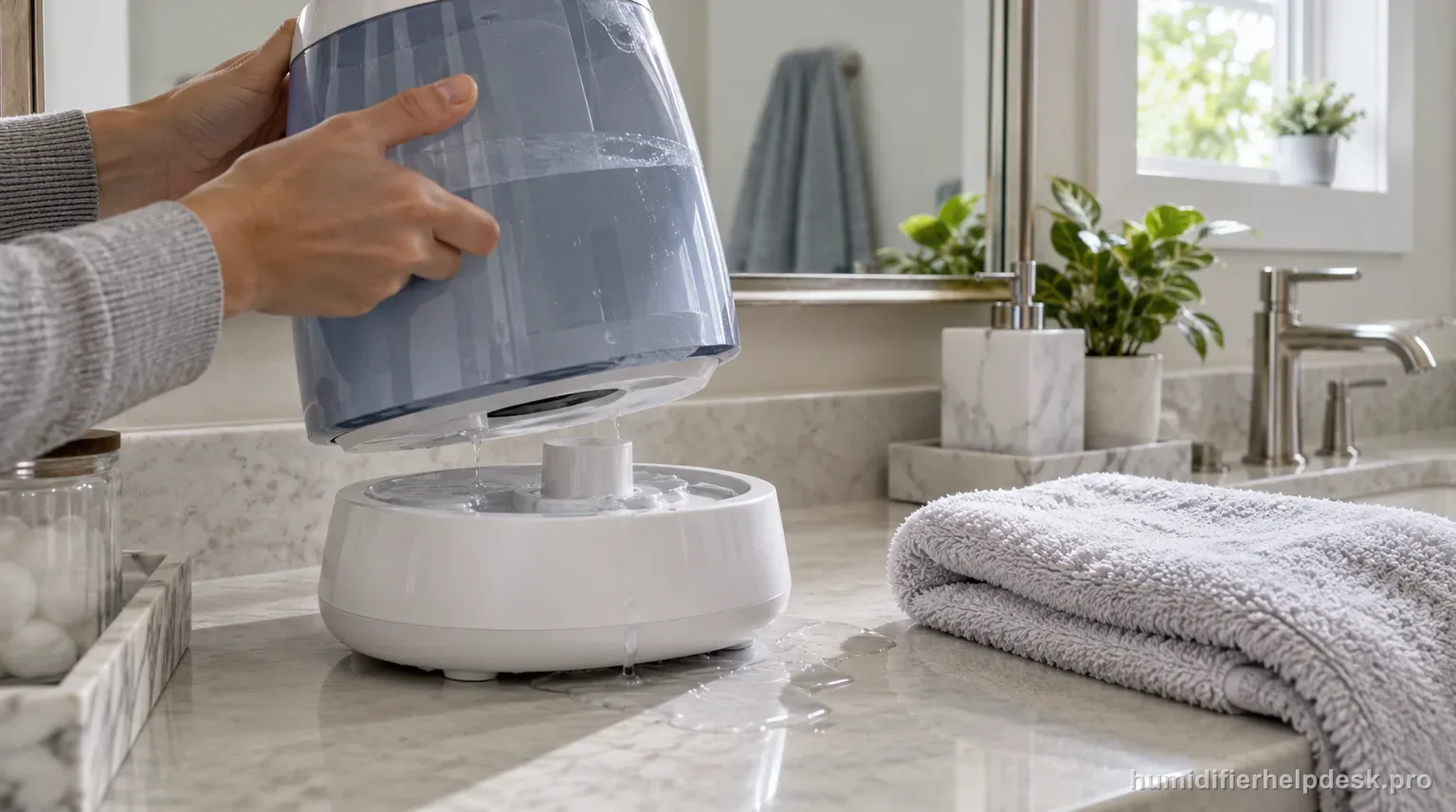
For a V750 reservoir overflow, Vicks narrows the first diagnosis to the water tank and tank cap: the tank may be leaking or the cap may not be tight. Dry the unit first and trace fresh water before assuming an internal housing leak.
Does this match what you are seeing?
Owners describe this Vicks V750 Warm Mist problem in a few different ways. If one of these sounds like yours, this guide covers it:
- Leaking water
- Water under the base
- Humidifier leaking from bottom
- Reservoir leaking or overflowing
Check these in order
- Turn the V750 off, unplug it, allow it to cool, and dry the tank/base area before tracing fresh water.
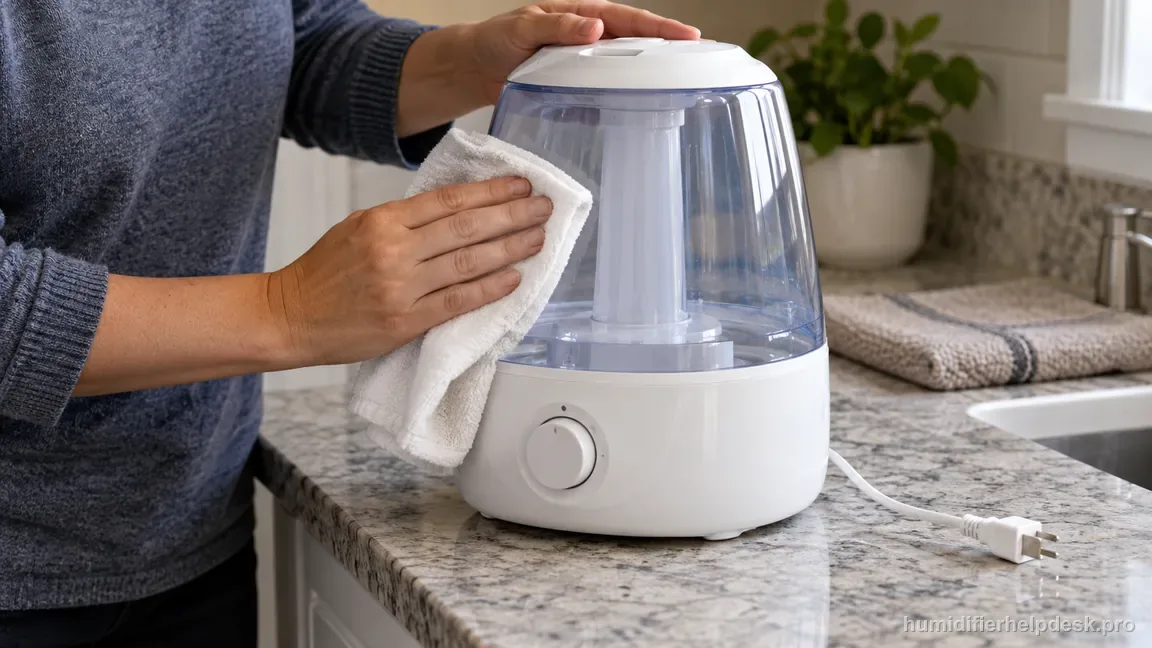
Illustrative: Turn the unit off, unplug it, let hot parts cool, and dry the tank and base before tracing a fresh leak. - Inspect the water tank for cracks, seam damage, or an active leak.
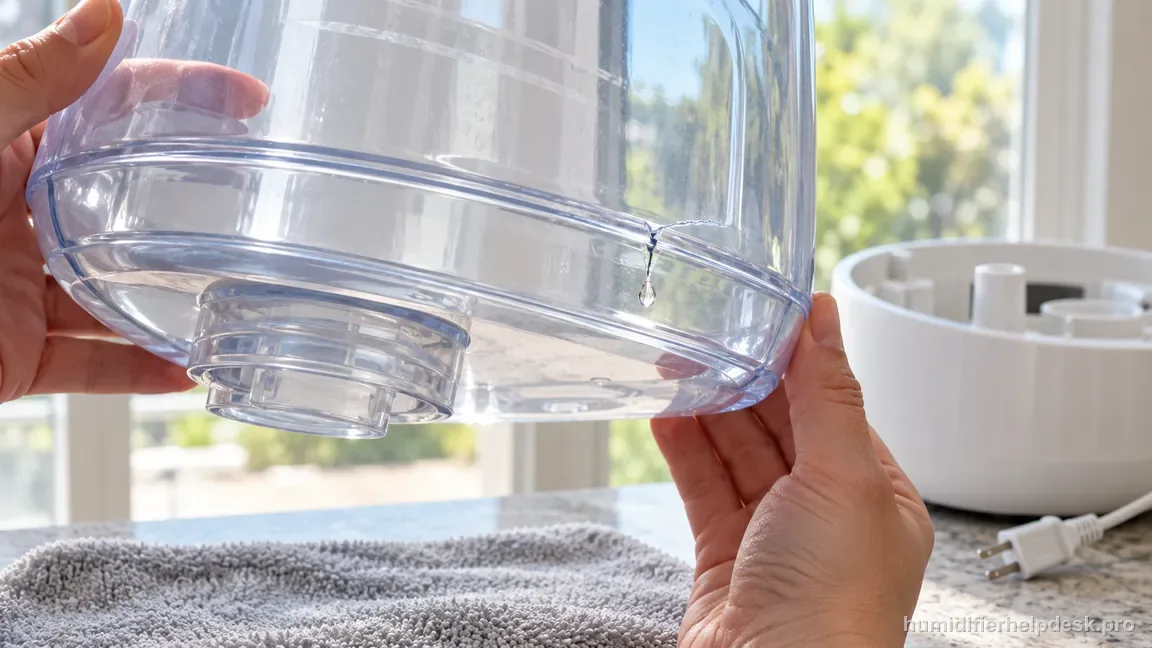
Illustrative: Inspect the tank for cracks, seam damage, or an active leak. - Remove and reinstall the tank cap so it is secure; the fill instructions specifically say not to over-tighten it.
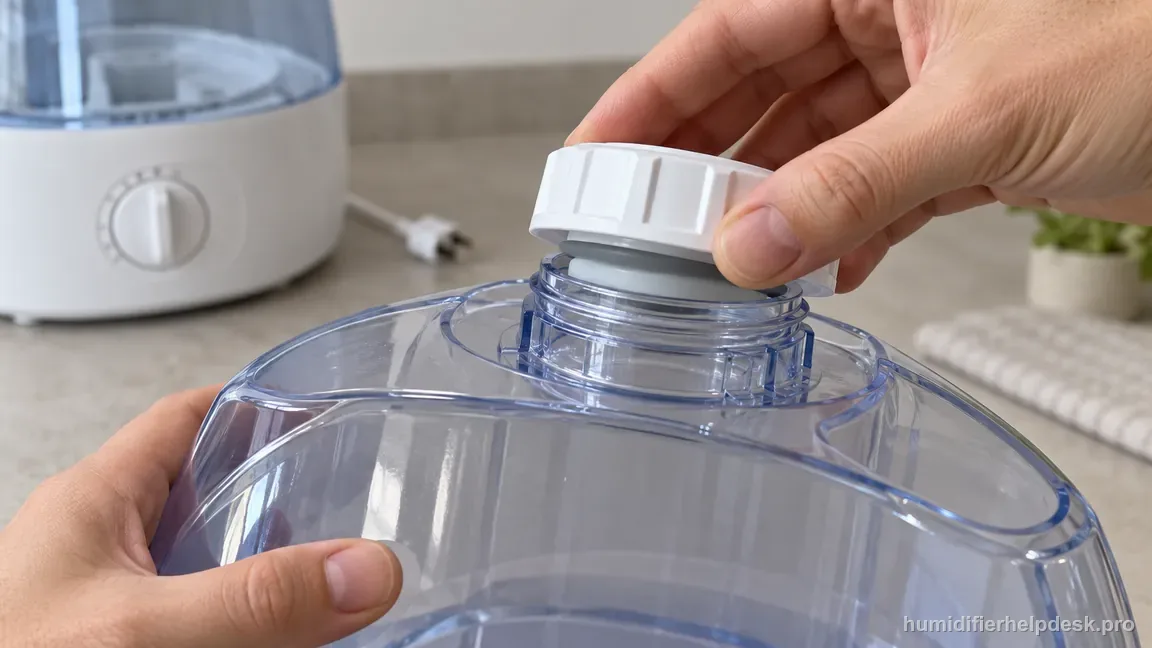
Illustrative: Reinstall the tank cap snugly and evenly; do not over-tighten it. - Place the tank back on the base and watch for new water without tilting or moving the operating unit.
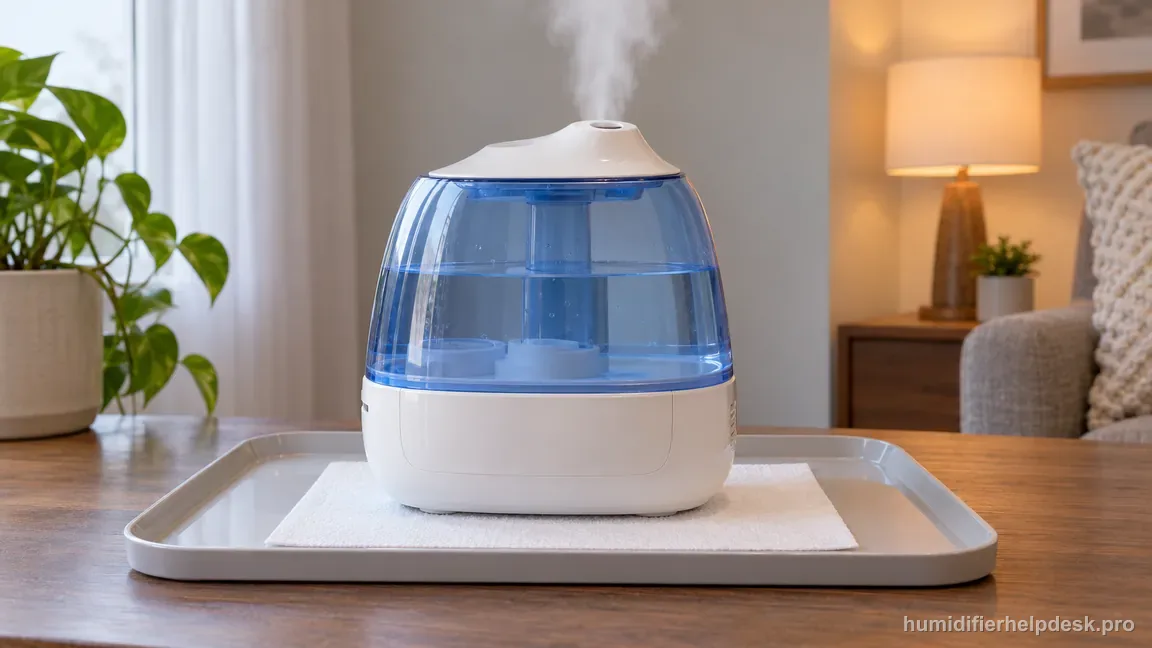
Illustrative: Watch for new water without tilting or moving the operating unit.
Diagnostic decision path
Vicks gives the V750 a much narrower reservoir-overflow tree than generic leak articles usually do: the tank may be leaking, or the Tank Cap may not be tight. Start by drying the unit and tracing fresh water from those two container paths. Because the base contains a heater and mains-powered parts, any water reaching the electrical side moves the issue out of DIY scope immediately.
- Turn the V750 off, unplug it, and if it was recently steaming wait 20–30 minutes before handling hot-side parts.
- Dry the tank, cap, base exterior, and surrounding surface so old spill water does not confuse the source trace.
- Keep the unit on a firm, flat, water-resistant surface and do not tilt or move it while operating.
If: Fresh water appears from a crack, seam, or damaged area of the Water Tank
What it means: The manual lists a leaking tank as a direct reservoir-overflow cause.
Do next: Stop using that tank and contact Vicks Consumer Relations for the correct replacement/support path.
If: Water appears around the Tank Cap and the cap is loose
What it means: A loose cap is the second documented overflow cause.
Do next: Remove the tank, reinstall the cap securely and evenly, but follow the fill instruction not to over-tighten it.
If: The tank and cap stay dry after reseating but water was already around the unit
What it means: The original moisture may have been a refill spill or room condensation rather than an active reservoir overflow.
Do next: Dry the area and run a short monitored test; if moisture forms on windows/walls instead of at the tank, move to the condensation path.
If: Water begins at the powered base/control area rather than the tank or cap
What it means: That does not fit the two user-level tank/cap causes and introduces electrical risk.
Do next: Unplug with dry hands if safe and keep the unit out of service; do not open the housing to find an internal leak.
If: The reservoir overflows again despite an intact tank and correctly fitted cap
What it means: The documented external leak checks are exhausted.
Do next: Contact Vicks Consumer Relations with model V750 instead of improvising a seal, valve repair, or housing disassembly.
How to interpret the retest
Use the next step as a controlled before-and-after comparison. Check “Turn the V750 off, unplug it, allow it to cool, and dry the tank/base area before tracing fresh water” on the Vicks V750 Warm Mist, then look specifically for “Fresh water appears from a crack, seam, or damaged area of the Water Tank”. A match supports the manual's interpretation “The manual lists a leaking tank as a direct reservoir-overflow cause” and sends you to “Stop using that tank and contact Vicks Consumer Relations for the correct replacement/support path”. If the observation is missing, that result narrows the Vicks V750 Warm Mist reservoir overflow or leaking water diagnosis without jumping to an unrelated reset.
Model-specific context that changes the diagnosis
Two Vicks V750 Warm Mist clues that point to different fixes
Do not merge these first two observations into one diagnosis. When “Fresh water appears from a crack, seam, or damaged area of the Water Tank” is true, the Vicks V750 Warm Mist path points to “The manual lists a leaking tank as a direct reservoir-overflow cause”; use “Stop using that tank and contact Vicks Consumer Relations for the correct replacement/support path”. When “Water appears around the Tank Cap and the cap is loose” is the better match, the path changes to “A loose cap is the second documented overflow cause”, so use “Remove the tank, reinstall the cap securely and evenly, but follow the fill instruction not to over-tighten it”. Retest one explanation before trying the action tied to the other.
Retest the Vicks V750 Warm Mist without changing multiple variables
Run the checks in order and judge each result before moving on. Test “Turn the V750 off, unplug it, allow it to cool, and dry the tank/base area before tracing fresh water” first, then inspect the Vicks V750 Warm Mist again. If the behavior persists, use “Inspect the water tank for cracks, seam damage, or an active leak”; save “Remove and reinstall the tank cap so it is secure; the fill instructions specifically say not to over-tighten it” for the next step. That order gives the Vicks V750 Warm Mist reservoir overflow or leaking water path a meaningful comparison instead of several changes with no clear cause.
Common mistakes that make this harder to diagnose
- Calling window condensation a tank leak without first drying and locating the first fresh water.
- Over-tightening the Tank Cap even though the V750 fill instructions explicitly say not to.
- Using tape, glue, or a generic seal on a damaged tank/cap instead of replacing the failed water-container part.
- Power-testing a V750 after water has reached the cord, plug, control area, or electrical housing.
The overflow is resolved when the intact tank and correctly fitted cap remain dry through a monitored refill/run and no new water enters the reservoir area abnormally. A cracked tank, repeated overflow with a correct cap, or any leak at the powered housing is a replacement/support boundary rather than an internal repair job.
Questions people ask about this exact symptom
Why is water collecting around my Vicks V750 Warm Mist?
Vicks lists two first causes for V750 reservoir overflow: a leaking tank or a tank cap that is not tight. Turn the unit off, unplug it, let it cool, and dry the area. Then inspect the tank for fresh leaks and tighten the cap. If water returns after those checks, stop using it and contact support.
What should I check first if my Vicks V750 Warm Mist is leaking or leaving water outside the unit?
Work through the checks in order: “Turn the V750 off, unplug it, allow it to cool, and dry the tank/base area before tracing fresh water”, then “Inspect the water tank for cracks, seam damage, or an active leak”, then “Remove and reinstall the tank cap so it is secure; the fill instructions specifically say not to over-tighten it”.
When should I contact Vicks about this Vicks V750 Warm Mist problem?
If the Vicks V750 Warm Mist still has the same problem after the manual-supported checks for reservoir overflow or leaking water, contact Vicks rather than disassembling the unit. Tell support what changed after the last reservoir overflow or leaking water check on the Vicks V750 Warm Mist, and do not bypass any protection or interlock.
Why this path is model-specific
The V750 troubleshooting table lists a leaking tank and a loose Tank Cap as the two causes of water overflowing from the reservoir. Its fill instructions say to screw the cap back in place without over-tightening, and its safety section prohibits owner electrical/mechanical repair.
For the Vicks V750 Warm Mist, the machine type matters: it is warm-mist. Visible steam is part of normal Vicks V750 Warm Mist output after warm-up, so a true no-steam complaint needs the model-specific heater, water, scale, and reset path.
Compare this symptom across verified models
If you are still deciding whether this behavior is normal or model-specific, use the symptom hub to compare only manufacturer-linked guides. Keep the Vicks V750 Warm Mist instructions above as the controlling path for this machine.
If the problem is still there
If the checks above do not change the symptom, use the manufacturer support path for this exact model. We intentionally stop before undocumented resets, sensor bypasses, internal mains work, or parts replacement that the consumer manual does not authorize.
What we do not recommend
Do not defeat a float, water-level sensor, overheat protection, interlock, or other safety feature. Do not open mains-powered sections for live testing. If the unit smells burned, becomes abnormally hot, smokes, sparks, has water near electrical parts, or repeatedly trips a circuit, stop using it and keep clear. Unplug it only if the plug, outlet, and surrounding area are dry and safe to reach; otherwise do not touch wet equipment and contact manufacturer support for next steps.
Primary source for this diagnosis
Source checked during the September 3, 2026 editorial review. Manufacturer documents can change; a material re-review updates this guide’s reviewed date rather than stamping unrelated pages.