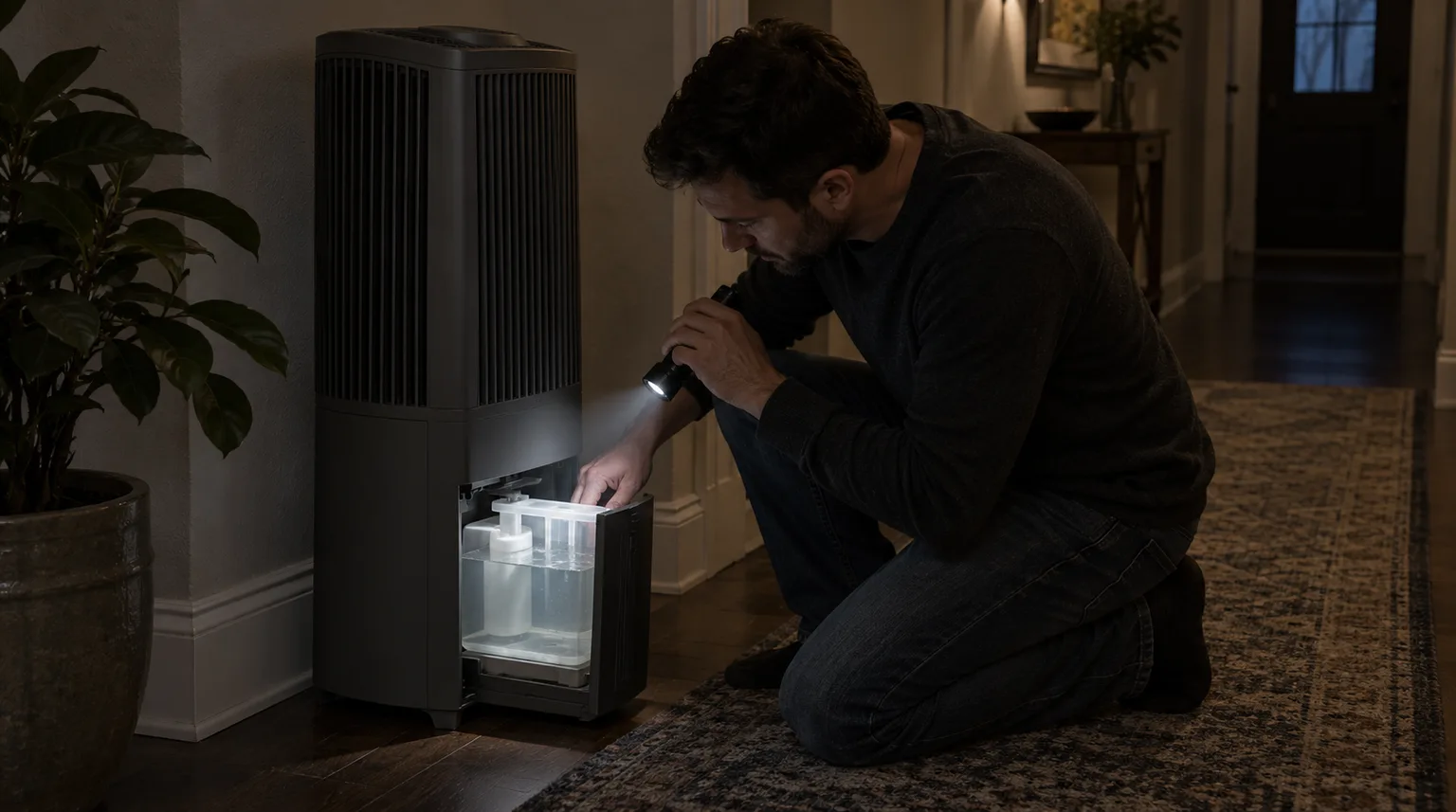
That is normal for the Pedestal EP-series. It is evaporative, so the 1043 wick and fan release invisible moisture rather than an ultrasonic fog plume.
Does this match what you are seeing?
Owners describe this AIRCARE EP9500 / EP9800 Pedestal problem in a few different ways. If one of these sounds like yours, this guide covers it:
- No visible mist
- Running but no mist
- Humidifier working but no fog
- Fan runs but I cannot see vapor
Check these in order
- Confirm the fan can run when humidity is below the target.
- Check that the 1043 SuperWick is wet and installed correctly.
- Judge performance by water use and room humidity—not by visible mist.
Diagnostic decision path
The EP9500/EP9800 Pedestal is evaporative, so a visible fog plume is not expected. The 1043 SuperWick absorbs water and the fan moves invisible water vapor into the room; the useful performance checks are fan operation, wick wetting, tank use, and room humidity.
- Do not use visible mist as the pass/fail test for this AIRCARE Pedestal.
- Confirm the 1043 SuperWick is installed and can wet through normally.
- Compare the room humidity with the selected target so normal humidistat cycling is not mistaken for low output.
If: There is no visible mist but the wick is wet, the fan runs, and water is being used
What it means: This matches normal evaporative operation.
Do next: Judge performance by room-humidity trend and comfort rather than visible vapor.
If: The fan is stopped because the room has reached the selected humidity
What it means: The humidistat is controlling the fan rather than the unit failing to make mist.
Do next: Allow humidity to fall or adjust the target if appropriate before testing again.
If: The wick stays dry or only partly wets
What it means: The issue is water transfer through the evaporative media, not invisible mist.
Do next: Check the wick's condition/installation and the float/water-level path.
If: The wick is wet and the fan runs but humidity remains low for an extended period
What it means: The unit may be operating but not delivering enough evaporation for the space or wick condition.
Do next: Increase output/fan as appropriate and inspect the 1043 wick for mineral hardening or replacement need.
How to interpret the retest
Set the expectation correctly before troubleshooting: the EP9500/EP9800 Pedestal is evaporative. The 1043 SuperWick releases moisture into fan airflow without an ultrasonic fog plume. No visible mist is therefore normal and should not trigger transducer cleaning or a search for a mist nozzle this model does not use.
Use the wick as the visible operating checkpoint. A serviceable 1043 should become wet as the unit receives water. If the wick stays dry, the useful problem is water transfer or filter condition; if it is wet and the fan runs, the absence of visible fog is not evidence of failure.
Track water consumption over a reasonable operating period in a dry room. Evaporative output removes water from the reservoir even though you cannot see the moisture leaving. A falling water level together with a wet wick and fan airflow is stronger proof of humidification than looking above the grille for vapor.
Account for the humidistat before calling the fan inactive. When room humidity reaches the selected target, fan cycling can be normal. Test again when the room is below target or raise output temporarily for diagnosis instead of assuming the unit stopped because it cannot produce moisture.
If the wick is wet and fan operation is normal but room humidity barely changes, inspect the 1043 for mineral hardening or replacement need and consider room load. That is a low-output question, not a no-visible-mist question. Keeping those intents separate makes the next action much clearer.
Resolve the concern when the Pedestal has a wet/serviceable wick, expected fan behavior, measurable water use, and a room-humidity trend consistent with evaporation. If those performance signs are absent, use the water-flow/wick/fan diagnostics; never borrow ultrasonic transducer advice because the EP-series is evaporative.
Model-specific context that changes the diagnosis
No visible plume is the correct technology behavior
The EP9500 and EP9800 are evaporative Pedestal models. Their fan moves air through a wet 1043 SuperWick, and the water enters the room as invisible vapor rather than a cloud of ultrasonic droplets. A search for a mist nozzle, nebulizer, or transducer is therefore a category error. The right evidence is wick wetness, airflow, water consumption, and humidity change.
Use water use as a practical output indicator
In a dry room, a working evaporative humidifier should gradually consume water as moisture leaves the wick. Mark the water level or note how much is added over a known period, then compare that with the room-humidity trend. A wet wick and falling water level support normal moisture transfer even though nothing visible comes out of the grille.
Humidistat cycling can stop the fan normally
The fan does not have to run continuously once the selected humidity is reached. If the unit cycles off near the target and restarts as the room dries, that is compatible with control logic. Test at a higher appropriate target or when the room is genuinely dry before deciding that a fan stop proves the humidifier has failed.
Move to low-output troubleshooting only when performance evidence is weak
If the wick is dry, water level never drops, the fan will not operate when humidity demand exists, or room RH does not improve over time, there is a real performance question. Then inspect wick condition, water feed, float installation, and fan behavior. Do not turn a normal no-visible-mist observation into ultrasonic cleaning advice the EP-series does not use.
Common mistakes that make this harder to diagnose
- Expecting an ultrasonic-style plume from an evaporative Pedestal.
- Calling normal humidistat fan cycling a no-mist failure.
- Ignoring whether the 1043 wick is actually wet.
- Replacing electronics before checking water use and wick condition.
The concern is resolved when the Pedestal has a wet, serviceable 1043 wick, appropriate fan operation, measurable water use, and a room-humidity trend consistent with evaporative output. Visible mist is not required.
Questions people ask about this exact symptom
AIRCARE EP9500/EP9800 fan is running but I see no mist—is that normal?
Yes. That is normal for these evaporative models. Moisture is carried into the room through airflow across the wet 1043 wick, so you should not expect an ultrasonic fog plume even when humidification is working correctly. Next, check “Confirm the fan can run when humidity is below the target” on the AIRCARE EP9500 / EP9800 Pedestal and note whether the symptom changes.
How can I tell whether it is humidifying if I cannot see mist?
Check that the wick becomes wet, the fan runs when humidity demand exists, water is being consumed, and the room-humidity reading trends upward over time. For the next AIRCARE EP9500 / EP9800 Pedestal check, use “Check that the 1043 SuperWick is wet and installed correctly” and note whether the symptom changes.
Does no visible mist mean the wick needs replacement?
Not by itself. Replace or service the wick when its condition or actual output is poor. Invisible moisture is normal even with a healthy new wick. Before escalating the AIRCARE EP9500 / EP9800 Pedestal, confirm “Judge performance by water use and room humidity—not by visible mist” and note the result.
Why this path is model-specific
AIRCARE identifies the EP9500/EP9800 Pedestal as evaporative and lists the 1043 SuperWick as the compatible wick.
For the AIRCARE EP9500 / EP9800 Pedestal, the machine type matters: it is evaporative. Its moisture output is not supposed to look like ultrasonic fog, so “I cannot see mist” by itself is not evidence of a failure.
This symptom appears on other humidifiers too, but the meaning and reset path can change by technology, sensor logic, and control layout. Use the exact model source above before borrowing a fix from a neighboring model.
Compare this symptom across verified models
If you are still deciding whether this behavior is normal or model-specific, use the symptom hub to compare only manufacturer-linked guides. Keep the AIRCARE EP9500 / EP9800 Pedestal instructions above as the controlling path for this machine.
If the problem is still there
If the checks above do not change the symptom, use the manufacturer support path for this exact model. We intentionally stop before undocumented resets, sensor bypasses, internal mains work, or parts replacement that the consumer manual does not authorize.
What we do not recommend
Do not defeat a float, water-level sensor, overheat protection, interlock, or other safety feature. Do not open mains-powered sections for live testing. If the unit smells burned, becomes abnormally hot, smokes, sparks, has water near electrical parts, or repeatedly trips a circuit, stop using it and keep clear. Unplug it only if the plug, outlet, and surrounding area are dry and safe to reach; otherwise do not touch wet equipment and contact manufacturer support for next steps.
Primary source for this diagnosis
Source checked during the September 4, 2026 editorial review. Manufacturer documents can change; a material re-review updates this guide’s reviewed date rather than stamping unrelated pages.