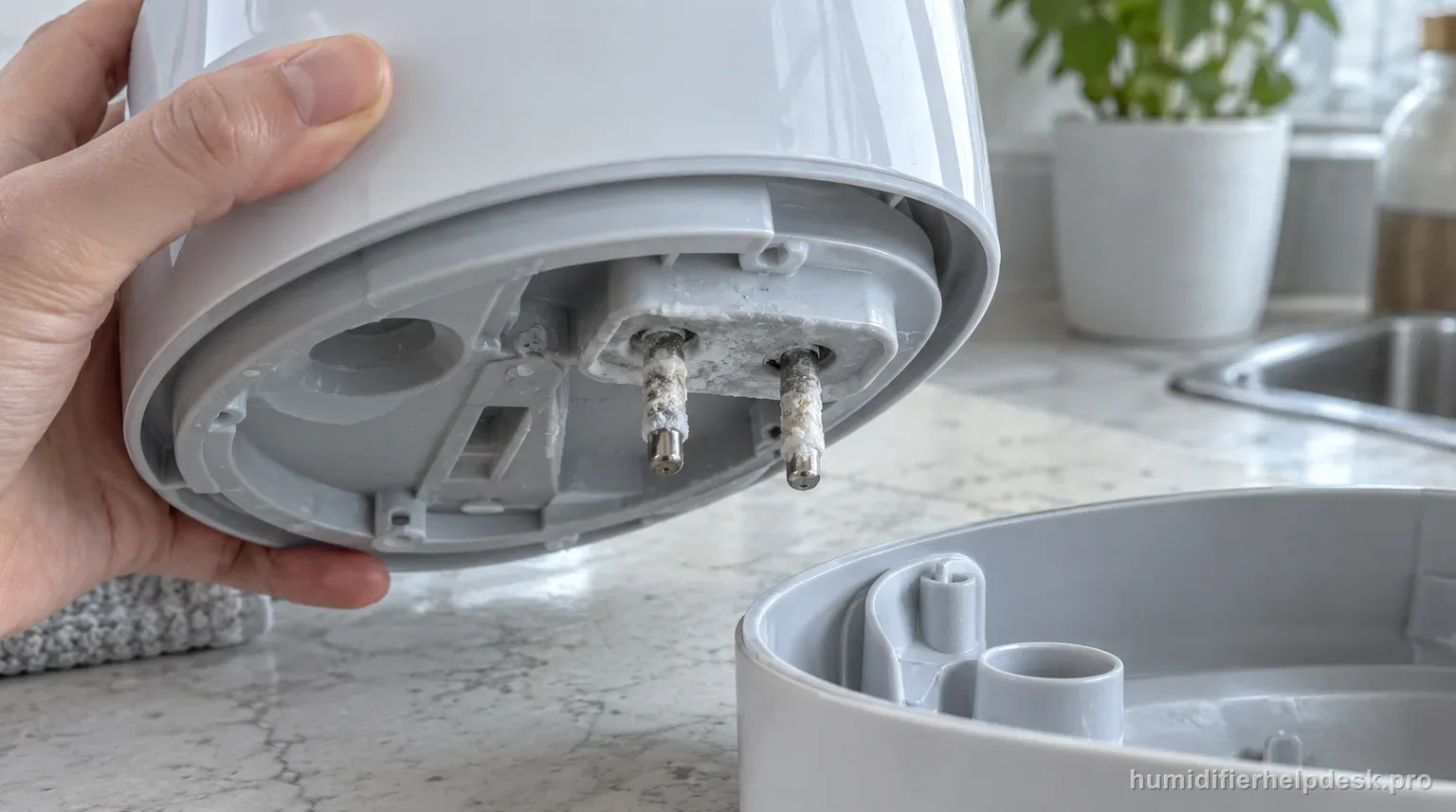
Calcium or iron buildup on the two water-sensing probes can cause sporadic operation. Clean the probes gently without opening the electrical body.
Does this match what you are seeing?
Owners describe this Canopy Bedside / Nursery Humidifier 2.0 problem in a few different ways. If one of these sounds like yours, this guide covers it:
- Water probes have scale
- Mineral buildup on water sensors
- Water sensor scale problem
- Probes dirty and water reading wrong
Check these in order
- Unplug the humidifier.
- Locate the two small metal water probes on the bottom of the unit.
- Wipe them gently with a damp washcloth or paper towel until mineral residue is removed.
- Reassemble and retest after the probes are dry and clean.
Diagnostic decision path
Canopy’s current Bedside/Nursery 2.0 cleaning guidance identifies the two water-sensing probes on the bottom of the unit as a user-cleanable point. Tap-water minerals can coat those probes and contribute to inconsistent water detection, but the fix stays entirely external.
- Unplug the humidifier and remove the water-holding parts so the bottom of the main body is accessible.
- Identify the two small metal water-sensing probes; do not confuse them with screws or electrical contacts inside the body.
- Use only a damp washcloth/paper towel for the probe surface unless Canopy publishes a different exact-model instruction.
If: A chalky calcium/iron film is visible on the probes
What it means: The water sensors may not be contacting water cleanly through the mineral layer.
Do next: Gently wipe the probe surfaces until visible residue is removed, then let the area dry before reassembly.
If: Operation becomes consistent after probe cleaning
What it means: Mineral buildup was interfering with water detection.
Do next: Keep the probes in the normal cleaning routine, especially if local tap water is hard.
If: The probes are already clean but water detection remains sporadic
What it means: The simple external scale explanation has been ruled out.
Do next: Check correct grill/spacer/tank assembly and use Canopy support if the behavior persists.
If: Someone proposes sanding, bending, bridging, or bypassing the probes
What it means: That would alter a water-detection component beyond Canopy’s cleaning guidance.
Do next: Do not modify the probes; keep troubleshooting to gentle external cleaning and normal assembly.
How to interpret the retest
This possibility becomes relevant when you can reproduce “A chalky calcium/iron film is visible on the probes”. For the Canopy Bedside / Nursery Humidifier 2.0, use “Unplug the humidifier” as the controlled test. If the same observation appears, the source meaning is “The water sensors may not be contacting water cleanly through the mineral layer” and the next action is “Gently wipe the probe surfaces until visible residue is removed, then let the area dry before reassembly”. If it does not appear, record the non-match and continue through the remaining Canopy Bedside / Nursery Humidifier 2.0 checks for water probes have scale.
For this branch, start with “Locate the two small metal water probes on the bottom of the unit”. On the retest, compare the Canopy Bedside / Nursery Humidifier 2.0 with “Operation becomes consistent after probe cleaning”. When those observations match, use the manufacturer-supported reading “Mineral buildup was interfering with water detection” and then “Keep the probes in the normal cleaning routine, especially if local tap water is hard”. If the comparison fails, step away from this Canopy Bedside / Nursery Humidifier 2.0 path and continue; that non-match helps rule out this explanation for the water probes have scale complaint.
Use “The probes are already clean but water detection remains sporadic” to select the next manual-supported check; the observation is not a diagnosis by itself. On the Canopy Bedside / Nursery Humidifier 2.0, it corresponds to “The simple external scale explanation has been ruled out”. Use “Wipe them gently with a damp washcloth or paper towel until mineral residue is removed” and retest. When the observation is present, continue with “Check correct grill/spacer/tank assembly and use Canopy support if the behavior persists”. When it is absent, rule out that explanation for now and keep the result with the current Canopy Bedside / Nursery Humidifier 2.0 water probes have scale notes.
Model-specific context that changes the diagnosis
Two Canopy Bedside / Nursery Humidifier 2.0 clues that point to different fixes
Keep these first two states separate because they call for different actions. When “A chalky calcium/iron film is visible on the probes” is true, the Canopy Bedside / Nursery Humidifier 2.0 path points to “The water sensors may not be contacting water cleanly through the mineral layer”; use “Gently wipe the probe surfaces until visible residue is removed, then let the area dry before reassembly”. When “Operation becomes consistent after probe cleaning” is the better match, the path changes to “Mineral buildup was interfering with water detection”, so use “Keep the probes in the normal cleaning routine, especially if local tap water is hard”. Retest one explanation before trying the action tied to the other.
Run the Canopy Bedside / Nursery Humidifier 2.0 checks in order
Make one change and retest before touching the next variable. For the Canopy Bedside / Nursery Humidifier 2.0, begin with “Unplug the humidifier”. If that does not change the outcome, continue to “Locate the two small metal water probes on the bottom of the unit”, followed by “Wipe them gently with a damp washcloth or paper towel until mineral residue is removed” if needed. During this Canopy Bedside / Nursery Humidifier 2.0 water probes have scale retest, avoid changing water level, placement, mode, and cleaning state together unless the step itself requires it.
Common mistakes that make this harder to diagnose
- Putting the electrical main body in the dishwasher with the water-contact parts.
- Scraping the probes aggressively with metal tools.
- Cleaning the probes while the unit is plugged in.
- Assuming every intermittent stop is a failed fan before checking the water-sensing surfaces.
The probe issue is resolved when the metal surfaces are clean and the Bedside/Nursery 2.0 returns to consistent water detection after normal reassembly. Persistent sporadic behavior with clean probes should be escalated, not bypassed.
Questions people ask about this exact symptom
How should I handle scale on the water probes in my Canopy Bedside / Nursery Humidifier 2.0?
For the Canopy Bedside / Nursery Humidifier 2.0, calcium or iron buildup on the two water-sensing probes can cause sporadic operation; clean the probes gently without opening the electrical body. For this water probes have scale check on the Canopy Bedside / Nursery Humidifier 2.0, start with “Unplug the humidifier” and check the result before making another change.
What should I check first if my Canopy Bedside / Nursery Humidifier 2.0 has scale on the water probes?
Change one documented condition, then judge the result before continuing. On the Canopy Bedside / Nursery Humidifier 2.0, begin with “Unplug the humidifier” and observe the result. Continue to “Locate the two small metal water probes on the bottom of the unit”, then “Wipe them gently with a damp washcloth or paper towel until mineral residue is removed”, only if the earlier step does not change the result.
When should I contact Canopy about this Canopy Bedside / Nursery Humidifier 2.0 problem?
Contact Canopy if the Canopy Bedside / Nursery Humidifier 2.0 still has the same problem after the documented checks for water probes have scale. Give support the Canopy Bedside / Nursery Humidifier 2.0's current mode and the before-and-after result from the documented water probes have scale checks.
Why this path is model-specific
Canopy’s power and cleaning guides both identify mineral buildup on the water-sensing probes as a cause of inconsistent operation and describe gentle external cleaning.
For the Canopy Bedside / Nursery Humidifier 2.0, the machine type matters: it is evaporative. Its moisture output is not supposed to look like ultrasonic fog, so “I cannot see mist” by itself is not evidence of a failure.
This symptom appears on other humidifiers too, but the meaning and reset path can change by technology, sensor logic, and control layout. Use the exact model source above before borrowing a fix from a neighboring model.
Compare this symptom across verified models
If you are still deciding whether this behavior is normal or model-specific, use the symptom hub to compare only manufacturer-linked guides. Keep the Canopy Bedside / Nursery Humidifier 2.0 instructions above as the controlling path for this machine.
If the problem is still there
If the checks above do not change the symptom, use the manufacturer support path for this exact model. We intentionally stop before undocumented resets, sensor bypasses, internal mains work, or parts replacement that the consumer manual does not authorize.
What we do not recommend
Do not defeat a float, water-level sensor, overheat protection, interlock, or other safety feature. Do not open mains-powered sections for live testing. If the unit smells burned, becomes abnormally hot, smokes, sparks, has water near electrical parts, or repeatedly trips a circuit, stop using it and keep clear. Unplug it only if the plug, outlet, and surrounding area are dry and safe to reach; otherwise do not touch wet equipment and contact manufacturer support for next steps.
Primary source for this diagnosis
Source checked during the September 3, 2026 editorial review. Manufacturer documents can change; a material re-review updates this guide’s reviewed date rather than stamping unrelated pages.