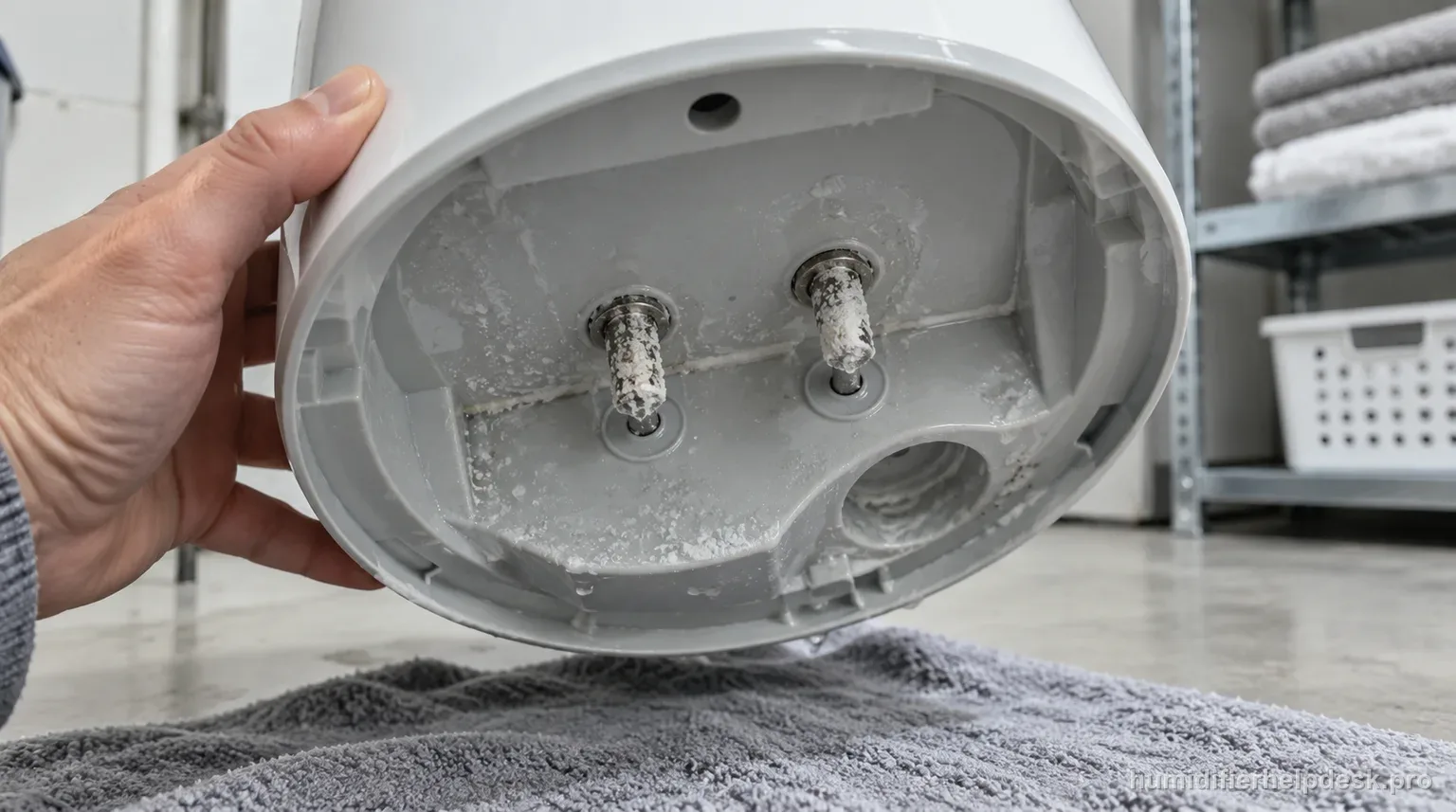
The two metal water-level probes can collect calcium or iron scale. Clean them externally before treating the water-detection system as failed.
Does this match what you are seeing?
Owners describe this Canopy Large Room Humidifier problem in a few different ways. If one of these sounds like yours, this guide covers it:
- Water probes have scale
- Mineral buildup on water sensors
- Water sensor scale problem
- Probes dirty and water reading wrong
Check these in order
- Disconnect power.
- Locate the two small metal rods/probes on the bottom of the body.
- Wipe mineral buildup away with a damp paper towel or sponge.
- Do not unscrew the body or bypass the probes.
Diagnostic decision path
The Canopy Large Room model also uses external metal water-level probes that can collect calcium or iron deposits. Canopy’s cleaning guidance keeps the remedy simple: disconnect power and wipe the probe surfaces clean without unscrewing the electrical body.
- Disconnect power and remove the tank/water-contact parts as needed to expose the bottom of the main body.
- Locate the two metal rods/probes used for water-level sensing.
- Inspect for chalky mineral coating before assuming the sensor system has failed.
If: Visible scale covers the probe surfaces
What it means: Mineral deposits can interfere with reliable water-level sensing.
Do next: Wipe the probes with a damp paper towel or sponge until the exposed metal is clean, then allow them to dry.
If: Water detection improves after cleaning
What it means: The problem was an external mineral-contact issue rather than an internal electronics failure.
Do next: Repeat gentle probe cleaning as part of maintenance when buildup returns.
If: The probes remain clean but the unit still misreads water
What it means: The easy scale explanation is no longer sufficient.
Do next: Verify normal tank/filter/grill assembly and use Canopy support if the problem persists.
If: A proposed fix involves unscrewing the body, bending the rods, or electrically bridging them
What it means: That goes beyond the manufacturer’s consumer cleaning guidance.
Do next: Do not modify the water-level sensing system.
How to interpret the retest
Use this as the first controlled change: “Disconnect power”. After that change, compare the Canopy Large Room Humidifier with “Visible scale covers the probe surfaces”. A match supports the documented reading “Mineral deposits can interfere with reliable water-level sensing” and then “Wipe the probes with a damp paper towel or sponge until the exposed metal is clean, then allow them to dry”. A non-match means this is not the right Canopy Large Room Humidifier path and continue; that non-match helps rule out this explanation for the water probes have scale complaint.
Keep this branch provisional unless the unit shows “Water detection improves after cleaning”. For the Canopy Large Room Humidifier, use “Locate the two small metal rods/probes on the bottom of the body” as the controlled test. If the same observation appears, the source meaning is “The problem was an external mineral-contact issue rather than an internal electronics failure” and the next action is “Repeat gentle probe cleaning as part of maintenance when buildup returns”. If it does not appear, record the non-match and continue through the remaining Canopy Large Room Humidifier checks for water probes have scale.
Make this one change, then compare the result with the original state. Check “Wipe mineral buildup away with a damp paper towel or sponge” on the Canopy Large Room Humidifier, then look specifically for “The probes remain clean but the unit still misreads water”. A match supports the manual's interpretation “The easy scale explanation is no longer sufficient” and sends you to “Verify normal tank/filter/grill assembly and use Canopy support if the problem persists”. If the observation is missing, that result narrows the Canopy Large Room Humidifier water probes have scale diagnosis without jumping to an unrelated reset.
Use “A proposed fix involves unscrewing the body, bending the rods, or electrically bridging them” to decide which documented branch to test next, not to declare the cause on its own. On the Canopy Large Room Humidifier, it corresponds to “That goes beyond the manufacturer’s consumer cleaning guidance”. Use “Do not unscrew the body or bypass the probes” and retest. When the observation is present, continue with “Do not modify the water-level sensing system”. When it is absent, rule out that explanation for now and keep the result with the current Canopy Large Room Humidifier water probes have scale notes.
Model-specific context that changes the diagnosis
Two Canopy Large Room Humidifier clues that point to different fixes
Separate the observations before guessing at an internal fault. On the Canopy Large Room Humidifier, “Visible scale covers the probe surfaces” supports the interpretation “Mineral deposits can interfere with reliable water-level sensing” and leads to “Wipe the probes with a damp paper towel or sponge until the exposed metal is clean, then allow them to dry”. “Water detection improves after cleaning” supports “The problem was an external mineral-contact issue rather than an internal electronics failure” and leads to “Repeat gentle probe cleaning as part of maintenance when buildup returns”. For the current Canopy Large Room Humidifier water probes have scale complaint, choose the state you can actually reproduce and work from that result.
Retest the Canopy Large Room Humidifier without changing multiple variables
Make one documented correction, retest, and only then continue. Start with “Disconnect power” and retest the Canopy Large Room Humidifier. If the water probes have scale complaint is unchanged, move to “Locate the two small metal rods/probes on the bottom of the body”. Use “Wipe mineral buildup away with a damp paper towel or sponge” only after judging the earlier result. Change only one thing at a time during this Canopy Large Room Humidifier water probes have scale retest so the result stays clear.
Common mistakes that make this harder to diagnose
- Using abrasive tools that scratch or deform the probe surface.
- Cleaning while the unit is connected to power.
- Putting the electrical body in a dishwasher.
- Treating a cleanable probe as a part that should be bypassed.
The water-probe problem is resolved when mineral film is removed and the Large Room humidifier again detects water consistently. Continued misreading with clean probes and correct assembly should be handled through Canopy support.
Questions people ask about this exact symptom
How should I handle scale on the water probes in my Canopy Large Room Humidifier?
For the Canopy Large Room Humidifier, the two metal water-level probes can collect calcium or iron scale; clean them externally before treating the water-detection system as failed. For this water probes have scale check on the Canopy Large Room Humidifier, start with “Disconnect power” and check the result before making another change. If the behavior is unchanged, continue with “Locate the two small metal rods/probes on the bottom of the body”.
What should I check first if my Canopy Large Room Humidifier has scale on the water probes?
Start by disconnecting power. Locate the two small metal water-level probes on the bottom of the body, then wipe mineral buildup away with a damp paper towel or sponge. Retest before doing anything else. If the probes are clean and the same behavior remains, move to the next documented possibility rather than unscrewing or probing the humidifier.
When should I contact Canopy about this Canopy Large Room Humidifier problem?
Escalate the Canopy Large Room Humidifier to Canopy if the documented checks do not resolve water probes have scale. When you contact support about water probes have scale on the Canopy Large Room Humidifier, report the last condition you tested, what changed, and what stayed the same; do not guess at an internal part.
Why this path is model-specific
Canopy’s Large Room cleaning guide specifically identifies the two metal water-level probes and says calcium/iron buildup can be wiped away without disassembly.
For the Canopy Large Room Humidifier, the machine type matters: it is evaporative. Its moisture output is not supposed to look like ultrasonic fog, so “I cannot see mist” by itself is not evidence of a failure.
This symptom appears on other humidifiers too, but the meaning and reset path can change by technology, sensor logic, and control layout. Use the exact model source above before borrowing a fix from a neighboring model.
Compare this symptom across verified models
If you are still deciding whether this behavior is normal or model-specific, use the symptom hub to compare only manufacturer-linked guides. Keep the Canopy Large Room Humidifier instructions above as the controlling path for this machine.
If the problem is still there
If the checks above do not change the symptom, use the manufacturer support path for this exact model. We intentionally stop before undocumented resets, sensor bypasses, internal mains work, or parts replacement that the consumer manual does not authorize.
What we do not recommend
Do not defeat a float, water-level sensor, overheat protection, interlock, or other safety feature. Do not open mains-powered sections for live testing. If the unit smells burned, becomes abnormally hot, smokes, sparks, has water near electrical parts, or repeatedly trips a circuit, stop using it and keep clear. Unplug it only if the plug, outlet, and surrounding area are dry and safe to reach; otherwise do not touch wet equipment and contact manufacturer support for next steps.
Primary source for this diagnosis
Source checked during the September 4, 2026 editorial review. Manufacturer documents can change; a material re-review updates this guide’s reviewed date rather than stamping unrelated pages.