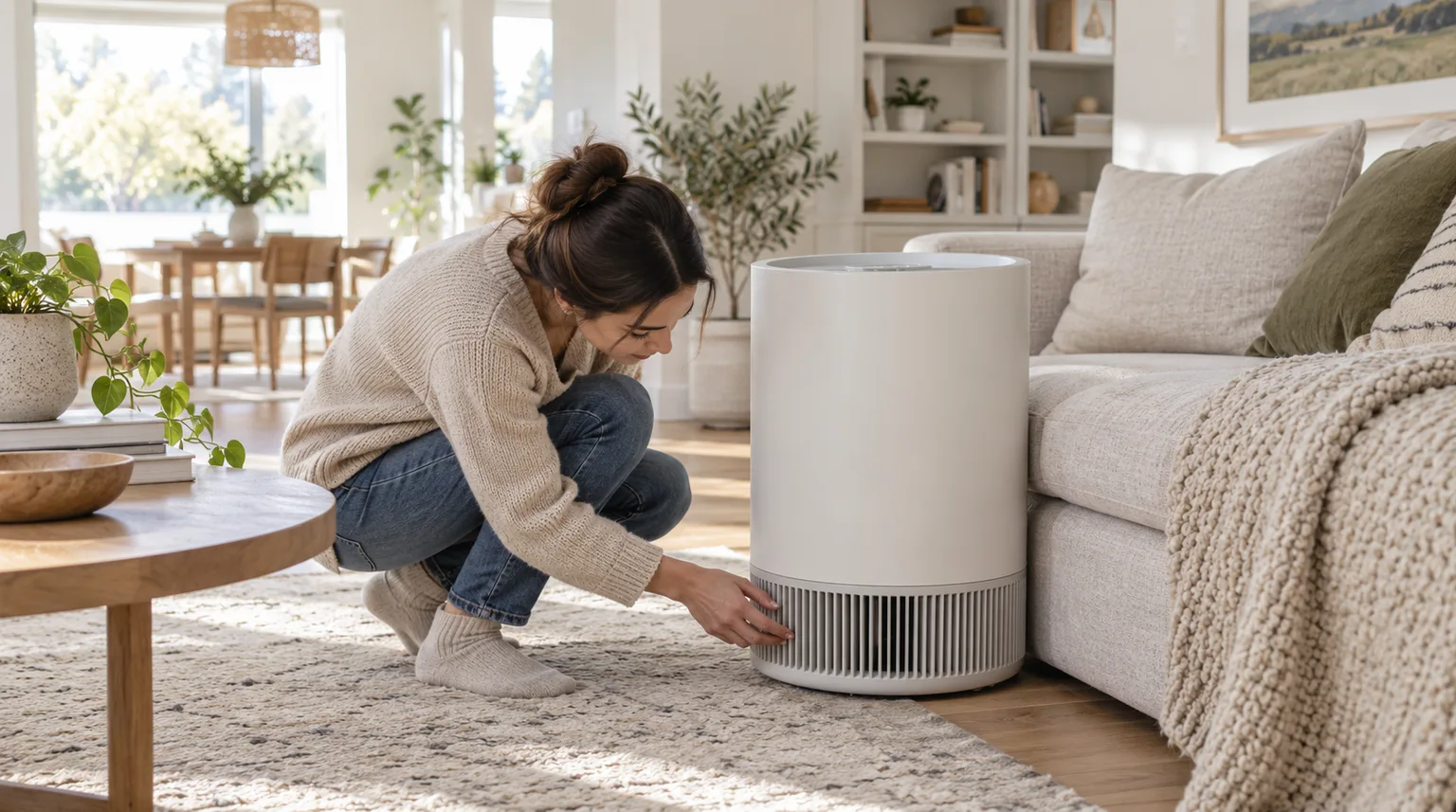
No visible mist is expected. The Large Room model is evaporative and sends invisible moisture into the room.
Does this match what you are seeing?
Owners describe this Canopy Large Room Humidifier problem in a few different ways. If one of these sounds like yours, this guide covers it:
- No visible mist
- Running but no mist
- Humidifier working but no fog
- Fan runs but I cannot see vapor
Check these in order
If the Filter indicator is also lit, use the Canopy Large Room filter light reset guide for that separate maintenance task. Record fan behavior and the reminder result independently.
If the fan resumes after Off while tray water or a damp wick remains, compare those conditions with the Canopy Large Room restart and drying guide before treating invisible output as a power fault.
- Check airflow rather than looking for fog.
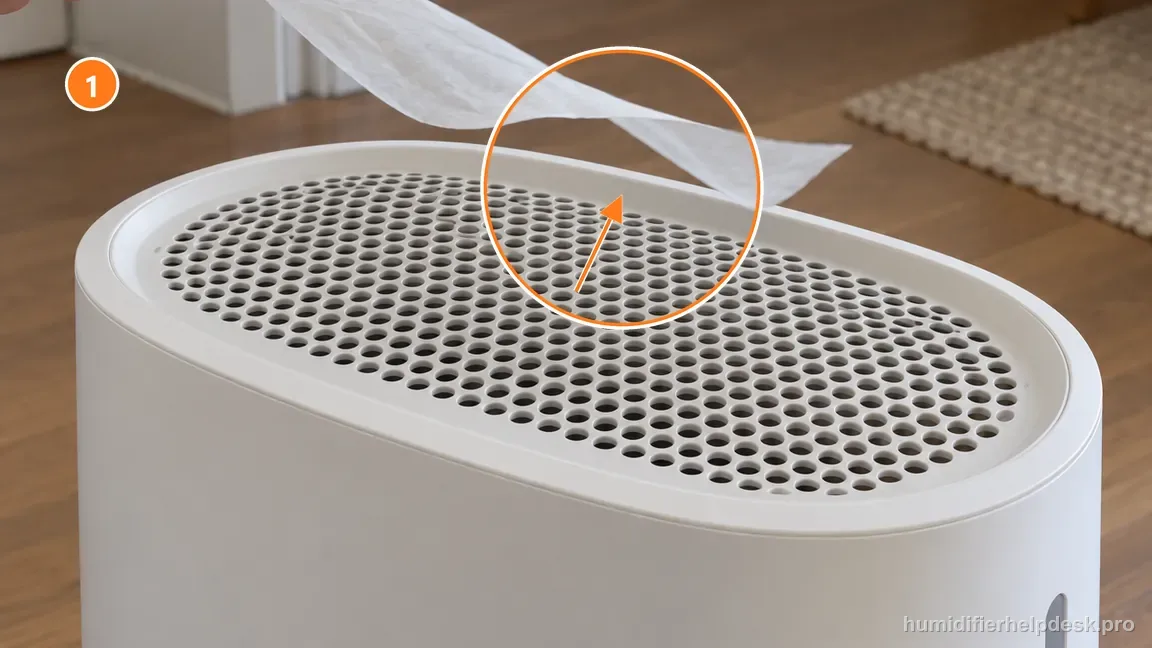
A deflected tissue confirms airflow even when there is no visible mist. - Make sure the filter is seated and able to wick water.
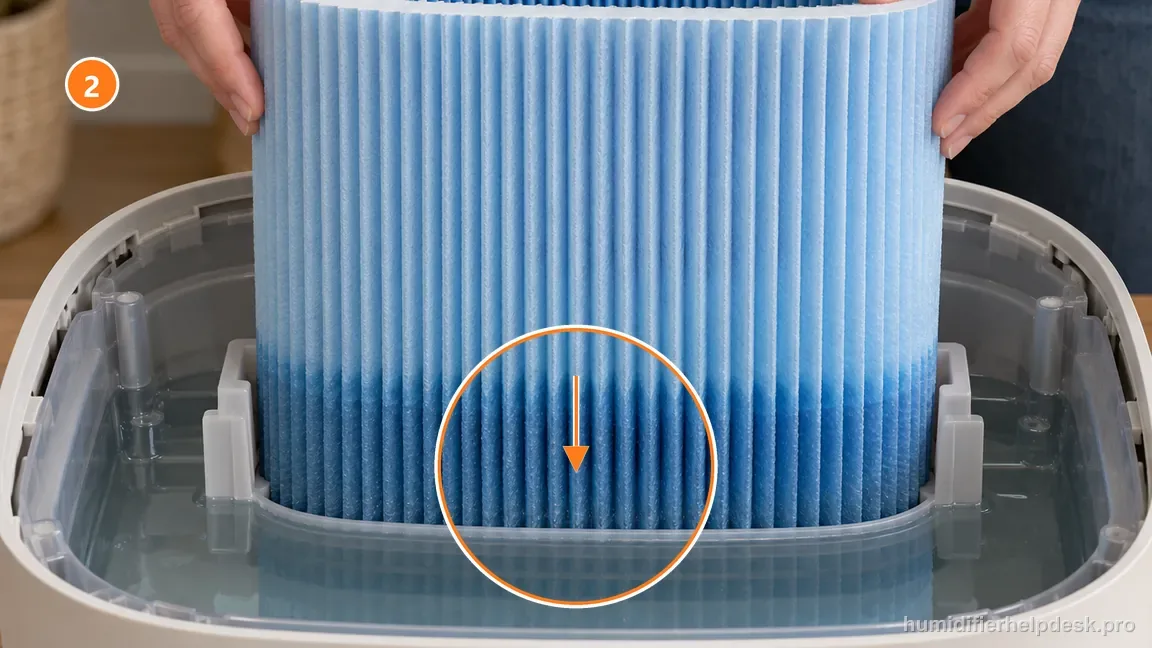
Seat the filter evenly so its lower pleats can wick water. - Monitor water use and room humidity over time.
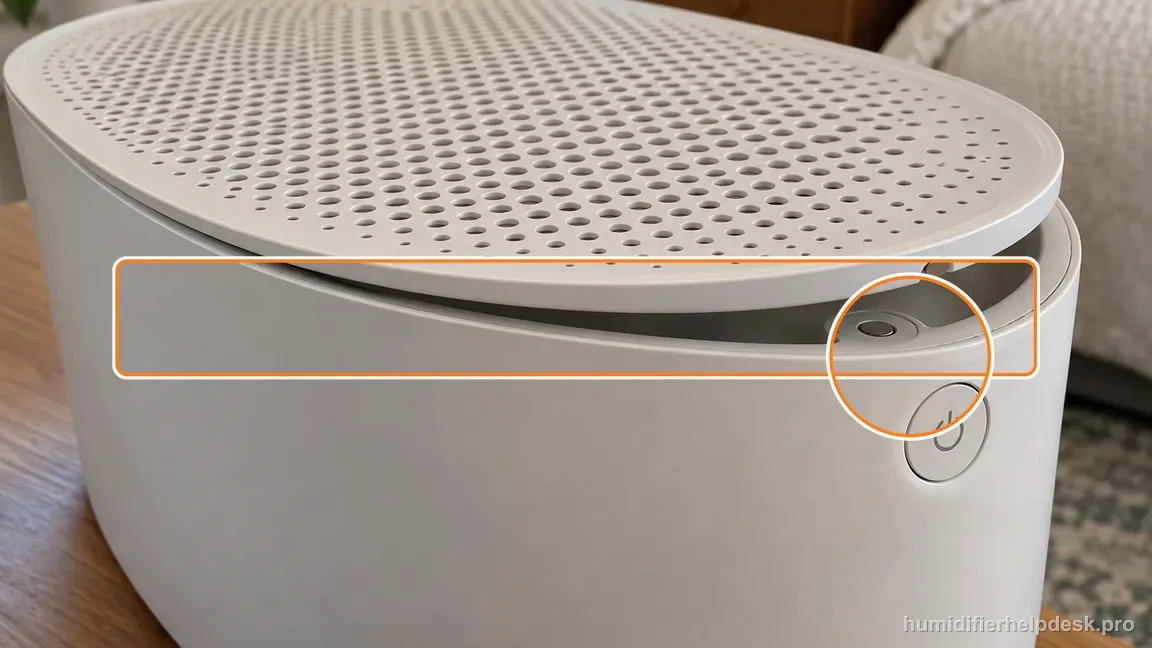
- If airflow stops, inspect the grate magnet/safety path.
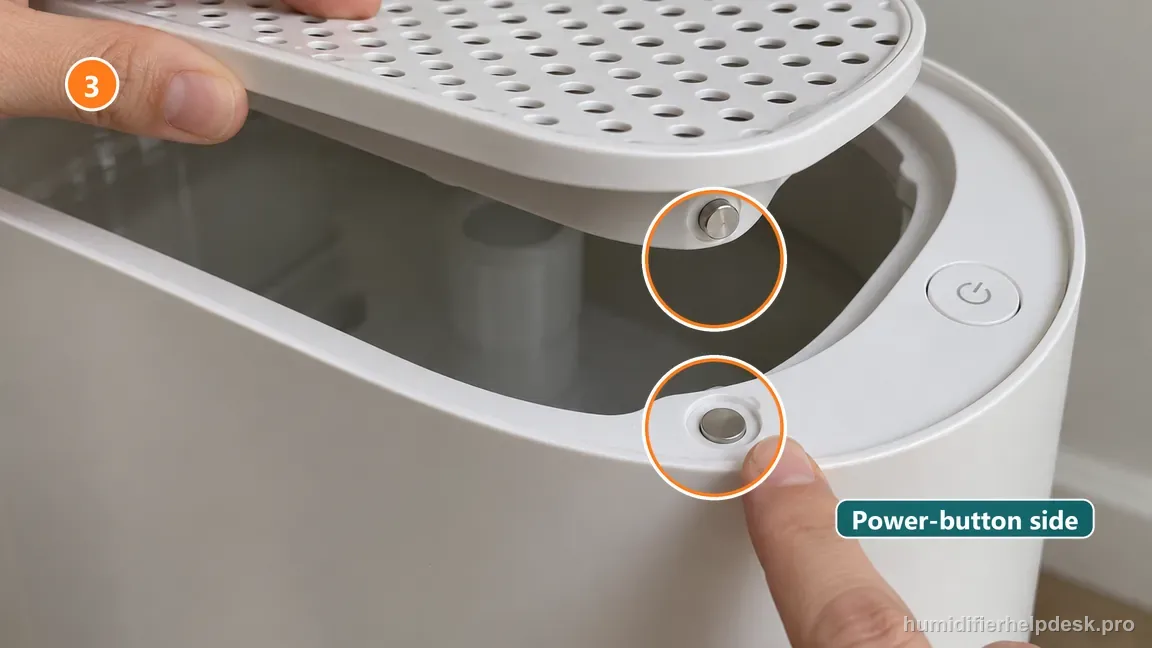
Inspect the magnet closest to the power button and reseat the grate.
Diagnostic decision path
The Canopy Large Room humidifier is evaporative, so no visible mist is the expected design behavior. It humidifies by moving air through wet filter media and releasing invisible moisture. Diagnose it by airflow, water consumption, and room humidity rather than by searching for a plume above the grate.
- Confirm the unit is the Large Room/Plus evaporative model rather than a portable misting product.
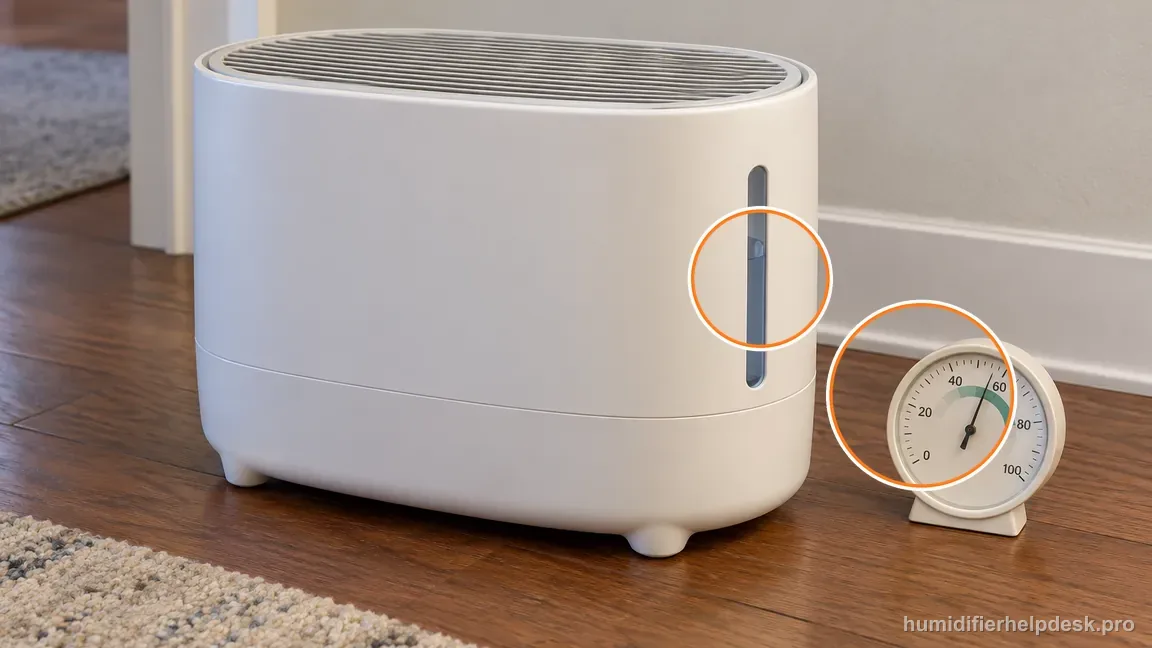
Confirm this page matches the Large Room evaporative model and judge room conditions with a separate humidity reading. - Check that the filter is seated and the top grate is secured.
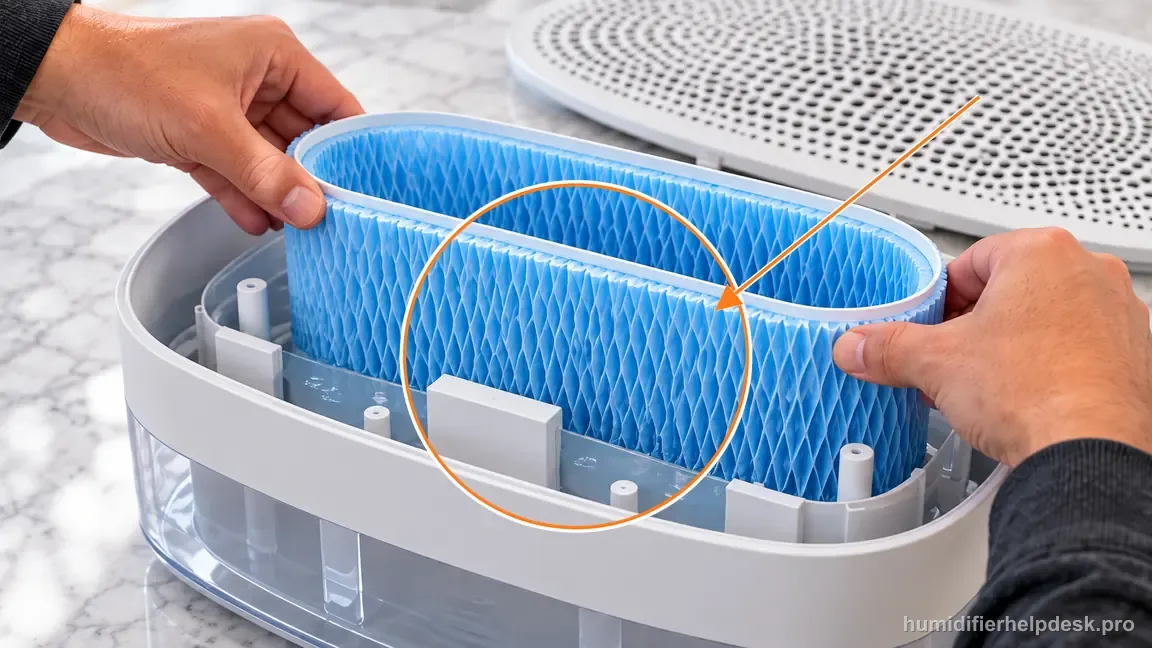
Check that the wick filter sits in its tray. 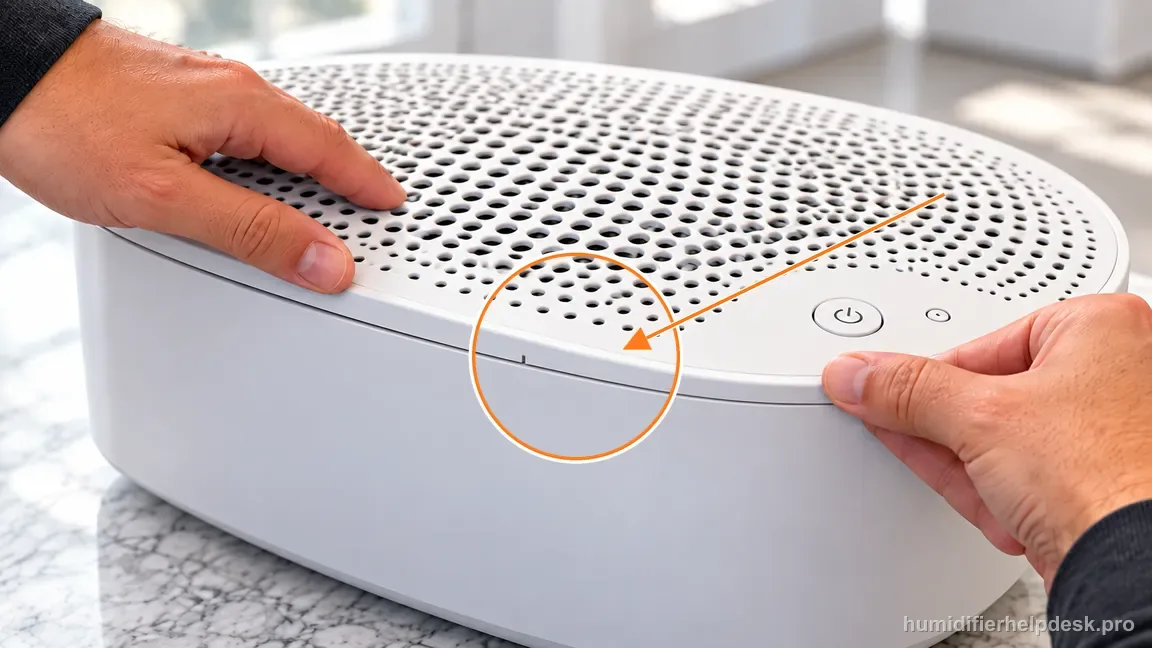
Check that the magnetic top grate is seated. - Observe operation over time because evaporative output is easier to judge by water use and humidity trend than by a momentary visual check.
If: The fan runs and water is being consumed
What it means: Invisible evaporation is occurring even though the exhaust air looks clear.
Do next: Monitor the room humidity trend and stop using visible fog as the success criterion.
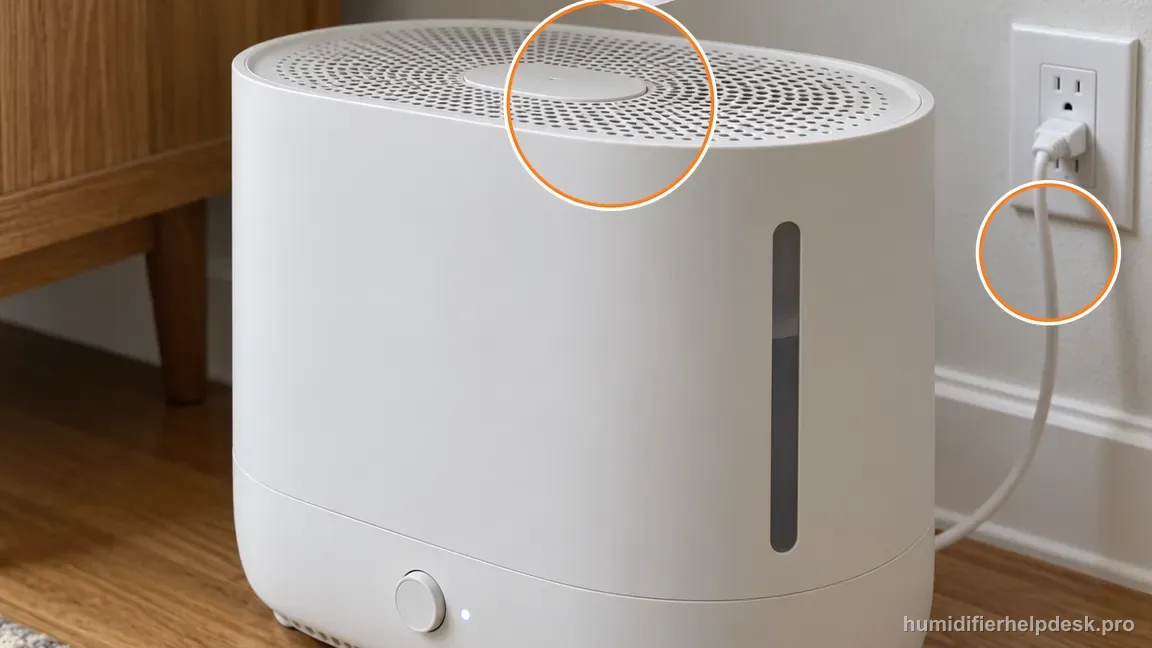
If: The fan is off and the grate is not seated
What it means: The magnetic grate safety can intentionally prevent operation.
Do next: Inspect the grate and magnet closest to the power-button side, then reseat it.
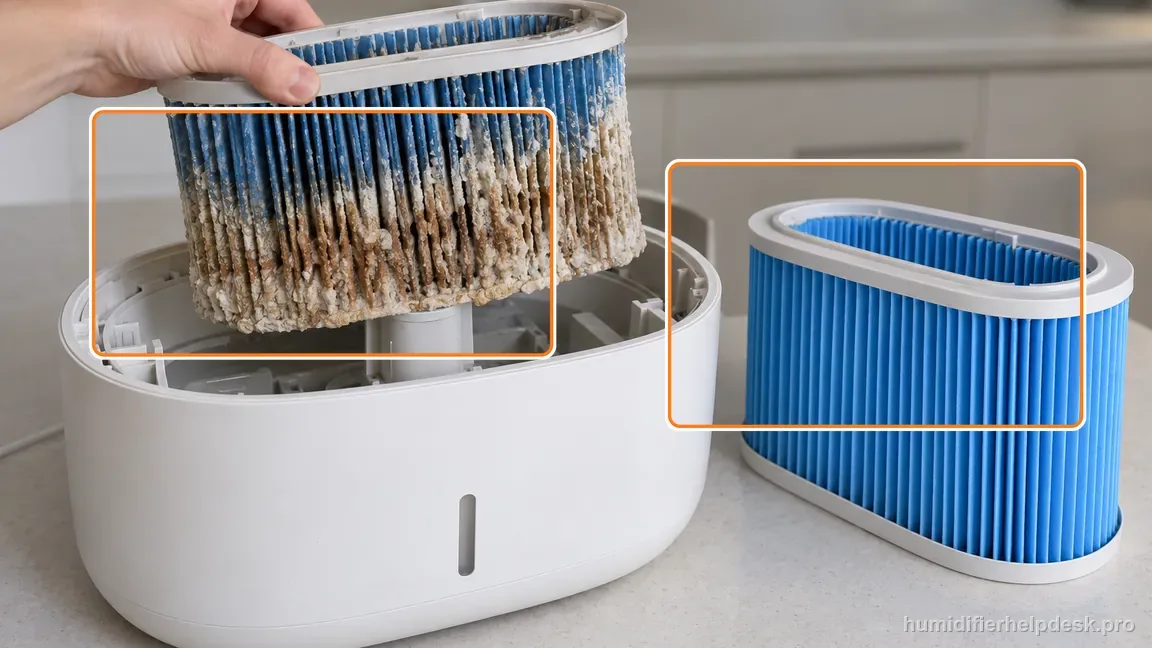
If: The fan runs but output seems weak and the filter is hardened
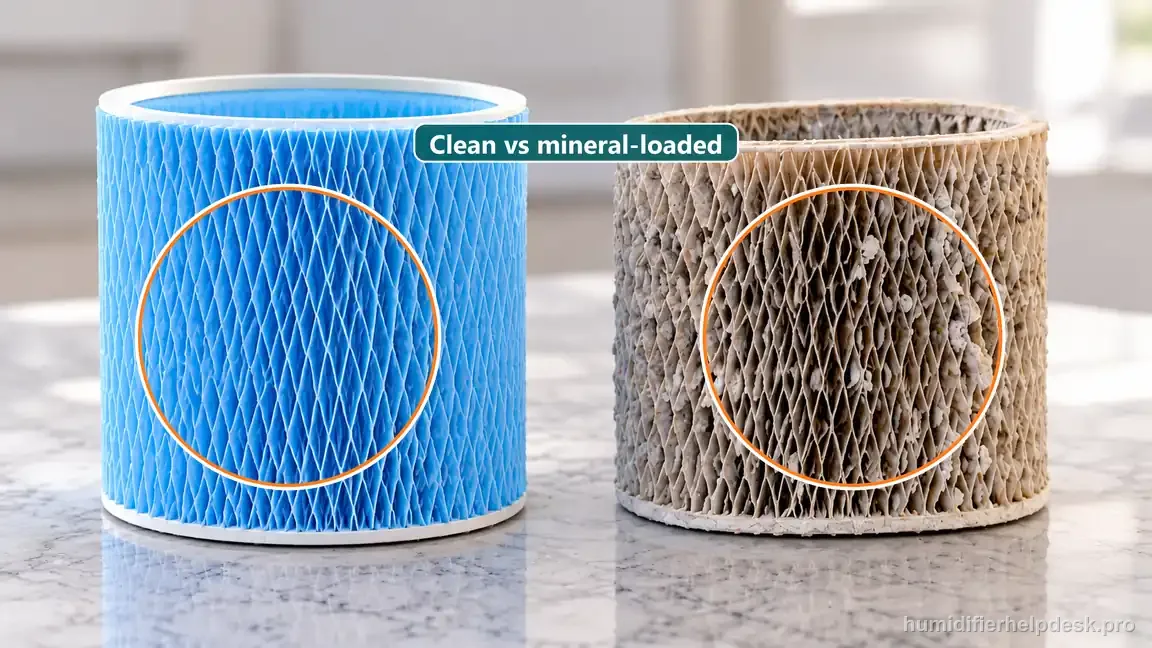
What it means: Filter mineral loading can reduce evaporative performance.
Do next: Replace the filter when it is hardened/crusty or heavily discolored, following Canopy's condition guidance.
If: The unit turns back on after an Off command while water remains
What it means: Smart Persistent Airflow may be finishing the water-use/drying cycle.
Do next: Allow the cycle to finish or empty remaining tray water if you need to complete shutdown.
If: No airflow or water use occurs after correct filter/grate assembly
What it means: The complaint is a true operation problem, not simply mist-free design.
Do next: Move to the Large Room probe, grate-magnet, and external USB-C power checks.
Canopy Large Room with no visible mist: normal or a problem?
The Large Room is evaporative, so a clear exhaust is the designed behavior. Use airflow, water use, and the room humidity trend to decide.
| What you see | What it means | Next step |
|---|---|---|
| The fan runs and water is being consumed | Invisible evaporation is occurring even though the exhaust looks clear | Monitor the room humidity trend and stop using visible fog as the success criterion |
| The fan is off and the grate is not seated | The magnetic grate safety can intentionally prevent operation | Inspect the grate and the magnet closest to the power-button side, then reseat it |
| The fan runs but output seems weak and the filter is hardened | Filter mineral loading can reduce evaporative performance | Replace the filter when it is hardened, crusty, or heavily discolored, following Canopy’s condition guidance |
| The unit turns back on after Off while water remains | Smart Persistent Airflow may be finishing the water-use and drying cycle | Let the cycle finish, or empty the remaining tray water if you need to complete shutdown |
| No airflow or water use after correct filter and grate assembly | This is a true operation problem, not simply mist-free design | Move to the Large Room probe, grate-magnet, and external USB-C power checks |
Large Room: ultrasonic advice versus what applies to this model
| Common assumption | What applies to the Large Room |
|---|---|
| Applying ultrasonic no-mist troubleshooting | This is an evaporative model: it moves air through wet filter media and releases invisible moisture |
| Clear exhaust means zero humidification | Judge by airflow, water use, and a humidity trend, using the same tank mark and a separate hygrometer over comparable runs |
| A lit Filter indicator means evaporation has stopped | It is a replacement reminder; judge the wick by its condition and fit, and record the reminder separately |
| Removing the grate to look inside is harmless | The Large Room safety connection is magnetic, and removing the grate can create a safety-related fan stop |
| Bedside/Nursery 2.0 photos and reset steps apply | The Large Room uses the magnet nearest the power button; Bedside/Nursery 2.0 uses a center-tab arrangement |
How to interpret the retest
Separate clear exhaust from absent airflow. With the fan moving air, a lack of visible plume is expected for this evaporative model. Check that the wick is damp and seated in its tray, then compare water use and room humidity under similar conditions. If the fan runs and water is being consumed, start with the measurement trend rather than searching for an ultrasonic-style mist fault.
If airflow stops after cleaning or filter replacement, unplug the unit before handling damp parts. Confirm the wick sits fully in its tray and does not touch the fan, then check that the removable grate sits flush. On the Large Room model, the magnet nearest the power button must meet the body. Do not borrow the center-tab check from Bedside/Nursery 2.0 or bypass the interlock.
A single humidity reading or a brief tank-level glance cannot establish an output failure. Keep the room, setting, door position, and sensor location comparable when checking for a trend; evaporation changes with room conditions. Canopy does not publish a universal water-use rate or guaranteed RH increase for this test. If there is no airflow and no water use after the exterior seating checks, move to the separate power/fan guide.
Model-specific context that changes the diagnosis
Large Room grille safety uses a magnet
Canopy identifies the Large Room safety connection as magnetic and points owners to the magnet nearest the power button. Bedside/Nursery 2.0 uses a different center-tab arrangement, so a generic photo or reset instruction may not match this model. If the grate is damaged or the magnet is missing, stop at an exterior inspection and send Canopy a photo. Do not tape the grate down or hold the interlock closed to test the fan.
Keep the Filter reminder separate from mist visibility
A lit Filter indicator is a replacement reminder, not proof that the Canopy Large Room has stopped evaporating. Judge the wick by its condition and fit: Canopy says to replace it when it is hardened, crusty, or heavily discolored. Record the reminder separately and follow the filter-reset guide after replacement; holding On/Off to clear that light cannot restore missing airflow or repair an incorrectly seated grate.
Read water use and humidity as a trend
Evaporation is less visible than ultrasonic output, and the room can absorb moisture without showing a fast change on a nearby meter. Compare the same tank mark and a separate hygrometer over a comparable run, with the doors and sensor position kept consistent. Do not treat a momentary reading or an invented gallons-per-day target as a pass/fail rule; Canopy does not publish one for this model.
Common mistakes that make this harder to diagnose
- Applying ultrasonic no-mist troubleshooting to the Large Room evaporative model.
- Removing the grate to look inside and then creating a safety-related fan stop.
- Assuming clear exhaust means zero humidification.
Normal operation is established when the Large Room unit moves air, uses water, and changes/maintains room humidity without visible mist.
Questions people ask about this exact symptom
Is it normal that I cannot see mist from my Canopy Large Room Humidifier?
Yes. Canopy identifies the Large Room as evaporative: it moves air through a wet filter and releases moisture without a visible plume. Clear exhaust alone is normal and does not show that the unit has failed. Look for airflow and water use; if either is missing, follow the separate checks below rather than trying to make a mist cloud appear.
How can I tell whether it is humidifying if I see no mist?
Confirm the fan moves air and the wick is seated and damp, then compare water use and room humidity under similar conditions. Evaporation varies with the room, so a brief reading is not a useful verdict. If both airflow and water use are absent after the filter and grate are seated, troubleshoot operation rather than the invisible output.
When should I contact Canopy about this Canopy Large Room Humidifier problem?
Contact Canopy if the fan still will not run or the wick stays dry after the filter and grate are correctly seated and the exterior checks are complete. Report whether the magnet is present, the filter is clear of the fan, and the power source was checked. Do not guess at an internal failure or bypass the safety interlock.
Why this path is model-specific
Canopy’s no-mist support explicitly includes the Large Room Humidifier among the evaporative models that do not produce visible mist.
For the Canopy Large Room Humidifier, the machine type matters: it is evaporative. Its moisture output is not supposed to look like ultrasonic fog, so “I cannot see mist” by itself is not evidence of a failure.
This symptom appears on other humidifiers too, but the meaning and reset path can change by technology, sensor logic, and control layout. Use the exact model source above before borrowing a fix from a neighboring model.
Compare this symptom across verified models
If you are still deciding whether this behavior is normal or model-specific, use the symptom hub to compare only manufacturer-linked guides. Keep the Canopy Large Room Humidifier instructions above as the controlling path for this machine.
If the problem is still there
If the checks above do not change the symptom, use the manufacturer support path for this exact model. We intentionally stop before undocumented resets, sensor bypasses, internal mains work, or parts replacement that the consumer manual does not authorize.
What we do not recommend
Do not defeat a float, water-level sensor, overheat protection, interlock, or other safety feature. Do not open mains-powered sections for live testing. If the unit smells burned, becomes abnormally hot, smokes, sparks, has water near electrical parts, or repeatedly trips a circuit, stop using it and keep clear. Unplug it only if the plug, outlet, and surrounding area are dry and safe to reach; otherwise do not touch wet equipment and contact manufacturer support for next steps.
Primary source for this diagnosis
Source checked during the September 3, 2026 editorial review. Manufacturer documents can change; a material re-review updates this guide’s reviewed date rather than stamping unrelated pages.