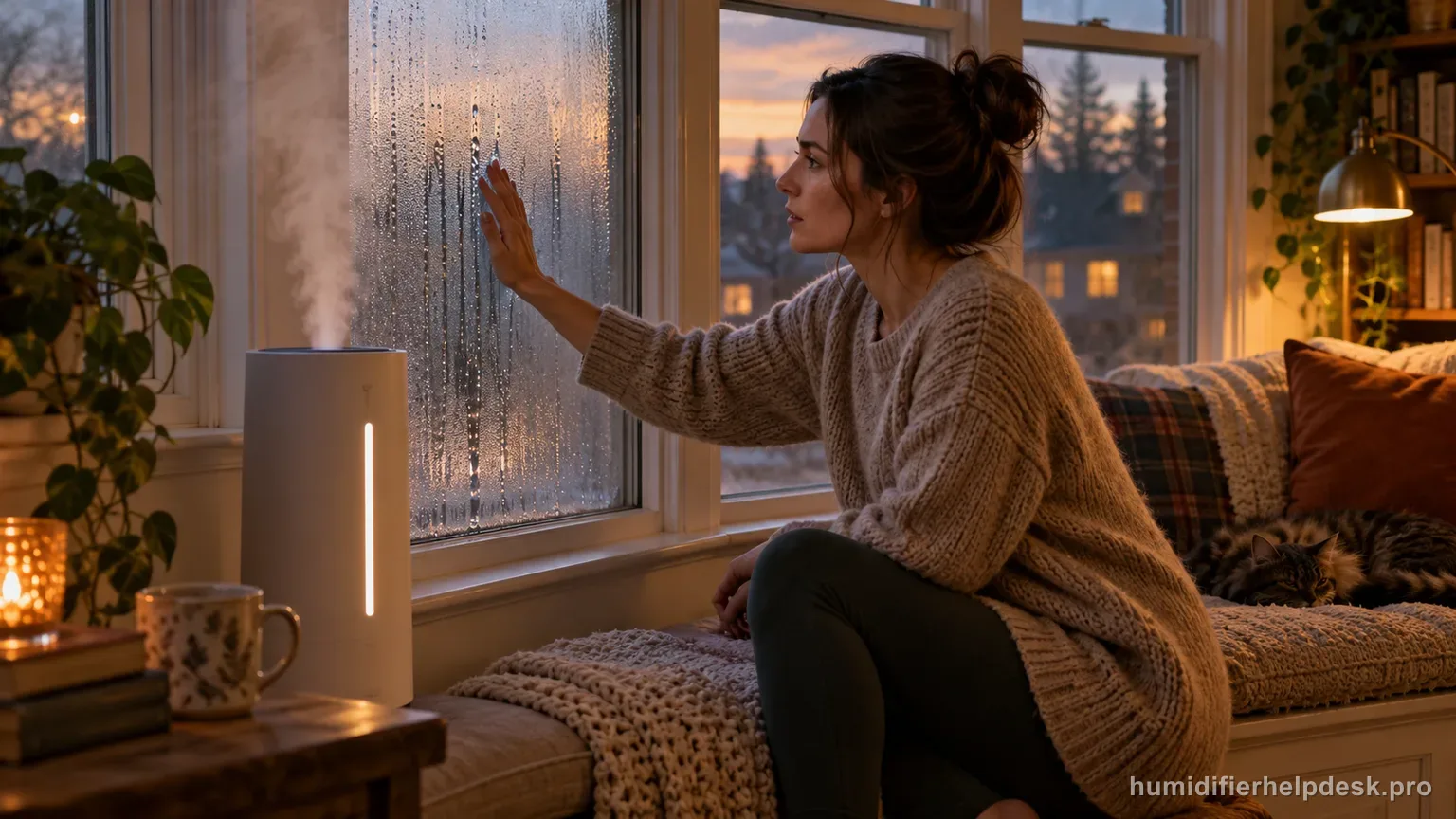
Treat this first as too much room humidity, not a tank leak: reduce mist output, turn the unit off, or increase room ventilation.
Does this match what you are seeing?
Owners describe this Dreo HM713S problem in a few different ways. If one of these sounds like yours, this guide covers it:
- Condensation around humidifier
- Making floor or furniture wet
- Mist collecting on surfaces
- Room too damp when running
Check these in order
- Lower the mist level.
- Turn the humidifier off temporarily if room humidity is already high.
- Open a door or window to increase ventilation.
- Wipe nearby condensation and reassess before concluding the machine is leaking.
Diagnostic decision path
Condensation near the HM713S is usually an over-humidification clue before it is evidence of a leaking tank. Dreo’s FAQ says to reduce mist, turn the humidifier off, or ventilate the room when moisture collects around the unit or on windows.
- Look at where the water is forming: windows and cool surfaces suggest condensation more than a tank leak.
- Check current room humidity and the selected mist level.
- Wipe existing moisture dry so you can see whether it returns during a controlled test.
If: Windows or nearby cool surfaces are fogging or wet
What it means: Room humidity is likely too high for the current temperature and ventilation.
Do next: Lower the mist level and monitor whether new condensation stops forming.
If: Condensation continues at the lower setting
What it means: The room is still receiving more moisture than it can hold comfortably.
Do next: Turn the humidifier off temporarily and open a door or window to increase ventilation.
If: Moisture disappears after output is reduced or the room is ventilated
What it means: The original water was condensation rather than proof of a tank failure.
Do next: Resume at a lower humidity/output setting and continue watching windows and nearby surfaces.
If: Water collects directly under the base or tank even while room humidity is moderate
What it means: The pattern no longer fits simple window/surface condensation well.
Do next: Use the HM713S leaking-water guide to inspect seal, float, level placement, and tank integrity.
How to interpret the retest
For the follow-up check, focus on “Windows or nearby cool surfaces are fogging or wet” rather than changing several settings at once. If the Dreo HM713S matches that observation, use the interpretation “Room humidity is likely too high for the current temperature and ventilation” and follow with “Lower the mist level and monitor whether new condensation stops forming”. First, check “Lower the mist level”. If the state does not appear again, keep that result and continue with the next documented possibility for condensation on the Dreo HM713S.
Start from a concrete state. After “Turn the humidifier off temporarily if room humidity is already high”, does the Dreo HM713S show “Condensation continues at the lower setting”? A yes points to the documented interpretation “The room is still receiving more moisture than it can hold comfortably”, so the next move is “Turn the humidifier off temporarily and open a door or window to increase ventilation”. If the state is absent, do not use the action from that Dreo HM713S possibility; record that it did not match the condensation complaint and test the next documented condition.
On the Dreo HM713S, use “Moisture disappears after output is reduced or the room is ventilated” as the observation to check first. On the Dreo HM713S, the source-backed interpretation is “The original water was condensation rather than proof of a tank failure”. Make “Open a door or window to increase ventilation” the only deliberate change, then repeat the same symptom test. If the observation matches, continue with “Resume at a lower humidity/output setting and continue watching windows and nearby surfaces”; if it does not, note that this Dreo HM713S condensation path did not match and move on.
Model-specific context that changes the diagnosis
Two Dreo HM713S clues that point to different fixes
The next step depends on which of these two observations is actually present. “Windows or nearby cool surfaces are fogging or wet” maps to “Room humidity is likely too high for the current temperature and ventilation” on the Dreo HM713S, followed by “Lower the mist level and monitor whether new condensation stops forming”. By contrast, “Condensation continues at the lower setting” maps to “The room is still receiving more moisture than it can hold comfortably”, followed by “Turn the humidifier off temporarily and open a door or window to increase ventilation”. For the Dreo HM713S, matching the response to the observed state keeps the condensation diagnosis from turning into a generic list of fixes.
Run the Dreo HM713S checks in order
Treat this as a short sequence rather than changing several things together. Start with “Lower the mist level” and retest the Dreo HM713S. If the condensation complaint is unchanged, move to “Turn the humidifier off temporarily if room humidity is already high”. Use “Open a door or window to increase ventilation” only after judging the earlier result. Change only one thing at a time during this Dreo HM713S condensation retest so the result stays clear.
Common mistakes that make this harder to diagnose
- Calling any nearby water a leak without checking windows and room humidity.
- Running maximum output after condensation is already visible.
- Leaving doors/windows closed in a room that is becoming excessively humid.
- Ignoring water directly beneath the unit because some condensation is also present.
The condensation problem is resolved when lowering output or improving ventilation stops new moisture from forming on windows and surfaces. Water that continues to appear directly from the unit should be treated as a separate leak path.
Questions people ask about this exact symptom
Why is my Dreo HM713S causing condensation or dampness?
For the Dreo HM713S, treat this first as too much room humidity, not a tank leak: reduce mist output, turn the unit off, or increase room ventilation. For this condensation check on the Dreo HM713S, start with “Lower the mist level” and check the result before making another change. If the behavior is unchanged, continue with “Turn the humidifier off temporarily if room humidity is already high”.
What should I check first if my Dreo HM713S causes condensation or dampness?
Use the Dreo HM713S checklist as an ordered troubleshooting sequence, with one change at a time. Try “Lower the mist level”, retest, then move to “Turn the humidifier off temporarily if room humidity is already high” and “Open a door or window to increase ventilation” only as required. With condensation, this makes it much easier to separate a documented cause from a condition that simply happened to be present.
When should I contact Dreo about this Dreo HM713S problem?
Contact Dreo if the Dreo HM713S still has the same problem after the documented checks for condensation. Give support the Dreo HM713S's current mode and the before-and-after result from the documented condensation checks. Do not open powered sections on the Dreo HM713S or assume an internal failed part unless Dreo documents that procedure for this condensation case.
Why this path is model-specific
Dreo’s HM713S FAQ says condensation around the humidifier or windows means humidity may be too high and recommends lower output, shutoff, or ventilation.
For the Dreo HM713S, the machine type matters: it is hybrid. Visible mist is part of normal output when mist production is active, so a true no-mist complaint deserves model-specific troubleshooting.
This symptom appears on other humidifiers too, but the meaning and reset path can change by technology, sensor logic, and control layout. Use the exact model source above before borrowing a fix from a neighboring model.
Compare this symptom across verified models
If you are still deciding whether this behavior is normal or model-specific, use the symptom hub to compare only manufacturer-linked guides. Keep the Dreo HM713S instructions above as the controlling path for this machine.
If the problem is still there
If the checks above do not change the symptom, use the manufacturer support path for this exact model. We intentionally stop before undocumented resets, sensor bypasses, internal mains work, or parts replacement that the consumer manual does not authorize.
What we do not recommend
Do not defeat a float, water-level sensor, overheat protection, interlock, or other safety feature. Do not open mains-powered sections for live testing. If the unit smells burned, becomes abnormally hot, smokes, sparks, has water near electrical parts, or repeatedly trips a circuit, stop using it and keep clear. Unplug it only if the plug, outlet, and surrounding area are dry and safe to reach; otherwise do not touch wet equipment and contact manufacturer support for next steps.
Primary source for this diagnosis
Source checked during the September 3, 2026 editorial review. Manufacturer documents can change; a material re-review updates this guide’s reviewed date rather than stamping unrelated pages.