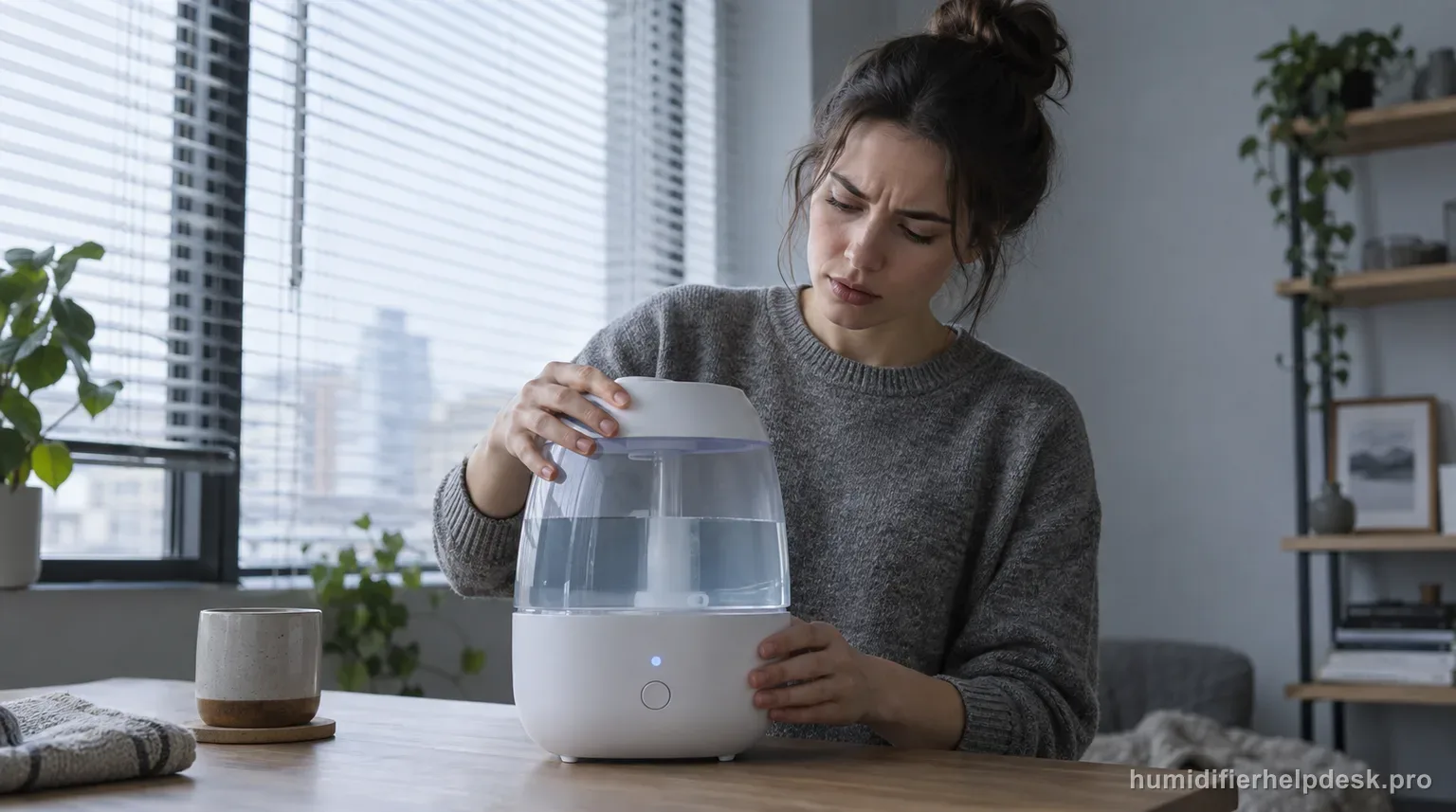
When the Classic 160 refill indicator remains on even though the tank contains water, first reseat the tank, then inspect the water filter assembly. The manual keeps this as an external water-path diagnosis and does not instruct the owner to open the base or manipulate the sensor.
Does this match what you are seeing?
Owners describe this Levoit Classic 160 problem in a few different ways. If one of these sounds like yours, this guide covers it:
- Red light with water in tank
- Red water light stays on
- Low water light but tank is full
- Refill light will not turn off
Check these in order
- Fill the tank normally and keep the water below the maximum line.
- Remove and reseat the tank squarely so it can feed the base through the intended valve path.
- Inspect the water filter assembly and sponge, cleaning or replacing it only as the manual allows.
- Reassemble the unit on a level surface and watch whether the refill indicator turns off as the normal water level is restored.
- If the indicator remains on after the documented fill, seating, and filter steps, use manufacturer support rather than opening the base.
Diagnostic decision path
The Classic 160 refill indicator should turn on when the tank is empty and turn off after the normal water supply is restored. If the red light remains on with water visibly present, the manual still keeps the diagnosis simple: fill correctly, make sure the tank is properly in place, and clean or replace the water filter assembly. A persistent light after those steps is not an invitation to press the float, remove the water-level sensor, or open the base.
- Turn the Classic 160 off before lifting the tank or removing the water filter assembly, and keep the base flat and dry.
- Confirm water is below the tank maximum line and was added through the normal fill opening, not into the base or mist tube.
- Look for an active leak first. A tank that cannot hold or feed water safely should not be repeatedly reseated while the electrical base is wet.
If: The refill light goes out immediately after the tank is reseated
What it means: Tank placement was preventing the normal water path from being recognized even though the tank itself contained water.
Do next: Leave the tank stationary and verify that mist resumes. Do not continue changing the filter or touching the water system once stable operation has returned.
If: The refill light remains on and the filter sponge/assembly is dirty or incorrectly installed
What it means: The manual explicitly includes the water filter in this indicator path, so it is the next documented user-serviceable checkpoint.
Do next: Clean or replace the documented filter component, reinstall it correctly, then repeat a single fill-and-seat test.
If: The light remains on after normal fill, seating, and filter service
What it means: The owner-level checklist is complete but the machine still reports low water.
Do next: Stop at this boundary. Do not hold down a sensor or remove the base cover; give Levoit the exact steps already completed.
If: The red light turns off but the plume is still weak or absent
What it means: The refill indication has cleared, so the remaining complaint belongs to output troubleshooting rather than the water-warning path.
Do next: Use the Classic 160 no-mist guide for mist setting, base water, airflow, nozzle, placement, temperature, rinse, and filter checks.
If: The indicator is accompanied by water beneath the unit
What it means: A leak can prevent a normal water path and creates a higher-priority electrical safety issue.
Do next: Unplug and follow the leak diagnosis. Do not keep filling the tank just to see whether the red light eventually clears.
How to interpret the retest
A visible water line in the tank does not show whether the tank is seated squarely or whether its normal outlet path is supplying the base. Reseating is therefore a functional step, not a cosmetic adjustment.
The filter sponge is accessible and documented for owner cleaning/replacement. The water-level sensor is not. These two components should not be treated as equivalent just because both relate to water availability.
Do not manually push a float or sensor to force the lamp off. That can only show how the indicator reacts to an artificial input; it does not prove the assembled humidifier can feed and sense water safely during use.
When the light clears after a single step, preserve that evidence. Avoid immediately performing a full cleaning, replacing the filter, and reseating again, because multiple changes make it impossible to know what corrected the condition.
If the unit is dry and correctly assembled but the indicator remains red after the manual sequence, repeated cycling is unlikely to add useful information. The next useful action is support with a clear record of the observed state.
Model-specific context that changes the diagnosis
Why this is not a hidden reset-code problem
Classic 160 uses a straightforward refill indicator rather than an app error code. The manual does not describe a secret button combination, long reset sequence, or calibration menu for a red light that stays on. The exact troubleshooting value is in confirming tank seating and filter condition, then knowing when to stop instead of searching for an undocumented reset.
Pair the indicator with one physical result
During the retest, watch whether the light goes out and whether mist begins. Both changing together after reseating supports a restored water path. A light that goes out but no mist follows means the indicator problem and the output problem have separated; move to no-mist troubleshooting rather than continuing to disturb the tank.
The service boundary is explicit
The Classic 160 safety instructions warn against opening the base or removing the water-level sensor for self-servicing. A sensor bypass may sound like an extra troubleshooting step, but it would be less faithful to the manual and less safe. Stop after the documented tank and filter actions rather than forcing the warning circuit into a different state.
Common mistakes that make this harder to diagnose
- Assuming that visible water in the tank means tank seating has already been ruled out.
- Searching for an undocumented reset sequence instead of following the tank and filter row.
- Pressing or wedging a water-level component to force the light off.
- Continuing to refill and power the unit when a leak is sending water toward the electrical base.
The refill-light issue is resolved when the Classic 160 indicator turns off after normal filling, correct tank seating, or documented filter service and remains off during a short stable run with normal mist. If the light persists after those external actions, or if a leak makes the water path unsafe, stop at the manual boundary and contact Levoit rather than opening the base or removing the sensor.
Questions people ask about this exact symptom
Why does my Classic 160 refill light stay on after I add water?
The manual treats water in the tank as only the first check. Turn the unit off, make sure the tank is seated properly on the base, and inspect the user-serviceable water filter assembly. Clean or replace that filter if needed, then perform one level, stationary retest. If the light still stays on, stop rather than manipulating the water-level sensor.
Is there a reset for the Classic 160 red refill light?
The manual does not give a special button reset for this symptom. Its troubleshooting row says to fill the tank, ensure the tank is properly in place, and clean or replace the water filter. If those steps do not clear the light, the safe next step is manufacturer support. Do not open the base or remove the water-level sensor to create a reset.
Why did the Classic 160 refill light turn off but the humidifier still has no mist?
That result means the low-water warning has cleared, but a separate mist-output problem remains. Move to the Classic 160 no-mist path: test a higher knob setting, normal tank/base water condition, lower air inlet, nozzle, level placement, cold water, cleaning residue, and filter assembly. Do not keep reseating the tank once the indicator itself is behaving normally.
Why this path is model-specific
The Classic 160 troubleshooting table tells owners with a refill indicator that stays on to fill the tank, ensure the tank is properly in place, and clean or replace the water filter. The safety section warns against opening the base or removing the water-level sensor for self-servicing.
For the Levoit Classic 160, the machine type matters: it is ultrasonic. Visible mist is part of normal output when mist production is active, so a true no-mist complaint deserves model-specific troubleshooting.
This symptom appears on other humidifiers too, but the meaning and reset path can change by technology, sensor logic, and control layout. Use the exact model source above before borrowing a fix from a neighboring model.
Compare this symptom across verified models
If you are still deciding whether this behavior is normal or model-specific, use the symptom hub to compare only manufacturer-linked guides. Keep the Levoit Classic 160 instructions above as the controlling path for this machine.
If the problem is still there
If the checks above do not change the symptom, use the manufacturer support path for this exact model. We intentionally stop before undocumented resets, sensor bypasses, internal mains work, or parts replacement that the consumer manual does not authorize.
What we do not recommend
Do not defeat a float, water-level sensor, overheat protection, interlock, or other safety feature. Do not open mains-powered sections for live testing. If the unit smells burned, becomes abnormally hot, smokes, sparks, has water near electrical parts, or repeatedly trips a circuit, stop using it and keep clear. Unplug it only if the plug, outlet, and surrounding area are dry and safe to reach; otherwise do not touch wet equipment and contact manufacturer support for next steps.
Primary source for this diagnosis
Source checked during the September 4, 2026 editorial review. Manufacturer documents can change; a material re-review updates this guide’s reviewed date rather than stamping unrelated pages.