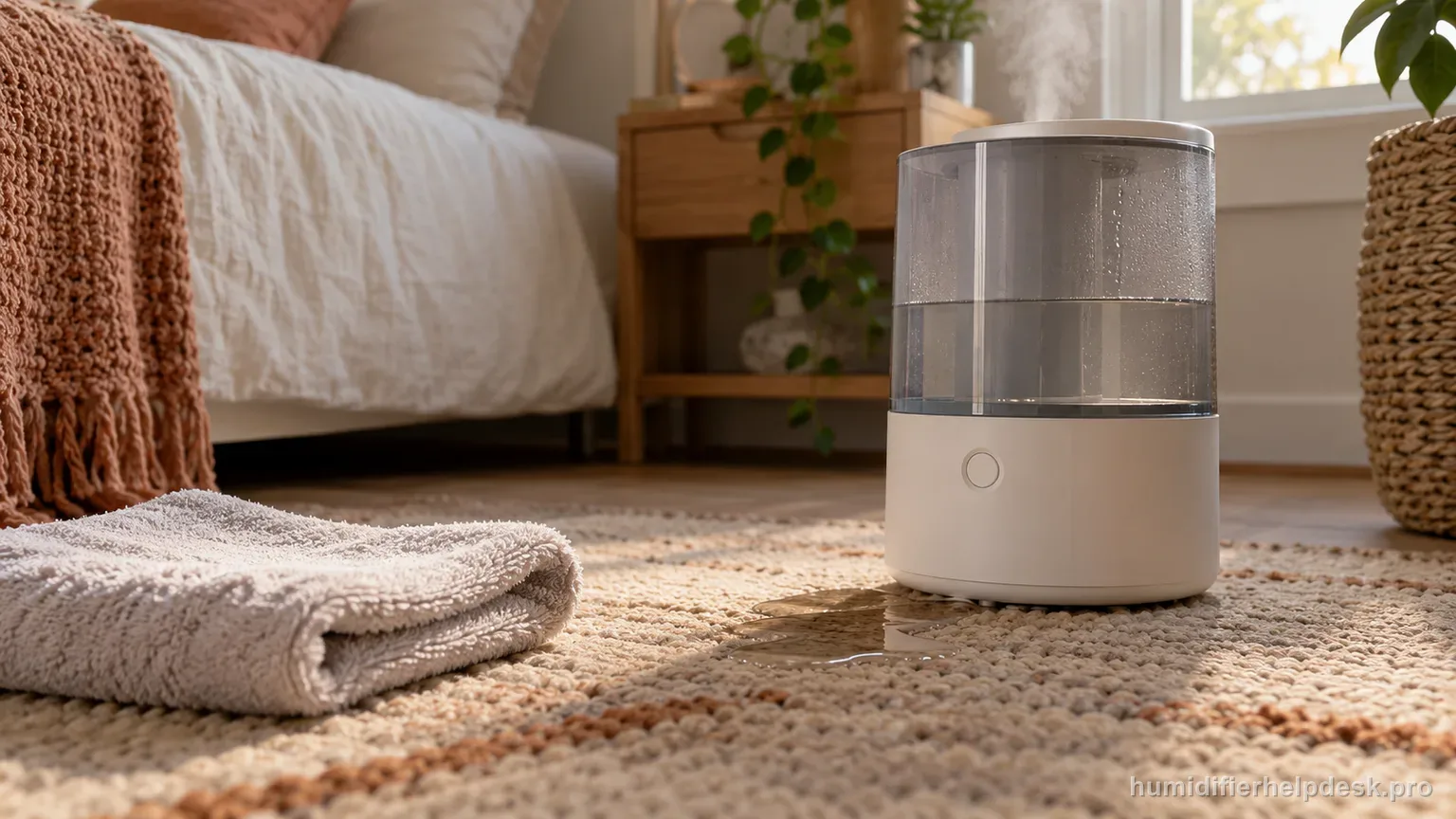
Rule out high-humidity condensation, excess water, shaking, uneven placement, and a leaking tank before assuming an internal failure.
Does this match what you are seeing?
Owners describe this Levoit LV600S problem in a few different ways. If one of these sounds like yours, this guide covers it:
- Leaking water
- Water under the base
- Humidifier leaking from bottom
- Reservoir leaking or overflowing
Check these in order
- Avoid running the humidifier in a room already over roughly 60% relative humidity.
- Wipe excess water from the tank and base and place the unit on a flat, level surface.
- Do not shake the humidifier.
- Inspect the water tank for cracks or leaks.
- If mist is escaping from the base rather than water visibly leaking, reseat the tank correctly.
Diagnostic decision path
A wet LV600S does not automatically mean the tank or base is leaking. The useful first split is visible liquid escaping from the appliance versus condensation or mist collecting nearby because room humidity is already high.
- Turn the unit off, wipe the tank/base and nearby surface completely dry, and start the test from a clean baseline.
- Place the humidifier on a flat, level, water-resistant surface and do not move or shake it while filled.
- Note the room humidity and whether the moisture appears on the machine, underneath it, or on nearby cold surfaces.
If: Moisture appears mainly on windows, walls, furniture, or the surface around the humidifier while room humidity is high
What it means: Condensation or local mist deposition is more likely than a tank seam failure.
Do next: Lower mist output, improve room air mixing, and keep humidity below the point where nearby surfaces become wet before retesting.
If: Mist seems to escape from the base but no liquid leak can be traced
What it means: The LV600S manual separates mist leaking from the base from actual water leakage and points to tank seating.
Do next: Remove and reseat the tank correctly, then check whether the mist path returns to the nozzle.
If: Fresh water reappears directly on the tank wall or along a seam after the unit is dried
What it means: The tank itself may have a true leak rather than simple condensation.
Do next: Stop using that tank and contact Levoit for the exact replacement/support path instead of sealing it with an improvised adhesive.
If: Water appears after carrying, shaking, or placing the filled unit unevenly
What it means: Movement or level placement may be causing water to leave its intended path.
Do next: Empty excess water, return the unit to a stable level surface, and repeat the dry-baseline test without moving it.
If: Water continues to emerge from the base on a level surface with a sound tank and normal humidity
What it means: The documented external explanations have been ruled down.
Do next: Unplug the LV600S and use Levoit support; do not open a water-exposed powered base.
How to interpret the retest
Make this the first check: “Avoid running the humidifier in a room already over roughly 60% relative humidity”. With that step complete, compare the Levoit LV600S with “Moisture appears mainly on windows, walls, furniture, or the surface around the humidifier while room humidity is high”. If the two states match, the source-backed interpretation is “Condensation or local mist deposition is more likely than a tank seam failure” and then “Lower mist output, improve room air mixing, and keep humidity below the point where nearby surfaces become wet before retesting”. If they do not match, leave this Levoit LV600S path and continue; that non-match helps rule out this explanation for the water leaking complaint.
This possibility becomes relevant when you can reproduce “Mist seems to escape from the base but no liquid leak can be traced”. For the Levoit LV600S, use “Wipe excess water from the tank and base and place the unit on a flat, level surface” as the controlled test. If the same observation appears, the source meaning is “The LV600S manual separates mist leaking from the base from actual water leakage and points to tank seating” and the next action is “Remove and reseat the tank correctly, then check whether the mist path returns to the nozzle”. If it does not appear, record the non-match and continue through the remaining Levoit LV600S checks for water leaking.
Model-specific context that changes the diagnosis
Two Levoit LV600S clues that point to different fixes
The first two states look similar to an owner but lead to different branches. When “Moisture appears mainly on windows, walls, furniture, or the surface around the humidifier while room humidity is high” is true, the Levoit LV600S path points to “Condensation or local mist deposition is more likely than a tank seam failure”; use “Lower mist output, improve room air mixing, and keep humidity below the point where nearby surfaces become wet before retesting”. When “Mist seems to escape from the base but no liquid leak can be traced” is the better match, the path changes to “The LV600S manual separates mist leaking from the base from actual water leakage and points to tank seating”, so use “Remove and reseat the tank correctly, then check whether the mist path returns to the nozzle”. Retest one explanation before trying the action tied to the other.
Retest water leaking after each correction
For the cleanest comparison, use “Avoid running the humidifier in a room already over roughly 60% relative humidity” as the first Levoit LV600S check. Retest before going to “Wipe excess water from the tank and base and place the unit on a flat, level surface”, and reach “Do not shake the humidifier” only if the earlier result is unchanged. For the Levoit LV600S, the goal is to learn which single documented condition affects the water leaking complaint while unrelated settings stay steady long enough to judge the result.
Common mistakes that make this harder to diagnose
- Calling window or tabletop condensation a tank leak without drying and retesting.
- Moving a full humidifier and then diagnosing the resulting spill as a seal failure.
- Running at high output in a room already near saturation.
- Using glue, tape, or sealant on a suspect tank instead of replacing a damaged water container.
The leak diagnosis is resolved when the unit remains dry during a controlled level-surface test and any previous moisture is clearly explained by condensation, seating, or movement. Persistent fresh water from the tank or powered base is an escalation condition, not a reason for internal repair.
Questions people ask about this exact symptom
Why is water collecting around my Levoit LV600S?
For the Levoit LV600S, rule out high-humidity condensation, excess water, shaking, uneven placement, and a leaking tank before assuming an internal failure. For this water leaking check on the Levoit LV600S, start with “Avoid running the humidifier in a room already over roughly 60% relative humidity” and check the result before making another change.
What should I check first if my Levoit LV600S is leaking or leaving water outside the unit?
Keep this sequence to one manufacturer-documented change per retest. On the Levoit LV600S, begin with “Avoid running the humidifier in a room already over roughly 60% relative humidity” and observe the result. Continue to “Wipe excess water from the tank and base and place the unit on a flat, level surface”, then “Do not shake the humidifier”, only if the earlier step does not change the result.
When should I contact Levoit about this Levoit LV600S problem?
Escalate the Levoit LV600S to Levoit if the documented checks do not resolve water leaking. When you contact support about water leaking on the Levoit LV600S, report the last condition you tested, what changed, and what stayed the same; do not guess at an internal part. Do not open powered sections on the Levoit LV600S or assume an internal failed part unless Levoit documents that procedure for this water leaking case.
Why this path is model-specific
The LV600S troubleshooting table separates “mist leaks from the base” from visible water leakage and lists tank seating, humidity, excess water, shaking, level placement, and tank leaks.
For the Levoit LV600S, the machine type matters: it is hybrid. Visible mist is part of normal output when mist production is active, so a true no-mist complaint deserves model-specific troubleshooting.
This symptom appears on other humidifiers too, but the meaning and reset path can change by technology, sensor logic, and control layout. Use the exact model source above before borrowing a fix from a neighboring model.
Compare this symptom across verified models
If you are still deciding whether this behavior is normal or model-specific, use the symptom hub to compare only manufacturer-linked guides. Keep the Levoit LV600S instructions above as the controlling path for this machine.
If the problem is still there
If the checks above do not change the symptom, use the manufacturer support path for this exact model. We intentionally stop before undocumented resets, sensor bypasses, internal mains work, or parts replacement that the consumer manual does not authorize.
What we do not recommend
Do not defeat a float, water-level sensor, overheat protection, interlock, or other safety feature. Do not open mains-powered sections for live testing. If the unit smells burned, becomes abnormally hot, smokes, sparks, has water near electrical parts, or repeatedly trips a circuit, stop using it and keep clear. Unplug it only if the plug, outlet, and surrounding area are dry and safe to reach; otherwise do not touch wet equipment and contact manufacturer support for next steps.
Primary source for this diagnosis
Source checked during the September 3, 2026 editorial review. Manufacturer documents can change; a material re-review updates this guide’s reviewed date rather than stamping unrelated pages.