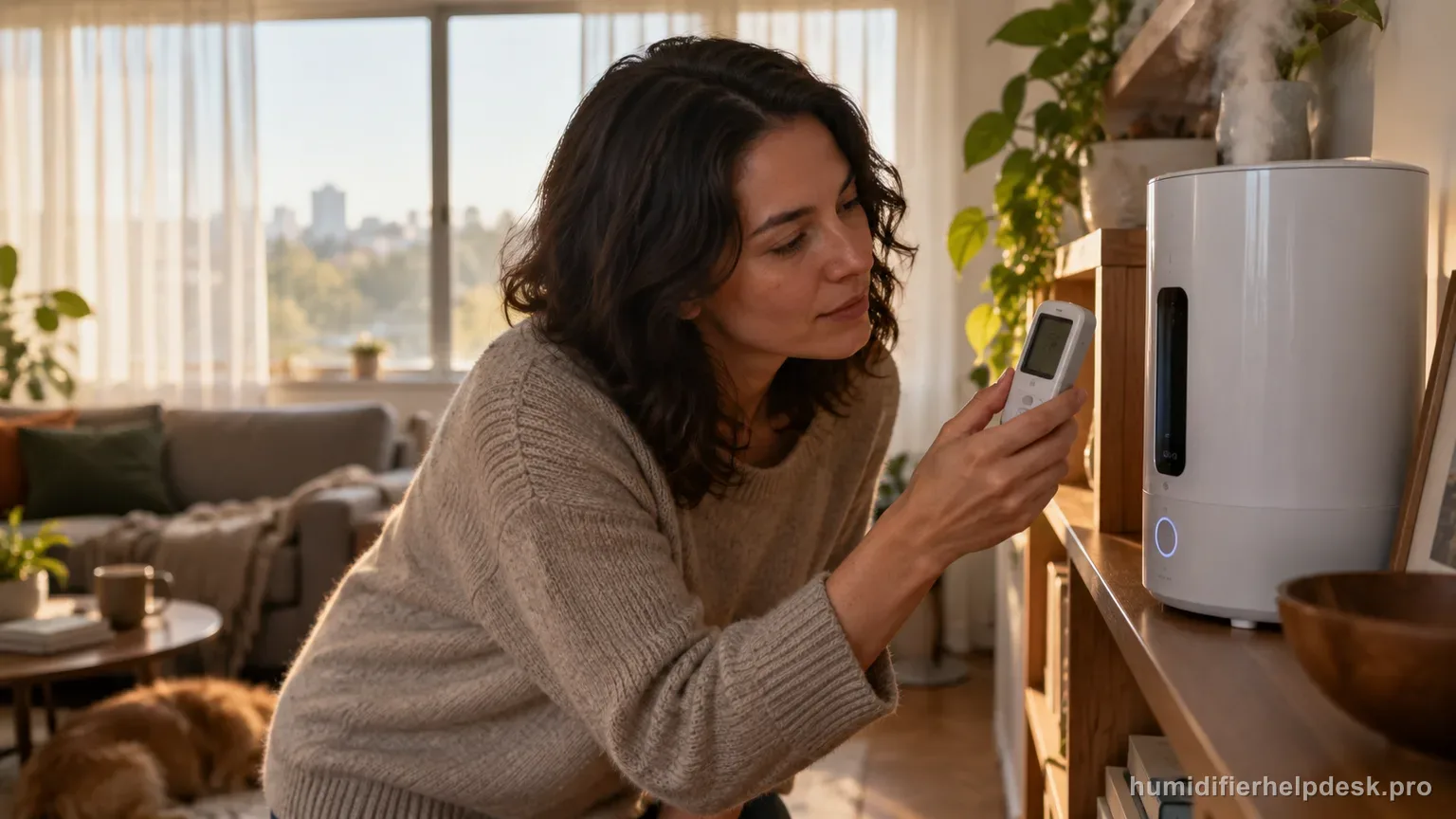
Sensor placement matters on the 450S. Moisture near the aroma-box sensor, walls/corners, dust, and room size can bias the reading.
Does this match what you are seeing?
Owners describe this Levoit OasisMist 450S problem in a few different ways. If one of these sounds like yours, this guide covers it:
- Humidity reading wrong
- Humidity sensor inaccurate
- Humidity display too high
- Humidity display too low
Check these in order
- Keep the humidifier more than about 12 in / 30 cm from walls and out of tight corners.
- Aim the nozzles away from the aroma-box/sensor area.
- Turn the unit off, remove the aroma box, and let the sensor area air-dry if it became damp.
- Move away from dusty placement and compare readings after room air mixes.
Diagnostic decision path
The OasisMist 450S has a more placement-sensitive humidity path than many simple humidifiers because its sensor/air inlet sits in the aroma-box compartment. The manual names room size, sensor moisture, nozzle direction, wall/corner distance, and dust as reasons the displayed humidity can be wrong. On OasisMist 450S, do not confuse a slow-changing room percentage with a wrong sensor value. This page is for the second case: the number itself looks implausible compared with the room after normal stabilization, so the test focuses on local mist exposure and sampling conditions.
- Keep the unit at least 12 in / 30 cm from walls and out of tight corners.
- Aim both nozzles away from the aroma-box side so mist does not settle on the sensor.
- Compare readings after room air has mixed, not directly in the mist plume.
If: The room exceeds about 215–430 ft² / 20–40 m²
What it means: The built-in sensor and output are being asked to represent a space larger than the model's effective range.
Do next: Test in a smaller in-range room before concluding the sensor itself is faulty.
If: Mist has been directed toward the aroma box or the sensor area is damp
What it means: Local moisture can drive an artificially high or unstable reading.
Do next: Turn the humidifier off, remove the aroma box, let the sensor air-dry, then redirect the nozzles away from that side.
If: The unit is within 12 in / 30 cm of a wall/corner or sits in a dusty area
What it means: Restricted representative airflow or dust exposure can bias the reading.
Do next: Move it into open room air at the documented clearance and keep the sensor area clean/dry.
If: The reading remains implausible after in-range placement, clearance, drying, and dust checks
What it means: The documented environmental causes no longer explain the mismatch.
Do next: Use Levoit support rather than attempting sensor calibration inside the base.
If: The documented checks are complete, but the same symptom remains after a controlled retest
What it means: The owner-facing evidence on this page no longer explains the repeat symptom.
Do next: Document the fixed mist mode, nearby reference reading, plume direction, and dry sensor condition before escalating the OasisMist 450S RH mismatch.
How to interpret the retest
Use the 450S in a representative space within its roughly 215–430 ft² / 20–40 m² effective range, then place the comparison hygrometer near the humidifier but not in the warm or cool plume. Because the 450S can change mist temperature and output, hold those settings steady while the two readings settle instead of adjusting them during the comparison.
Redirect the dual mist output away from the sensor area and allow any dampness around the sensing path to dry before retesting. If the discrepancy shrinks after plume direction changes, treat that as local feedback rather than an electronic failure. If a large mismatch persists with stable placement and dry sensing conditions, use Levoit support rather than an undocumented calibration.
With the rest of the setup unchanged, see whether the unit shows “The unit is within 12 in / 30 cm of a wall/corner or sits in a dusty area” rather than changing several settings at once. If the Levoit OasisMist 450S matches that observation, use the interpretation “Restricted representative airflow or dust exposure can bias the reading” and follow with “Move it into open room air at the documented clearance and keep the sensor area clean/dry”. First, check “Turn the unit off, remove the aroma box, and let the sensor area air-dry if it became damp”. If the state does not appear again, keep that result and continue with the next documented possibility for humidity reading wrong on the Levoit OasisMist 450S.
Model-specific context that changes the diagnosis
Warm versus cool mist can change the local microclimate
OasisMist 450S can operate with different mist-temperature settings, but the humidity sensor still samples air close to the unit. Keep the selected mode constant while comparing another hygrometer. Switching temperature and output during the same test changes evaporation and local mixing, making it harder to decide whether the sensor or the test conditions caused the difference.
A wrong reading is different from “humidity is not changing”
If the 450S display looks believable but the room percentage barely rises, use the separate output/room-load guide: higher mist, more time, and room size are the relevant checks. If the displayed number itself is clearly inconsistent with nearby conditions, stay here and correct plume direction, sensor moisture, and comparison placement.
Use a controlled nearby reference
Do not put the comparison meter on a window sill or across an open doorway while the 450S sits elsewhere. Those locations can have different temperature and airflow, which changes relative humidity. Keep both sensors in the same general room zone outside direct mist, wait for stabilization, and look for a sustained difference rather than a momentary one.
Common mistakes that make this harder to diagnose
- Pointing mist toward the aroma box and then trusting the locally saturated reading as room RH.
- Testing in a corner because it is convenient even though the manual warns about that placement.
- Treating a separate hygrometer several feet away as an instantaneous one-to-one calibration reference.
The display should become plausible and stable when the 450S is in-range, clear of walls/corners, and its aroma-box sensor is dry and free of direct mist. Persistence after those controls is the support boundary.
Questions people ask about this exact symptom
Why does my Levoit OasisMist 450S show the wrong humidity?
First rule out a local sampling problem. Keep direct warm or cool mist away from the sensor area, let any damp sensing area dry, and compare with another hygrometer in the same general room zone outside the plume. Hold mist settings steady while the air mixes. If the number remains clearly implausible after those controls, contact Levoit.
Is a slow-changing humidity number the same as a bad OasisMist 450S sensor?
No. A believable reading that changes slowly is usually an output/room-load question, while a value that is obviously inconsistent with nearby conditions is a sensor-sampling question. The 450S troubleshooting paths should stay separate. For slow room response, test higher mist, more time, and coverage; for a wrong value, control placement and local moisture.
Can warm mist make the OasisMist 450S humidity reading look different?
Warm versus cool output can change the immediate plume and mixing pattern, so it can affect the microclimate near the humidifier. Keep one mist mode and output level during the comparison, aim the outlet away from the sensing area, and give the room time to stabilize. The goal is to remove changing local conditions before judging sensor accuracy.
Why this path is model-specific
Levoit’s 450S manual names effective room range, sensor moisture, nozzle direction, wall/corner distance, dust, and water/mineral conditions as humidity-reading factors.
For the Levoit OasisMist 450S, the machine type matters: it is hybrid. Visible mist is part of normal output when mist production is active, so a true no-mist complaint deserves model-specific troubleshooting.
This symptom appears on other humidifiers too, but the meaning and reset path can change by technology, sensor logic, and control layout. Use the exact model source above before borrowing a fix from a neighboring model.
Compare this symptom across verified models
If you are still deciding whether this behavior is normal or model-specific, use the symptom hub to compare only manufacturer-linked guides. Keep the Levoit OasisMist 450S instructions above as the controlling path for this machine.
If the problem is still there
If the checks above do not change the symptom, use the manufacturer support path for this exact model. We intentionally stop before undocumented resets, sensor bypasses, internal mains work, or parts replacement that the consumer manual does not authorize.
What we do not recommend
Do not defeat a float, water-level sensor, overheat protection, interlock, or other safety feature. Do not open mains-powered sections for live testing. If the unit smells burned, becomes abnormally hot, smokes, sparks, has water near electrical parts, or repeatedly trips a circuit, stop using it and keep clear. Unplug it only if the plug, outlet, and surrounding area are dry and safe to reach; otherwise do not touch wet equipment and contact manufacturer support for next steps.
Primary source for this diagnosis
Source checked during the September 4, 2026 editorial review. Manufacturer documents can change; a material re-review updates this guide’s reviewed date rather than stamping unrelated pages.