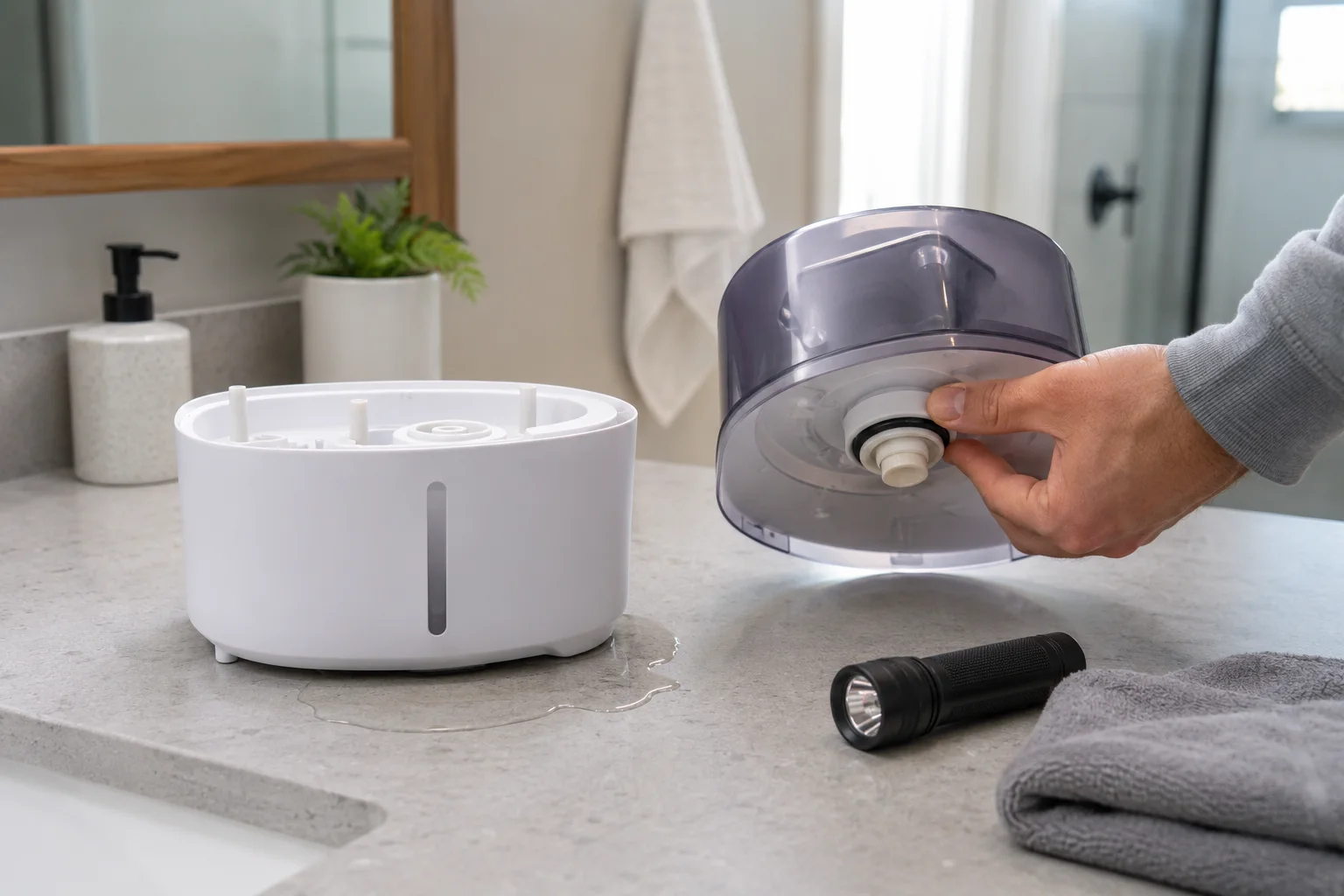
Check the outlet-valve seal, level placement, base float, and tank before assuming an internal failure.
Does this match what you are seeing?
Owners describe this Dreo HM311S problem in a few different ways. If one of these sounds like yours, this guide covers it:
- Leaking water
- Water under the base
- Humidifier leaking from bottom
- Reservoir leaking or overflowing
Check these in order
- Confirm the silicone sealing ring around the water outlet valve is secure.
- Place the unit on a flat, level surface and do not shake it.
- Check the float in the base is in place.
- Inspect the tank for cracks/leaks.
- Reduce mist or stop the unit if room humidity is already very high and nearby “leaking” may actually be condensation.
Diagnostic decision path
Dreo’s HM311S leak guidance is broader than a simple cracked-tank check: it includes the outlet-valve silicone seal, base float, level placement, tank damage, and high room humidity that can create condensation mistaken for a leak. The first step is to identify where the water actually originates.
- Unplug before lifting the tank or touching water in the base.
- Dry the outside of the unit and table so fresh water is easier to trace.
- Keep the HM311S on a hard, flat, level surface during the test.
If: Water appears around the tank outlet/valve area
What it means: The silicone sealing ring or outlet path is the first documented suspect.
Do next: Check that the sealing ring is secure and the tank is seated normally.
If: The base float is out of position
What it means: The normal base water-control path may be disrupted.
Do next: Reinstall the float correctly before refilling and retesting.
If: The tank itself shows a crack or active seep
What it means: The tank is the water source, not room condensation.
Do next: Stop using the damaged tank and contact Dreo support for replacement.
If: The unit is dry but nearby surfaces are wet and room RH is above about 60%
What it means: Dreo treats high humidity as a condensation contributor that can look like leaking.
Do next: Reduce/stop mist, dry the area, and retest at lower room humidity.
How to interpret the retest
Use “Water appears around the tank outlet/valve area” to decide which documented branch to test next, not to declare the cause on its own. On the Dreo HM311S, it corresponds to “The silicone sealing ring or outlet path is the first documented suspect”. Use “Confirm the silicone sealing ring around the water outlet valve is secure” and retest. When the observation is present, continue with “Check that the sealing ring is secure and the tank is seated normally”. When it is absent, rule out that explanation for now and keep the result with the current Dreo HM311S leaking notes.
Keep the other conditions steady and compare the result around this check. Check “Place the unit on a flat, level surface and do not shake it” on the Dreo HM311S, then look specifically for “The base float is out of position”. A match supports the manual's interpretation “The normal base water-control path may be disrupted” and sends you to “Reinstall the float correctly before refilling and retesting”. If the observation is missing, that result narrows the Dreo HM311S leaking diagnosis without jumping to an unrelated reset.
Do not assign this cause until you have observed “The tank itself shows a crack or active seep”. For the Dreo HM311S, use “Check the float in the base is in place” as the controlled test. If the same observation appears, the source meaning is “The tank is the water source, not room condensation” and the next action is “Stop using the damaged tank and contact Dreo support for replacement”. If it does not appear, record the non-match and continue through the remaining Dreo HM311S checks for leaking.
Make this the first check: “Inspect the tank for cracks/leaks”. With that step complete, compare the Dreo HM311S with “The unit is dry but nearby surfaces are wet and room RH is above about 60%”. If the two states match, the source-backed interpretation is “Dreo treats high humidity as a condensation contributor that can look like leaking” and then “Reduce/stop mist, dry the area, and retest at lower room humidity”. If the comparison fails, step away from this Dreo HM311S path and continue; that non-match helps rule out this explanation for the leaking complaint.
Model-specific context that changes the diagnosis
Let the Dreo HM311S observation choose the next step
Choose the branch from the state you can actually have. If the Dreo HM311S shows “Water appears around the tank outlet/valve area”, the source-backed interpretation is “The silicone sealing ring or outlet path is the first documented suspect” and the next step is “Check that the sealing ring is secure and the tank is seated normally”. If it instead shows “The base float is out of position”, use the separate interpretation “The normal base water-control path may be disrupted” and follow with “Reinstall the float correctly before refilling and retesting”. On the Dreo HM311S, do not combine both responses; retest the explanation that matches the current leaking complaint first.
Retest leaking after each correction
Make one documented correction, retest, and only then continue. Test “Confirm the silicone sealing ring around the water outlet valve is secure” first, then inspect the Dreo HM311S again. If the behavior persists, use “Place the unit on a flat, level surface and do not shake it”; save “Check the float in the base is in place” for the next step. That order gives the Dreo HM311S leaking path a meaningful comparison instead of several changes with no clear cause.
Common mistakes that make this harder to diagnose
- Calling condensation a tank leak without drying and tracing the water source.
- Shaking or tilting the humidifier during testing.
- Ignoring the base float and focusing only on the tank.
The leak path is resolved when the HM311S remains externally dry on a level surface with the seal and float correctly installed. Any cracked tank or persistent water escape after these checks should be escalated to Dreo.
Questions people ask about this exact symptom
Why is water collecting around my Dreo HM311S?
For the Dreo HM311S, check the outlet-valve seal, level placement, base float, and tank before assuming an internal failure. For this leaking check on the Dreo HM311S, start with “Confirm the silicone sealing ring around the water outlet valve is secure” and check the result before making another change. If the behavior is unchanged, continue with “Place the unit on a flat, level surface and do not shake it”.
What should I check first if my Dreo HM311S is leaking or leaving water outside the unit?
Use the Dreo HM311S checklist as an ordered troubleshooting sequence, with one change at a time. Try “Confirm the silicone sealing ring around the water outlet valve is secure”, retest, then move to “Place the unit on a flat, level surface and do not shake it” and “Check the float in the base is in place” only as required.
When should I contact Dreo about this Dreo HM311S problem?
Use Dreo support if the Dreo HM311S still has the same problem after the documented checks for leaking. Have the Dreo HM311S's last retest notes, current mode, and any warning light or code ready; tell support you followed the documented leaking checks. Do not open powered sections on the Dreo HM311S or assume an internal failed part unless Dreo documents that procedure for this leaking case.
Why this path is model-specific
Dreo’s HM311S FAQ lists the outlet seal, level surface, base float, tank leaks, and high room humidity among leak/condensation checks.
For the Dreo HM311S, the machine type matters: it is ultrasonic. Visible mist is part of normal output when mist production is active, so a true no-mist complaint deserves model-specific troubleshooting.
This symptom appears on other humidifiers too, but the meaning and reset path can change by technology, sensor logic, and control layout. Use the exact model source above before borrowing a fix from a neighboring model.
Compare this symptom across verified models
If you are still deciding whether this behavior is normal or model-specific, use the symptom hub to compare only manufacturer-linked guides. Keep the Dreo HM311S instructions above as the controlling path for this machine.
If the problem is still there
If the checks above do not change the symptom, use the manufacturer support path for this exact model. We intentionally stop before undocumented resets, sensor bypasses, internal mains work, or parts replacement that the consumer manual does not authorize.
What we do not recommend
Do not defeat a float, water-level sensor, overheat protection, interlock, or other safety feature. Do not open mains-powered sections for live testing. If the unit smells burned, becomes abnormally hot, smokes, sparks, has water near electrical parts, or repeatedly trips a circuit, stop using it and keep clear. Unplug it only if the plug, outlet, and surrounding area are dry and safe to reach; otherwise do not touch wet equipment and contact manufacturer support for next steps.
Primary source for this diagnosis
Source checked during the September 4, 2026 editorial review. Manufacturer documents can change; a material re-review updates this guide’s reviewed date rather than stamping unrelated pages.