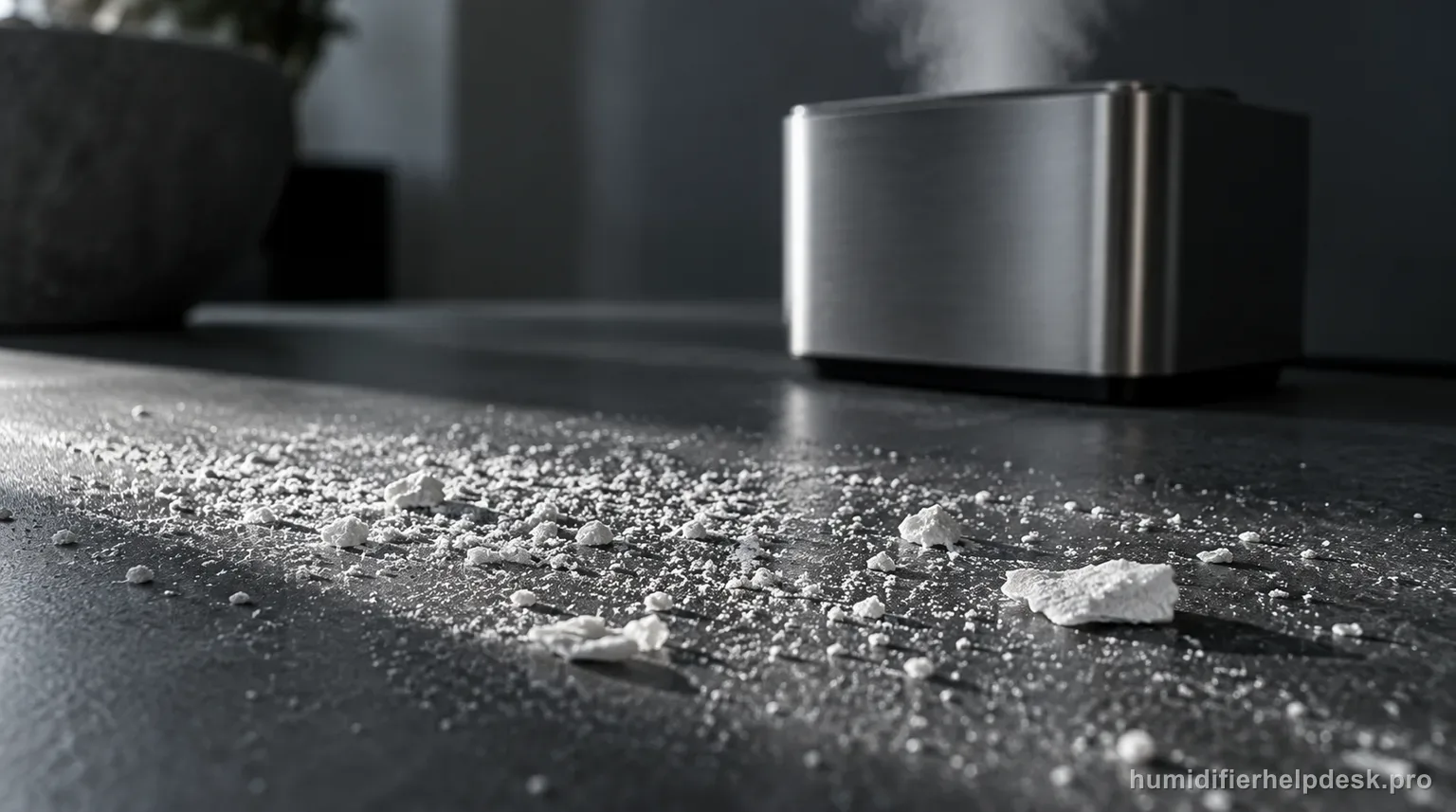
White dust around an ultrasonic Carepod One is usually a water-mineral clue. Carepod recommends filtered or distilled water and notes that tap water can leave white dust or particles.
Does this match what you are seeing?
Owners describe this Carepod One problem in a few different ways. If one of these sounds like yours, this guide covers it:
- White dust
- Leaving white powder
- Mineral dust on furniture
- White residue after misting
Check these in order
- Change to filtered or distilled water for the next controlled fill.
- Clean the stainless-steel tank and the user-cleanable lower portion of the wand as Carepod directs.
- Wipe existing residue from nearby surfaces before the retest so old dust is not mistaken for new output.
- If residue continues with low-mineral water, verify that the particles truly originate from the humidifier before adding cleaners or additives.
Diagnostic decision path
White dust around a Carepod One is best treated first as a water-mineral problem. Ultrasonic humidifiers can carry dissolved minerals into tiny airborne droplets, and Carepod explicitly recommends filtered or distilled water while warning that tap water can leave white dust or particles. The useful test is therefore simple: remove the old residue, change the water source, clean the tank and user-cleanable lower wand, and compare what appears during the next several fills. That approach is more informative and safer than adding unapproved chemicals to the tank or repeatedly wiping the room without changing the source water.
- Photograph or note where the white residue appears, then wipe nearby surfaces clean so the retest begins with no old dust.
- Empty the tank and clean the stainless-steel water-contact surfaces and lower wand according to Carepod's maintenance guidance.
- Keep the wand's upper plug/connector area dry and do not add a descaler or household cleaner to water that will be misted into the room.
- Use filtered or distilled water for the comparison rather than mixing it with the same tap water that produced the original residue.
If: White residue drops sharply or disappears after switching to filtered or distilled water
What it means: The result strongly supports minerals in the previous water as the source of the airborne particles.
Do next: Keep using the lower-mineral water and maintain the tank and lower wand before buildup becomes heavy.
If: The room residue is reduced but the wand still develops a mineral film
What it means: The water-contact parts are still collecting some dissolved material even though less is reaching surrounding surfaces.
Do next: Continue routine lower-wand cleaning and review the actual water source; distilled water generally provides a cleaner comparison than partially filtered hard water.
If: White particles continue at the same rate with fresh distilled water and a cleaned tank
What it means: The simple source-water explanation is no longer sufficient for the observation.
Do next: Confirm that the material is new and truly coming from the humidifier, then document the result for Carepod support rather than adding chemicals or opening the wand.
If: Residue is accompanied by a burning smell, discoloration of powered parts, or damaged plastic/connector material
What it means: That pattern does not fit ordinary mineral white dust and may involve component damage.
Do next: Stop using the humidifier and contact Carepod; do not continue a mineral-cleaning routine on a potentially damaged powered component.
If: Only old residue remains after the water change and no new film appears
What it means: The humidifier is no longer creating the observed white-dust condition under the new water/cleaning setup.
Do next: Use that setup as the baseline and clean the room normally; no additional troubleshooting is needed unless fresh particles return.
How to interpret the retest
Wipe the old dust before changing water. Otherwise an unchanged-looking shelf can make a successful water-source test appear to have failed.
Filtered water varies widely in mineral removal. If the result with filtered water is ambiguous, distilled water provides a clearer low-mineral comparison.
White dust and colored spots on the wand can share a mineral cause, but they are different observations. One is airborne residue around the room; the other is buildup on a water-contact component.
Do not assume every white particle in a room comes from the humidifier. If distilled water and a clean tank do not change the rate, verify nearby dust sources before escalating the appliance diagnosis.
A water-source correction is preventative as well as diagnostic. Reducing minerals can lower both room residue and the maintenance burden on the ultrasonic water path.
Model-specific context that changes the diagnosis
Make the water change a real A/B test
Use a clean tank, clean nearby surface, and one clearly different water source. Mixing old tap water with distilled water or leaving a dusty shelf untouched weakens the comparison and can make mineral carryover look persistent.
Do not aerosolize a cleaning experiment
The tank is for humidification water during operation, not a place to test household acids, fragrances, or descaling chemicals unless Carepod explicitly authorizes them for that use. Cleaning and operating-water instructions are separate.
Room residue and wand deposits tell a combined story
If both decrease after the switch to low-mineral water, the evidence is especially consistent with the original water chemistry. That is more useful than guessing at a failed ultrasonic element based on white dust alone.
Common mistakes that make this harder to diagnose
- Continuing with the same tap water while repeatedly cleaning white residue from furniture.
- Adding vinegar, descaler, or another household chemical to operating water in an attempt to prevent dust.
- Judging the water-source test without wiping away the old residue first.
- Submerging the wand connector while cleaning mineral buildup associated with the same complaint.
The white-dust complaint is resolved when freshly cleaned nearby surfaces stay free of new mineral residue during normal Carepod One use with filtered or distilled water, while the tank and lower wand remain on a manageable cleaning schedule. If substantial new white particles continue with distilled water after the tank has been cleaned, verify that the material truly originates from the humidifier and contact Carepod with that controlled-test result. Stop immediately for signs that look like electrical or material damage rather than ordinary mineral residue.
Questions people ask about this exact symptom
Why is my Carepod One leaving white dust on furniture?
Carepod notes that tap water can leave white dust or particles and recommends filtered or distilled water for best results. Wipe the existing residue away, clean the stainless-steel tank and lower water-contact portion of the wand, then make the next fills with lower-mineral water. If new dust drops sharply, the result supports water minerals as the cause. Keep the wand's upper plug/connector area dry during cleaning.
Will distilled water stop white dust from a Carepod One?
It is the clearest first comparison because distilled water contains far fewer dissolved minerals than typical tap water, and Carepod recommends distilled or filtered water. Clean old residue from both the humidifier and nearby surfaces before testing so you can identify genuinely new particles. If white dust continues at the same rate with a cleaned tank and fresh distilled water, verify another source and document the result for Carepod support.
Should I add vinegar to Carepod One water to prevent white dust?
Do not turn a cleaning substance into an operating-water additive unless Carepod explicitly instructs that use. The manufacturer's prevention guidance for white dust centers on filtered or distilled water, while mineral cleaning is performed on user-cleanable components with the humidifier unplugged. Aerosolizing an improvised mixture creates a different exposure and does not give a clean diagnostic test of whether the original tap-water minerals caused the residue.
Why this path is model-specific
Carepod’s support center recommends filtered or distilled water for best results and says tap water can leave white dust or particles. It separately provides cleaning guidance for mineral deposits on the wand.
For the Carepod One, the machine type matters: it is ultrasonic. Visible mist is part of normal output when mist production is active, so a true no-mist complaint deserves model-specific troubleshooting.
Compare this symptom across verified models
If you are still deciding whether this behavior is normal or model-specific, use the symptom hub to compare only manufacturer-linked guides. Keep the Carepod One instructions above as the controlling path for this machine.
If the problem is still there
If the checks above do not change the symptom, use the manufacturer support path for this exact model. We intentionally stop before undocumented resets, sensor bypasses, internal mains work, or parts replacement that the consumer manual does not authorize.
What we do not recommend
Do not defeat a float, water-level sensor, overheat protection, interlock, or other safety feature. Do not open mains-powered sections for live testing. If the unit smells burned, becomes abnormally hot, smokes, sparks, has water near electrical parts, or repeatedly trips a circuit, stop using it and keep clear. Unplug it only if the plug, outlet, and surrounding area are dry and safe to reach; otherwise do not touch wet equipment and contact manufacturer support for next steps.
Primary source for this diagnosis
Source checked during the September 5, 2026 editorial review. Manufacturer documents can change; a material re-review updates this guide’s reviewed date rather than stamping unrelated pages.