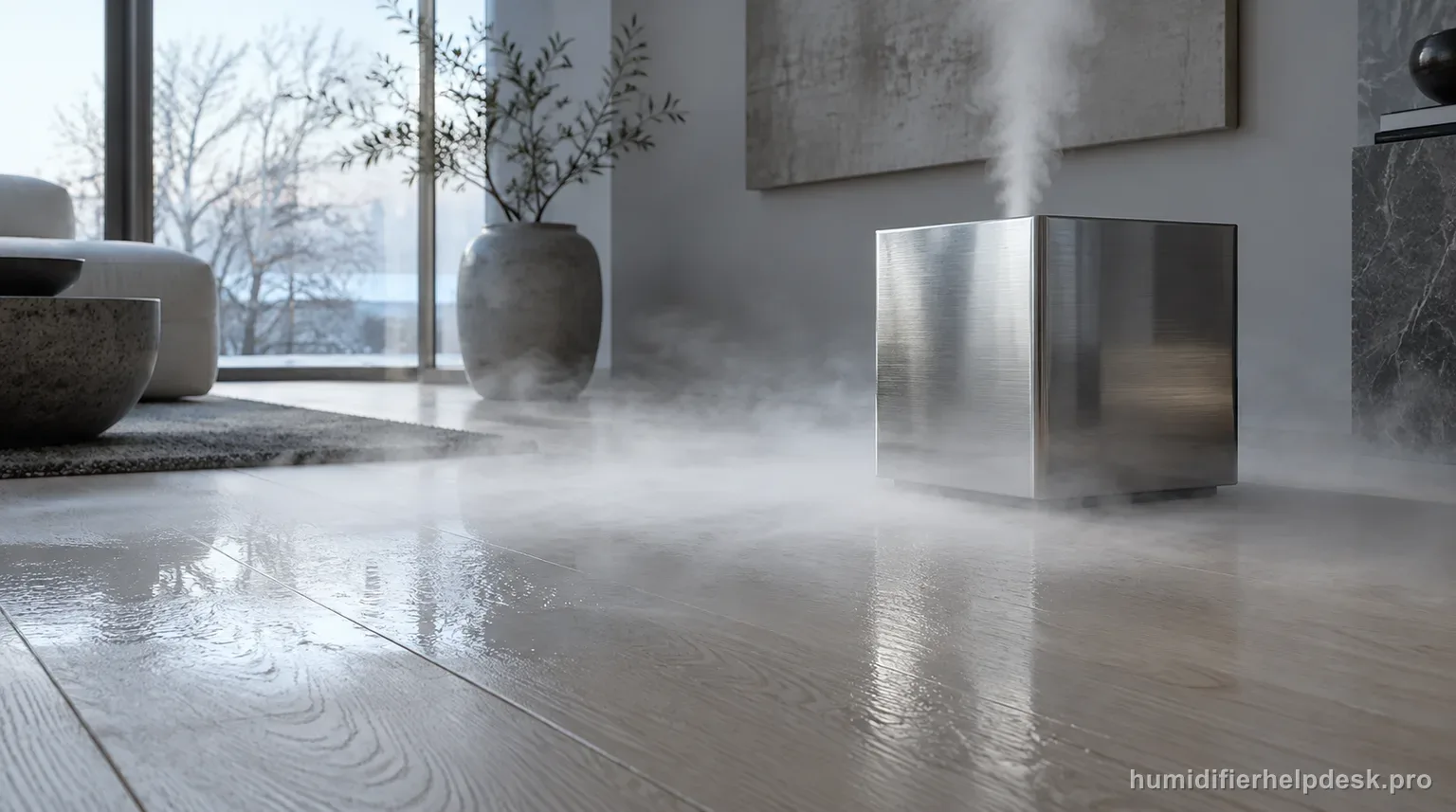
If the Carepod One is producing mist but the floor becomes damp, Carepod recommends elevating the unit at least 2 feet, using Mist Level 1, and limiting a session with the timer. First make sure the moisture is settling mist rather than water escaping from under the stainless-steel tank.
Does this match what you are seeing?
Owners describe this Carepod One problem in a few different ways. If one of these sounds like yours, this guide covers it:
- Condensation around humidifier
- Making floor or furniture wet
- Mist collecting on surfaces
- Room too damp when running
Check these in order
- Unplug and dry the table, floor, and outside of the humidifier so new moisture has a clear source.
- Place the Carepod One on a stable elevated surface at least 2 feet above the floor with open space around the outlet.
- Select Mist Level 1 and use a 4–8 hour timer for the controlled retest.
- If liquid water appears under the stainless-steel tank rather than only on the surrounding floor, stop this path and check tank/lid/seal assembly instead.
Diagnostic decision path
A damp floor around a Carepod One does not automatically mean the tank is leaking. This model sends visible ultrasonic mist into the room, so a concentrated plume can settle before it fully mixes with room air. Carepod's own support response for mist collecting on the floor is unusually specific: raise the humidifier at least two feet, use Mist Level 1, and limit the session with the timer. The useful diagnosis is therefore to separate airborne mist fallout or room condensation from liquid water escaping underneath the stainless-steel tank. Dry everything first, change only placement and output, and watch where fresh moisture appears.
- Unplug the Carepod One and wipe the unit, table, and floor completely dry so old moisture cannot confuse the retest.
- Confirm the stainless-steel tank is below the MAX line and that there is no visible water trapped under the tank before starting the mist-fallout test.
- Move papers, electronics, fabric, and finished wood away from the plume so a short diagnostic run cannot damage nearby items.
- Use a stable surface rather than carpet or an unstable stand; the goal is an elevated, repeatable position with open room air around the mist outlet.
If: The surrounding floor becomes damp while the humidifier body and area under the tank remain dry
What it means: The pattern fits mist settling out of the air more closely than a liquid-water leak.
Do next: Elevate the Carepod One at least 2 feet, select Mist Level 1, set a 4–8 hour timer, and compare the same area after the next controlled session.
If: The elevated Level 1 test stays dry
What it means: Placement and output concentration were strong contributors to the earlier wet floor.
Do next: Keep the higher placement and lower output as the working setup, then increase runtime or output only if the room actually needs more humidity without renewed surface moisture.
If: Dampness returns only after a long session even on the lower setting
What it means: The room may be receiving moisture faster than it can disperse, especially in a small or poorly ventilated space.
Do next: Shorten the timer window and monitor room humidity rather than raising mist output simply because the tank still contains water.
If: Fresh liquid appears directly under the stainless-steel tank or inside the base area
What it means: This is no longer just a mist-settling complaint; Carepod provides a separate assembly checklist for water underneath the tank.
Do next: Unplug, dry the unit, and inspect tank-lip alignment, the inner lid cover, and the silicone seal before another short leak test.
If: Moisture reaches the cord, controls, connector area, or outlet
What it means: The location creates an electrical hazard regardless of whether the original source was mist or a leak.
Do next: Stop operating the humidifier and let the area dry fully; use Carepod support if the water source cannot be corrected with the documented external checks.
How to interpret the retest
Surface location is more informative than the total amount of water. A broad damp patch below the plume with a dry tank underside points in a different direction from a concentrated pool beneath the stainless-steel tank.
Do not compensate for a wet floor by aiming the plume at a wall or furniture. That can simply move the condensation problem to a surface where damage is harder to notice.
A single low-output comparison is more useful than repeatedly changing height, timer, fill level, and mist setting together. If the floor stays dry after one controlled change, you know what actually improved the condition.
The manufacturer's 4–8 hour timer suggestion is a practical upper boundary for this specific troubleshooting path, not proof that every room should run the humidifier for that long.
Model-specific context that changes the diagnosis
Trace the moisture before calling it a leak
Dry the Carepod One and the supporting surface, then look at where the first new moisture forms. Mist fallout tends to wet the area reached by the plume, while an assembly leak starts at the tank/base path. That distinction prevents unnecessary disassembly and also keeps a real water-under-tank problem from being dismissed as normal condensation.
Height and output belong in the same retest
Carepod does not merely suggest turning the mist down. Its support guidance combines at least two feet of elevation with Mist Level 1 and a timed session. Reproducing that combination gives a cleaner test of whether the plume was settling before it mixed into the room.
A dry result is enough
Once the floor remains dry during the same kind of use, do not keep escalating the test simply to prove the point. Continue with the lowest setting and runtime that maintains comfortable room humidity without wetting nearby surfaces.
Common mistakes that make this harder to diagnose
- Calling any wet floor a cracked-tank leak before checking whether the underside of the humidifier is actually wet.
- Leaving the Carepod One at floor level while only turning the mist direction toward another nearby surface.
- Running maximum output for hours during diagnosis, which can recreate condensation even when nothing is mechanically wrong.
- Changing placement, output, timer, and water level all at once, making the successful correction impossible to identify.
Consider this complaint resolved when the Carepod One can complete a normal timed session without new moisture collecting on the floor, table, or adjacent surfaces. The useful endpoint is a dry exterior and dry tank underside while room humidity still rises as intended. If fresh water instead originates under the stainless-steel tank, switch to the assembly-leak path. If water reaches an electrical area or recurs despite the documented placement and assembly checks, stop using the unit and contact Carepod rather than improvising a seal or continuing wet tests.
Questions people ask about this exact symptom
Why does my Carepod One make the floor wet even though it is not leaking?
Visible ultrasonic mist can settle on nearby surfaces when the plume is too concentrated or the unit is positioned too low. Carepod recommends placing the humidifier at least 2 feet above the floor, selecting Mist Level 1, and using a 4–8 hour timer. Dry the area first; if the underside of the tank stays dry during that retest, the pattern is more consistent with mist fallout than a tank leak.
How high should I place a Carepod One if mist is collecting on the floor?
Carepod's support guidance says to elevate the humidifier at least 2 feet. Use a stable, water-tolerant surface with open air around the outlet, then test at Mist Level 1 instead of maximum output. Keep electronics, paper, and finished surfaces out of the plume. If liquid appears under the stainless-steel tank rather than only on the surrounding floor, use the separate tank-assembly leak checks.
What should I do if the floor is still damp on Carepod One Mist Level 1?
Shorten the run and verify the unit is elevated as Carepod recommends. Also distinguish broad surface condensation from liquid originating under the tank. If the room is already humid, a shorter timer may be enough. If fresh water forms directly beneath the stainless-steel tank, unplug and inspect tank-lip alignment, the inner lid cover, and the silicone seal instead of continuing to lower mist output.
Why this path is model-specific
Carepod support says to elevate the humidifier at least 2 feet, set Mist Level 1, and use the timer for 4–8 hours when mist is collecting on the floor. Water found under the stainless-steel tank has a separate assembly checklist.
For the Carepod One, the machine type matters: it is ultrasonic. Visible mist is part of normal output when mist production is active, so a true no-mist complaint deserves model-specific troubleshooting.
Compare this symptom across verified models
If you are still deciding whether this behavior is normal or model-specific, use the symptom hub to compare only manufacturer-linked guides. Keep the Carepod One instructions above as the controlling path for this machine.
If the problem is still there
If the checks above do not change the symptom, use the manufacturer support path for this exact model. We intentionally stop before undocumented resets, sensor bypasses, internal mains work, or parts replacement that the consumer manual does not authorize.
What we do not recommend
Do not defeat a float, water-level sensor, overheat protection, interlock, or other safety feature. Do not open mains-powered sections for live testing. If the unit smells burned, becomes abnormally hot, smokes, sparks, has water near electrical parts, or repeatedly trips a circuit, stop using it and keep clear. Unplug it only if the plug, outlet, and surrounding area are dry and safe to reach; otherwise do not touch wet equipment and contact manufacturer support for next steps.
Primary source for this diagnosis
Source checked during the September 5, 2026 editorial review. Manufacturer documents can change; a material re-review updates this guide’s reviewed date rather than stamping unrelated pages.